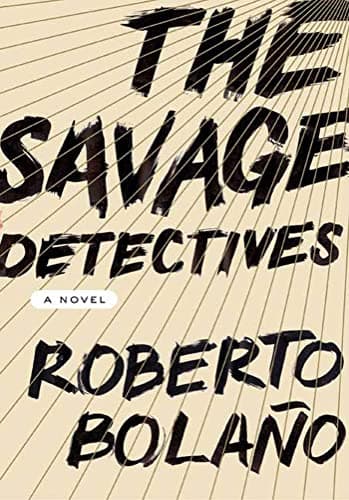
New Year's Eve, 1975: Arturo Belano and Ulises Lima, founders of the visceral realist movement in poetry, leave Mexico City in a borrowed white Impala. Their quest: to track down the obscure, vanished poet Cesárea Tinajero. A violent showdown in the Sonora desert turns search to flight; twenty years later Belano and Lima are still on the run. The explosive first long work by "the most exciting writer to come from south of the Rio Grande in a long time" (Ilan Stavans, Los Angeles Times), The Savage Detectives follows Belano and Lima through the eyes of the people whose paths they cross in Central America, Europe, Israel, and West Africa. This chorus includes the muses of visceral realism, the beautiful Font sisters; their father, an architect interned in a Mexico City asylum; a sensitive young follower of Octavio Paz; a foul-mouthed American graduate student; a French girl with a taste for the Marquis de Sade; the great-granddaughter of Leon Trotsky; a Chilean stowaway with a mystical gift for numbers; the anorexic heiress to a Mexican underwear empire; an Argentinian photojournalist in Angola; and assorted hangers-on, detractors, critics, lovers, employers, vagabonds, real-life literary figures, and random acquaintances. A polymathic descendant of Borges and Pynchon, Roberto Bolaño traces the hidden connection between literature and violence in a world where national boundaries are fluid and death lurks in the shadow of the avant-garde. The Savage Detectives is a dazzling original, the first great Latin American novel of the twenty-first century.
Add to your library to track progress and write reviews
Find The Savage Detectives Roberto Bolaño in PDF, EPUB, ebook, audiobook, print, or library editions.

4 books in catalog
Sprawling narrative structures, poet-detectives, and haunting examinations of literary culture define the fiction of one of Latin America's most influential late-twentieth-century writers. Roberto Bolaño transformed contemporary Spanish-language literature through formally innovative novels and short stories that blend autobiography, political history, and literary mystery, most notably in The Savage Detectives.
Born in Santiago, Chile, in 1953, Roberto Bolaño grew up in Chile before relocating with his family to Mexico City in 1968. As a young writer in Mexico, he co-founded the Infrarealist poetry movement, an avant-garde group that challenged established literary conventions. In 1973, Bolaño returned to Chile to support the socialist government of Salvador Allende. Shortly after his arrival, Augusto Pinochet seized power in a military coup, and Bolaño was arrested and detained in Concepción. Following his release, he returned to Mexico and later moved to Europe, living in Paris and eventually settling in Spain, where he worked various jobs as a salesperson and night watchman while writing poetry and prose.
Although Bolaño focused primarily on poetry during his early career, he turned to fiction in the 1980s and 1990s. In 1983, he co-wrote the novel Advice from a Morrison Disciple to a Joyce Fanatic with A. G. Porta, which was published in 1984. His major critical break came with The Savage Detectives (published in Spanish as Los detectives salvajes in 1998), which earned the Herralde Prize and the 1999 Rómulo Gallegos Prize. Bolaño continued to write prolifically until his death from liver failure in July 2003 in Barcelona at age fifty. His ambitious final novel, 2666, was published posthumously and received the National Book Critics Circle Award for Fiction in 2008.
Bolaño's narrative technique combines elements of noir detective fiction, poetic manifestos, and sprawling multi-perspective structures. His stories frequently center on vagabond poets, obscure scholars, and enigmatic writers navigating political unrest and exile across Latin America and Europe. Rather than relying on conventional plot resolutions, his work utilizes fragmentary scenes, nested anecdotes, and open-ended investigations.
A central focus of his writing is the relationship between literature, art, and political violence. In novels like By Night in Chile, he employs dark irony and a continuous monologue to probe intellectual complicity during authoritarian regimes. His non-fiction and essay collection Between Parentheses (Entre paréntesis), along with his short fiction and poetry, reflect a sustained investigation into the nature of evil and the precarious idealism of writers.