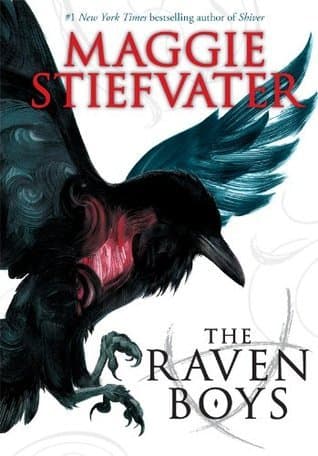
Every year, Blue Sargent stands next to her clairvoyant mother as the soon-to-be dead walk past. Blue never sees them--until this year, when a boy emerges from the dark and speaks to her. His name is Gansey, a rich student at Aglionby, the local private school. Blue has a policy of staying away from Aglionby boys. Known as Raven Boys, they can only mean trouble. But Blue is drawn to Gansey, in a way she can't entirely explain. He is on a quest that has encompassed three other Raven Boys: Adam, the scholarship student who resents the privilege around him; Ronan, the fierce soul whose emotions range from anger to despair; and Noah, the taciturn watcher who notices many things but says very little. For as long as she can remember, Blue has been warned that she will cause her true love to die. She doesn't believe in true love, and never thought this would be a problem. But as her life becomes caught up in the strange and sinister world of the Raven Boys, she's not so sure anymore.
This is a book about a friend group that happens to be sold as a love story. Blue is under a prophecy that her true love will die, and the kiss is mostly offstage in this volume. What you get instead is Gansey, Adam, Ronan and Noah, and a quest to find the Welsh king Owain Glendower, who Gansey believes is asleep nearby. Publishers Weekly loved the characters and the way the magic grows out of small-town strangeness rather than a built-from-scratch world.
The money divide does real work too: rich boys, a scholarship student juggling jobs, and a girl from a house of psychics with little cash. The cost is clarity. The magic's rules stay murky, the first half is slow, and the ending stops mid-quest. Think of it as the first act of a longer story, not a complete one.
Publishers Weekly was glowing about the characters, and Kirkus called it compulsively readable, with its only complaint being the wait for the sequel. Common Sense Media praised the beautiful writing and the friendship themes. Cooler readers found the pacing slow, the quest derivative and the ending abrupt.
Add to your library to track progress and write reviews

2 books in catalog
Young adult fantasy literature gained one of its most distinctive mythological voices with the publication of The Raven Cycle, a four-book series that fuses Appalachian folklore, Welsh legend, and small-town Virginia atmosphere. The author, Maggie Stiefvater, established her reputation for blending ancient mythology with contemporary teenage reality through bestselling works that examine mortality, class dynamics, and the human cost of supernatural forces.
Born Heidi Hummel on November 18, 1981, in Harrisonburg, Virginia, Stiefvater earned a B.A. in history from Mary Washington College (now the University of Mary Washington). Before committing fully to fiction writing, she pursued varied creative and technical fields, working as a professional portrait artist, a Celtic musician, a race-car driver, and an automotive journalist. She published her debut fantasy novel, Lament, in 2008, followed by The Wolves of Mercy Falls series, which reached number one on the New York Times bestseller list.
Stiefvater's career continued to expand with standalone projects such as The Scorpio Races and her multi-book series The Raven Cycle. Her narrative universe has also extended into visual formats, including graphic adaptations like The Dream Thieves: The Graphic Novel, as well as sequel projects like The Dreamer Trilogy, which expands on the dream-manifestation mechanics introduced in her earlier Virginia-set novels.
Stiefvater is recognized for a poetic, atmospheric writing style that emphasizes sensory detail, local geography, and character psychology. Rather than using magic as a convenient plot device or simple escape, her narratives utilize supernatural elements—such as ley lines, precognition, water horses, and physicalized dreams—to explore complex real-world concerns including socioeconomic inequality, grief, family trauma, and personal autonomy.
The Raven Cycle