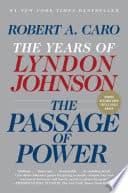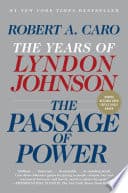
The Passage of Power follows Lyndon Johnson through both the most frustrating and the most triumphant periods of his career - 1958 to 1964. It is a time that would see him trade the extraordinary power he had created for himself as Senate Majority Leader for what became the wretched powerlessness of a Vice President in an administration that disdained and distrusted him. Yet it was, as well, the time in which the presidency, the goal he had always pursued, would be thrust upon him in the moment it took an assassin’s bullet to reach its mark.
For the first time, we see the Kennedy assassination through Lyndon Johnson’s eyes. We watch Johnson step into the presidency, inheriting a staff fiercely loyal to his slain predecessor; a Congress determined to retain its power over the executive branch; and a nation in shock and mourning. We see how within weeks - grasping the reins of the presidency with supreme mastery - he propels through Congress essential legislation that at the time of Kennedy’s death seemed hopelessly logjammed and seizes on a dormant Kennedy program to create the revolutionary War on Poverty.
Caro makes clear how the political genius with which Johnson had ruled the Senate now enabled him to make the presidency wholly his own. This was without doubt Johnson’s finest hour, before his aspirations and accomplishments were overshadowed and eroded by the trap of Vietnam.
It is an epic story told with a depth of detail possible only through the peerless research that forms the foundation of Robert Caro’s work, confirming Nicholas von Hoffman’s verdict that “Caro has changed the art of political biography.”
Add to your library to track progress and write reviews
Find The Passage of Power Robert A. Caro in PDF, EPUB, ebook, audiobook, print, or library editions.
1 books in catalog
Robert Allan Caro is an American journalist and author known for his biographies of United States political figures Robert Moses and Lyndon B. Johnson. After working for many years as a reporter, Caro wrote The Power Broker (1974), a biography of New York urban planner Robert Moses, which was chosen by the Modern Library as one of the hundred greatest nonfiction books of the twentieth century. He has since written four of a planned five volumes of The Years of Lyndon Johnson (1982, 1990, 2002, 2012), a biography of the former president. Caro has been described as "the most influential biographer of the last century". For his biographies, he has won two Pulitzer Prizes in Biography, two National Book Awards (including one for Lifetime Achievement), the Francis Parkman Prize (awarded by the Society of American Historians to the book that "best exemplifies the union of the historian and the artist"), three National Book Critics Circle Awards, the Mencken Award for Best Book, the Carr P. Collins Award from the Texas Institute of Letters, the D. B. Hardeman Prize, and a Gold Medal in Biography from the American Academy of Arts and Letters. In 2010 President Barack Obama awarded Caro the National Humanities Medal. Due to Caro's reputation for exhaustive research and detail, he is sometimes invoked by reviewers of other writers who are called "Caro-esque" for their own extensive research.
The Years of Lyndon Johnson