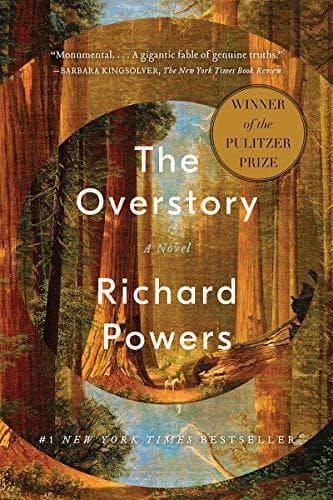
WINNER OF THE PULITZER PRIZE NEW YORK TIMES BESTSELLER An Air Force loadmaster in the Vietnam War is shot out of the sky, then saved by falling into a banyan. An artist inherits a hundred years of photographic portraits, all of the same doomed American chestnut. A hard-partying undergraduate in the late 1980s electrocutes herself, dies, and is sent back into life by creatures of air and light. A hearing- and speech-impaired scientist discovers that trees are communicating with one another. These four, and five other strangers—each summoned in different ways by trees—are brought together in a last and violent stand to save the continent’s few remaining acres of virgin forest. In his twelfth novel, National Book Award winner Richard Powers delivers a sweeping, impassioned novel of activism and resistance that is also a stunning evocation of—and paean to—the natural world. From the roots to the crown and back to the seeds, The Overstory unfolds in concentric rings of interlocking fables that range from antebellum New York to the late twentieth-century Timber Wars of the Pacific Northwest and beyond, exploring the essential conflict on this planet: the one taking place between humans and nonhumans. There is a world alongside ours—vast, slow, interconnected, resourceful, magnificently inventive, and almost invisible to us. This is the story of a handful of people who learn how to see that world and who are drawn up into its unfolding catastrophe. The Overstory is a book for all readers who despair of humanity’s self-imposed separation from the rest of creation and who hope for the transformative, regenerating possibility of a homecoming. If the trees of this earth could speak, what would they tell us? "Listen. There’s something you need to hear."
Add to your library to track progress and write reviews
Find The Overstory Richard Powers in PDF, EPUB, ebook, audiobook, print, or library editions.

3 books in catalog
Exploring the intricate intersections of modern science, technology, music, and the natural world, fiction that bridges human emotion and intellectual discipline has redefined contemporary American literature. Richard Powers has constructed a sprawling body of work that addresses complex topics ranging from artificial intelligence to forest ecology, earning the 2019 Pulitzer Prize for Fiction for his environmental novel The Overstory.
Born on June 18, 1957, in Evanston, Illinois, Richard Powers developed an early interest in both the humanities and the sciences. He pursued his higher education at the University of Illinois, where he later served as the CAS and Swanlund Professor of English. Over the course of his career, he has held academic appointments at both the University of Illinois and Stanford University while producing fourteen novels.
Throughout his career, Powers has received significant critical recognition, including a MacArthur Fellowship, the James Fenimore Cooper Prize for Historical Fiction, a Lannan Literary Award, and four nominations as a National Book Critics Circle Award finalist. His 2006 novel The Echo Maker won the National Book Award for Fiction and was a finalist for the Pulitzer Prize, while his 2018 novel The Overstory secured the 2019 Pulitzer Prize for Fiction. He currently resides in the foothills of the Great Smoky Mountains.
Powers is noted for employing complex, multi-layered narrative structures that connect diverse academic disciplines, including genomics, game theory, artificial intelligence, virtual reality, photography, and music. His prose examines how human beings navigate large systemic networks, exploring the tension between individual connection and systemic dislocation.
A recurring theme across his fiction is the human reliance on technological systems and the ethical implications of technological and environmental changes. By embedding scientific principles within deeply character-driven narratives, Powers investigates neurology, memory, machine consciousness, and ecological interdependence.