
Richard Powers
Also known as Richard S. Powers
Exploring the intricate intersections of modern science, technology, music, and the natural world, fiction that bridges human emotion and intellectual discipline has redefined contemporary American literature. Richard Powers has constructed a sprawling body of work that addresses complex topics ranging from artificial intelligence to forest ecology, earning the 2019 Pulitzer Prize for Fiction for his environmental novel The Overstory.
Career & Background
Born on June 18, 1957, in Evanston, Illinois, Richard Powers developed an early interest in both the humanities and the sciences. He pursued his higher education at the University of Illinois, where he later served as the CAS and Swanlund Professor of English. Over the course of his career, he has held academic appointments at both the University of Illinois and Stanford University while producing fourteen novels.
Throughout his career, Powers has received significant critical recognition, including a MacArthur Fellowship, the James Fenimore Cooper Prize for Historical Fiction, a Lannan Literary Award, and four nominations as a National Book Critics Circle Award finalist. His 2006 novel The Echo Maker won the National Book Award for Fiction and was a finalist for the Pulitzer Prize, while his 2018 novel The Overstory secured the 2019 Pulitzer Prize for Fiction. He currently resides in the foothills of the Great Smoky Mountains.
Writing Style & Themes
Powers is noted for employing complex, multi-layered narrative structures that connect diverse academic disciplines, including genomics, game theory, artificial intelligence, virtual reality, photography, and music. His prose examines how human beings navigate large systemic networks, exploring the tension between individual connection and systemic dislocation.
A recurring theme across his fiction is the human reliance on technological systems and the ethical implications of technological and environmental changes. By embedding scientific principles within deeply character-driven narratives, Powers investigates neurology, memory, machine consciousness, and ecological interdependence.
Major Works
- The Overstory — Winner of the 2019 Pulitzer Prize for Fiction, this multi-narrative novel follows nine individuals whose personal journeys intersect through their shared connection to trees and the natural environment.
- Galatea 2.2 — A modern reimagining of the Pygmalion myth, this novel examines artificial intelligence and human memory through a writer assisting in training a neural network to analyze literature.
- The Echo Maker — Recipient of the 2006 National Book Award for Fiction, this novel explores trauma, neurology, and Capgras syndrome after a man suffers a head injury along Nebraska's Platte River.
- Bewilderment — A bestseller that recounts the story of an astrobiologist father navigating the challenges of raising his neurodivergent son while dealing with ecological grief and experimental neurofeedback treatment.

The Overstory
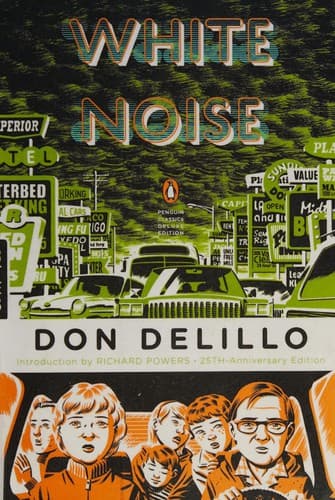
White Noise
