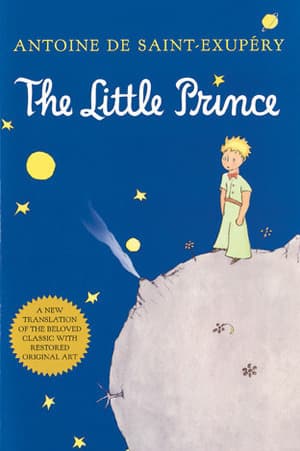
A pilot crashes in the Sahara Desert and encounters a strange young boy who calls himself the Little Prince. The Little Prince has traveled there from his home on a lonely, distant asteroid with a single rose. The story that follows is a beautiful and at times heartbreaking meditation on human nature.
The Little Prince is one of the best-selling and most translated books of all time, universally cherished by children and adults alike, and Richard Howard's translation of the beloved classic beautifully reflects Saint-Exupéry's unique and gifted style, bringing the English text as close as possible to the French in language, style, and spirit.
The shortness is the whole trick. The surviving manuscript shows a draft of roughly 30,000 words cut by well over half, including a bleak epilogue on war. What's left is clear enough for a child and slippery enough for an adult to argue over.
Who it's for has never been settled. A 1943 New York Times reviewer doubted that its irony and paradox would hold eight-to-ten-year-olds. Common Sense Media says ten and up, though some younger kids engage, and older, patient readers may get more from the symbolic language. Treat it as a book to read slowly, not a quick bedtime story.
The 1943 reception was mixed, with reviewers struggling to place it between children's and adult literature. It stayed on the New York Times bestseller list for about two weeks. In France it first drew less acclaim than Saint-Exupéry's earlier books, but by 2020 it was Gallimard's most successful title.
Add to your library to track progress and write reviews
Find O Pequeno Príncipe Antoine de Saint-Exupéry in PDF, EPUB, ebook, audiobook, print, or library editions.
2 books in catalog
Pioneering aviation literature through personal experience and philosophical reflection created a distinctive body of work that appeals to readers across generations. Antoine de Saint-Exupéry drew from his years as a commercial pilot and air force officer to craft poetic memoirs, philosophical essays, and timeless fables. His celebrated work The Little Prince remains one of the most widely read books in world literature.
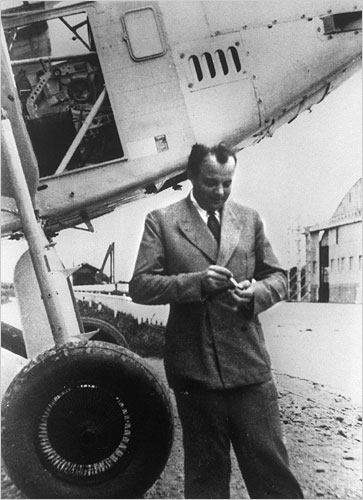
Born into an aristocratic French family in Lyon in 1900, Antoine de Saint-Exupéry lost his father at a young age and was educated in Catholic schools. He developed a passion for aviation early in life, taking his first airplane ride at twelve years old. After failing the entrance examination for the naval academy, he learned to fly during his military service in 1921 and received his pilot's wings in 1922. In 1926, he became a commercial pilot, flying pioneer airmail routes across Europe, Africa, and South America alongside noted aviators such as Jean Mermoz and Henri Guillaumet. His literary career began with the publication of the short story The Aviator in 1926, followed by novels and memoirs inspired by his flight experiences. During World War II, he served as a pilot in the French Air Force. On July 31, 1944, his Lockheed P-38 Lightning airplane disappeared during a reconnaissance mission over France.
All of Antoine de Saint-Exupéry's literary endeavors were rooted in his personal adventures as a pilot, using aviation as a launching point for abstract discussions on wisdom and the meaning of life. His early novels featured a poetic evocation of the romance and discipline of flying, while his later memoirs and essays stressed a deeply humanistic philosophy. His writing combines a child's sense of wonder with a pilot's eye for danger and duty, blending action with quiet philosophical contemplation.