SSansFiction
The libraryCollectionsJournalStatsFor authors
Sign inJoin now
Sansfiction,

A digital library for books. Made by readers, for readers.

v 2.0 · 2026
The library
  • Discover
  • Collections
  • Book tracker
  • Journal
  • Stats
For authors
  • SF Links
  • Analytics
  • How it works
  • FAQ
Elsewhere
  • X / @sansfiction
  • Privacy
  • Terms
  • Contact
© 2026 SansFiction · Digital · GlobalA quiet room for your reading life.
The libraryCollectionsJournalStatsFor authors
Sign inJoin now →
Navigation
Library
Bookshelf
Journal
Discover
Collections
Tierlists
Stats
Profile
Author Page
Link Builder
Account
Sign in
S
G
BooksadventureThe Light Fantastic
Cover of The Light Fantastic by Terry Pratchett
№ 2 · Discworld

The Light Fantastic,

by Terry Pratchett

Ask AI
Rating3.9/ 5
Ratings819
Pages285
Reading Hours6h
Published1986
LanguageEnglish

§Synopsis

01

It needs a hero, and fast.

What it doesn't need is Rincewind, an inept and cowardly wizard who is still recovering from the trauma of falling off the edge of the world. Or Twoflower, the well-meaning tourist whose luggage has a mind (and legs) of its own.

Which is a shame, because that's all there is . . .

§Our take

This is the odd sequel that improves as a story while becoming a worse place to begin. The Colour of Magic ends with Rincewind falling off the Disc, and The Light Fantastic catches him, Twoflower and the Luggage without pausing for orientation. Most readers find this volume more unified and more satisfying than its predecessor; a minority prefer the first book's freshness or call them equal.

What arrives is useful even if the delivery is early Pratchett: Death has presence, Cohen the Barbarian is a fine reversal of sword-and-sorcery muscle, and the Horsemen learning Bridge captures the book's comic priorities. The jokes are quick, the plot wanders, and the jokes can win at the story's expense. Read it immediately after The Colour of Magic, not as a free-standing taste of Discworld.

§Themes

Reluctant heroism
Rincewind's cowardice makes him useless as a conventional hero and the Disc's last hope, which pushes the story toward the livelier people around him.
Fantasy under demolition
Barbarian muscle, sacrificial maidens, wizard plots and a doom star become parody, with Cohen the aged barbarian reversing the usual ideal of strength.
Death in an early sketch
Death appears early, still more a sketch than the fully developed figure the series later becomes.
Jokes against momentum
One-line gags and footnotes can outrun the loose plot, especially before Cohen arrives.

§How it was received

In 1986, Dave Langford found it less sharp than The Colour of Magic but still very funny, while Wendy Graham praised it and likened its comic reach to Douglas Adams's work in science fiction. Formal critical coverage is thin, so much of its reputation rests with fans and bloggers. A fantasy-review site rates it highly for humour, singles out Cohen the Barbarian and Death, and notes that the jokes can cost the story momentum while the first half drifts until Cohen arrives.

§Read it if

  • You like broad fantasy parody, puns and a fast run of jokes more than a tightly plotted adventure
  • You have already read The Colour of Magic and are willing to treat the two books as one continuous story
  • You enjoy Death, Cohen the Barbarian, the Luggage and the Librarian doing comic work

§Skip it if

  • You want a clean entry into Discworld; this book opens without recapping and assumes knowledge of book one
  • You need a propelling central plot; the episodic wandering, shifting viewpoints and dense joke runs can blunt momentum

§Before you start

Reading experience
It moves quickly but wanders episodically, and anyone arriving without The Colour of Magic may struggle to sort the cast.
Reading order
It is Discworld book 2 and Rincewind book 2, continuing The Colour of Magic directly. Read the pair back to back. Later Rincewind books are Sourcery, Eric, Interesting Times, The Last Continent, The Last Hero and Unseen Academicals. Many fans suggest entering Discworld through Mort, Guards! Guards! or Small Gods instead.
Content notes
Cartoonish fantasy violence and peril; A sacrificial ritual involving a maiden, and a threat that the world will be destroyed.

§Common questions

Do I have to read The Colour of Magic first?
The safe answer is yes. This is a direct continuation, and it opens without recapping who Rincewind, Twoflower and the Luggage are.
Is The Light Fantastic better than The Colour of Magic?
For most readers, yes: it has a more unified plot and clearer direction. A minority prefer the first book's freshness, and some call the two about equal.
Should I start Discworld with The Light Fantastic?
Not really. It works best after The Colour of Magic; fans who want a stronger entry point often start with Mort, Guards! Guards! or Small Gods.

§If you liked this

  • The Colour of Magic by Terry Pratchett — The direct predecessor and other half of the cliffhanger; most readers find this sequel more unified, while the first book wins some votes for freshness.
  • The Hitchhiker's Guide to the Galaxy by Douglas Adams — Contemporary reviewers linked its genre-spoofing comedy to Douglas Adams, though each book mocks a different branch of speculative fiction.
  • Mort by Terry Pratchett — A popular first Discworld choice for readers who find the early broad spoofs too slapstick, and the place to meet Death as a lead rather than a cameo.
  • Guards! Guards! by Terry Pratchett — A frequently recommended starting point for readers who find the earliest Discworld books uneven.
Sources
  • Wikipedia
  • Wikipedia
  • Wikipedia
  • Wikipedia
  • Goodreads
  • Fantasy Book Review (UK)
  • Den of Geek

Track this book

Add to your library to track progress and write reviews

§Genres
adventure1classics1comic fantasy1discworld (imaginary place)1fantasy1fiction1humor1
§Moods
adventurous1funny1inspiring1lighthearted1mysterious1reflective1relaxing1
§Tags
#diverse characters1#loveable characters1#male author1#not diverse characters1#plot driven1#strong character development1#united states1

§About the Author

Terry Pratchett
Terry Pratchett

11 books in catalog

Comic fantasy gained one of its most expansive settings with the creation of the Discworld series, a flat world balanced on four elephants resting atop a giant cosmic turtle. English novelist Sir Terence David John Pratchett, OBE, widely known as Terry Pratchett, authored over forty novels set in this humorous universe, beginning with The Colour of Magic in 1983. Over his career, Pratchett produced an average of two books a year, blending satire, slapstick, and philosophical inquiry to construct a vast literary universe.

By the late 1990s, Pratchett was the UK's best-selling author of the decade, and as of December 2007 had sold more than 55 million books worldwide with translations into 36 languages. His literary achievements include winning the Carnegie Medal in 2001 for his young adult novel The Amazing Maurice and his Educated Rodents. At various points in his career, he was recorded as the second most-read writer in the UK and the seventh most-read non-US author in the United States.

Career & Background

Born Terence David John Pratchett on 28 April 1948 in Beaconsfield, Buckinghamshire, he published his first short story as a teenager before leaving school at age seventeen to work as a journalist for the Bucks Free Press. While working in journalism and later public relations, he casually mentioned a manuscript to publisher Peter Bander van Duren, leading to the publication of his debut novel, The Carpet People, in 1971. Pratchett followed his debut with two standalone science-fiction novels, The Dark Side of the Sun (1976) and Strata (1981), before pivoting permanently toward comic fantasy.

The launch of the Discworld series in 1983 redirected his writing career, leading him to resign from his public relations position to focus entirely on writing fiction full-time. Between 1983 and 2015, Pratchett published 41 Discworld novels alongside collaborative projects such as the 1990 apocalyptic comedy Good Omens: The Nice and Accurate Prophecies of Agnes Nutter, Witch, written with Neil Gaiman. His output remained prolific throughout his life, generating tens of millions of book sales and adapting his works into television shows, plays, and video games.

Writing Style & Themes

Pratchett's writing is distinguished by its satirical sharpness, parody of traditional fantasy tropes, and extensive use of inventive footnotes. His narrative settings serve as mirrors for real-world institutions, exploring complex subjects such as religious dogma, political bureaucracy, journalism, death, and human nature through a humorous lens. Rather than presenting pure escapism, his narrative arcs frequently feature deeply practical, fallible characters navigating social and ethical dilemmas on a world carried through space by Great A'Tuin.

Through sub-series featuring distinct casts—such as the inept wizard Rincewind, the Witches of Lancre, the City Watch, and the anthropomorphic personification of Death—Pratchett examined how myth and storytelling shape reality. His young adult fiction, including The Amazing Maurice and his Educated Rodents and the Tiffany Aching sequence starting with The Wee Free Men, brought these same thematic complexities to younger audiences while maintaining his signature wit.

Major Works

  • The Carpet People — Published in 1971, this debut novel introduced Pratchett's comic adventure storytelling before he created the Discworld setting.
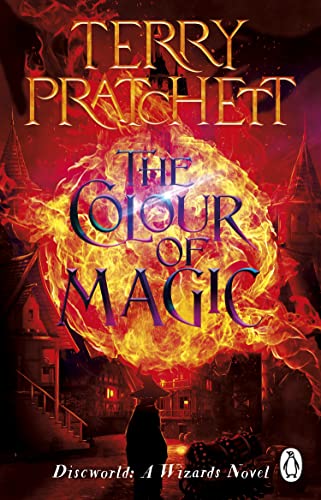
  • The Colour of Magic — Published in 1983, this book launched the Discworld series, introducing the inept wizard Rincewind and the flat world riding through space on four elephants and a giant turtle.
  • The Light Fantastic — The direct sequel to The Colour of Magic, continuing Rincewind's comedic misadventures across Discworld.
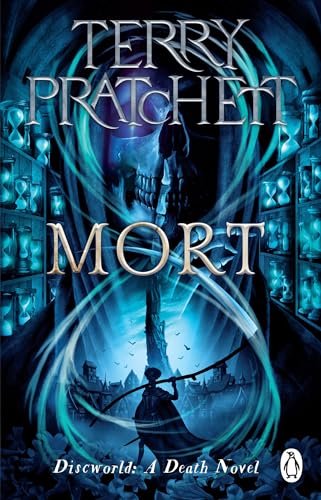
  • Mort — A prominent early Discworld novel that focuses on the character Death taking on a young apprentice, expanding the series' philosophical comedic scope.
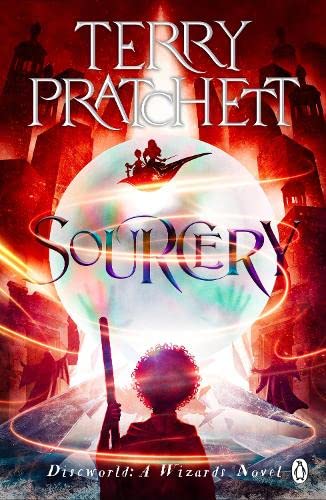
  • Sourcery — A Discworld novel centering on Rincewind and the magical chaos unleashed when a powerful wizard's eighth son is born.
  • Wyrd Sisters — A satirical Discworld novel that parodies Shakespearean drama through the exploits of Granny Weatherwax and the Lancre witches.
  • Good Omens: The Nice and Accurate Prophecies of Agnes Nutter, Witch — A 1990 apocalyptic comedy novel co-written with Neil Gaiman about an angel and a demon attempting to avert the end of the world.
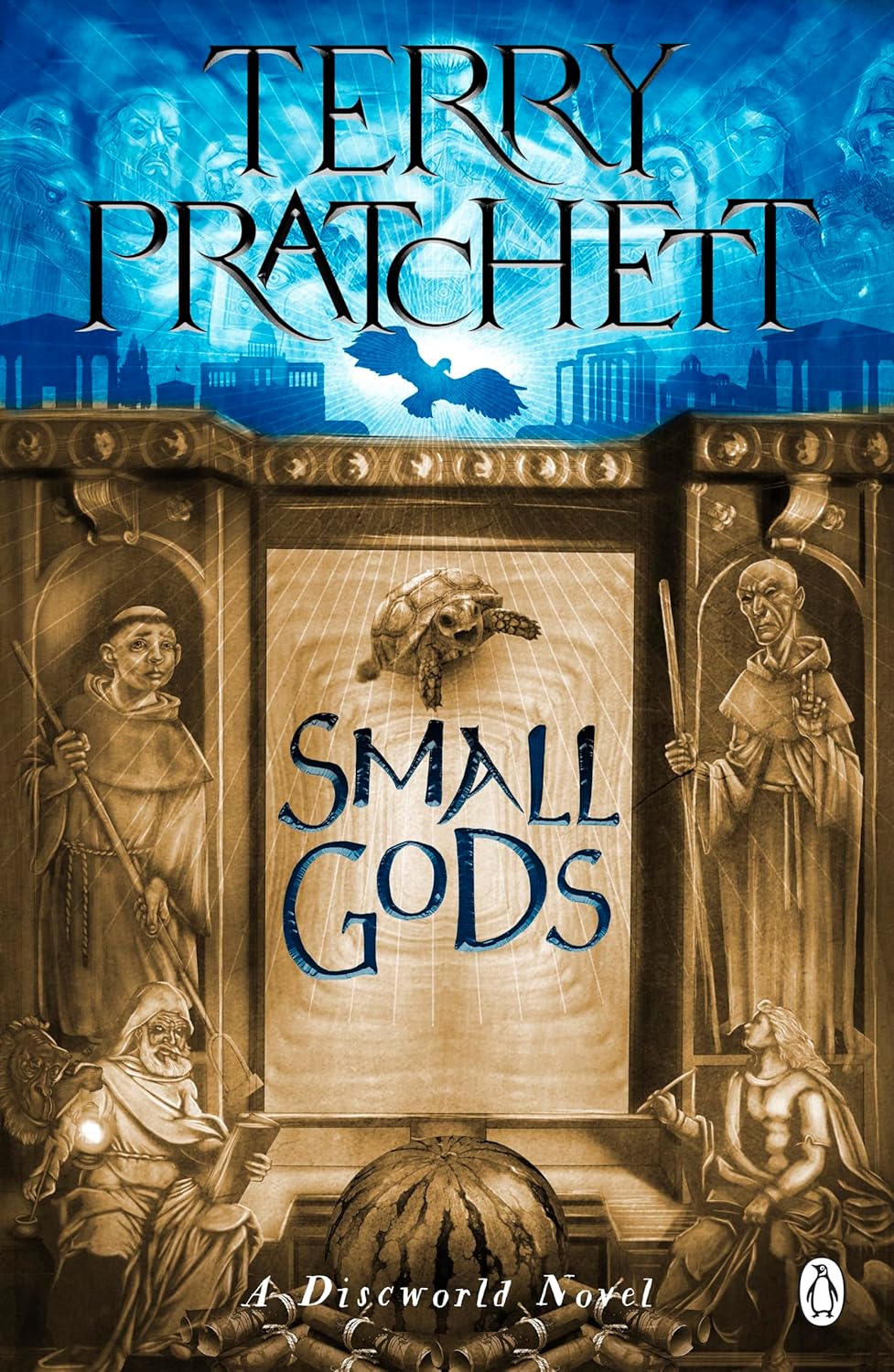
  • Small Gods — A critically acclaimed Discworld novel examining religion, belief, and institutional authority through the story of the god Om.
  • Hogfather — A festive Discworld satire exploring belief and holiday traditions when Death steps in to take the place of the Disc's midwinter gift-giver.
  • The Amazing Maurice and his Educated Rodents — A 2001 young adult novel set in Discworld that won the Carnegie Medal for its clever twist on the Pied Piper folk tale.
  • The Wee Free Men — The first novel in the Tiffany Aching sequence within Discworld, featuring the fierce, blue-skinned Nac Mac Feegle.
  • A Hat Full of Sky — A young adult Discworld novel continuing the story of apprentice witch Tiffany Aching as she learns her craft.
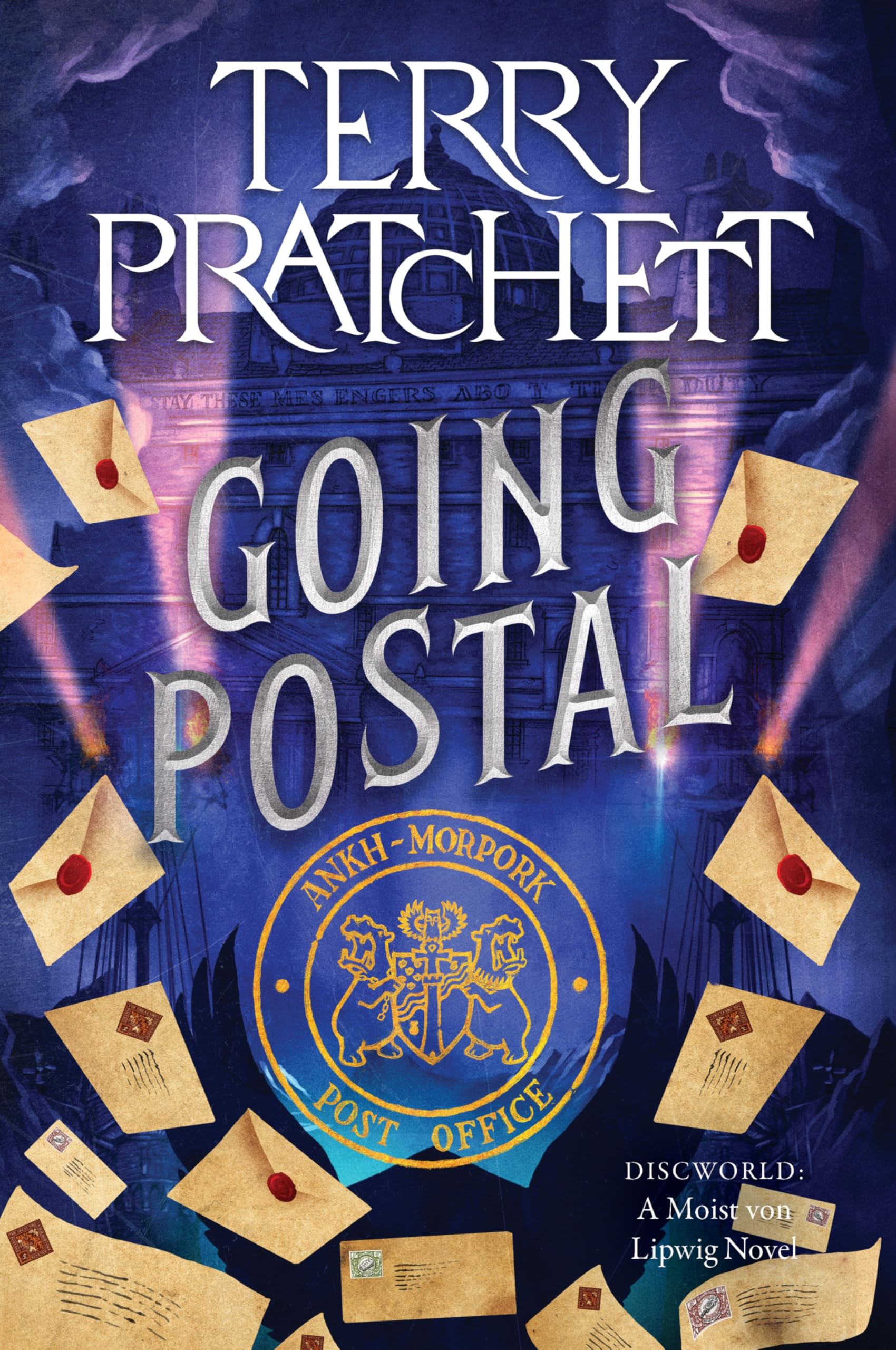
  • Going Postal — A popular late-era Discworld novel following con man Moist von Lipwig as he is forced to revitalize the Ankh-Morpork Post Office.

§Featured Series

Discworld

Cover of The Colour of Magic by Terry Pratchett

The Colour of Magic

Terry Pratchett, 1983
Cover of The Light Fantastic by Terry Pratchett

The Light Fantastic

Terry Pratchett, 1986
Cover of Mort by Terry Pratchett

Mort

Terry Pratchett, 1987
Cover of Sourcery by Terry Pratchett

Sourcery

Terry Pratchett, 1988
Cover of Wyrd Sisters by Terry Pratchett

Wyrd Sisters

Terry Pratchett, 1988
Cover of Small Gods by Terry Pratchett

Small Gods

Terry Pratchett, 1992
Cover of Hogfather by Terry Pratchett

Hogfather

Terry Pratchett, 1996
Cover of The Wee Free Men by Terry Pratchett

The Wee Free Men

Terry Pratchett, 2003
Cover of A Hat Full of Sky by Terry Pratchett

A Hat Full of Sky

Terry Pratchett, 2004
Cover of Going Postal by Terry Pratchett

Going Postal

Terry Pratchett, 2004

§Also part of

Discworld - Rincewind

§Editions

Showing 3 of 61 editions
Cover of The Light Fantastic

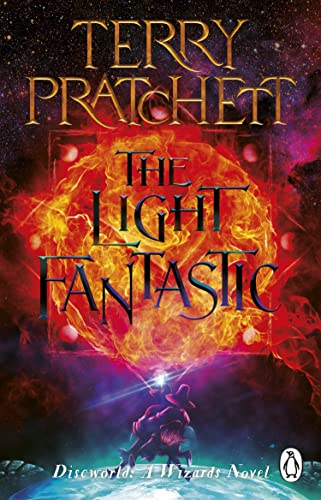
The Light Fantastic

engPaperback
Transworld20229781804990254
Amazon
Cover of The Light Fantastic

The Light Fantastic

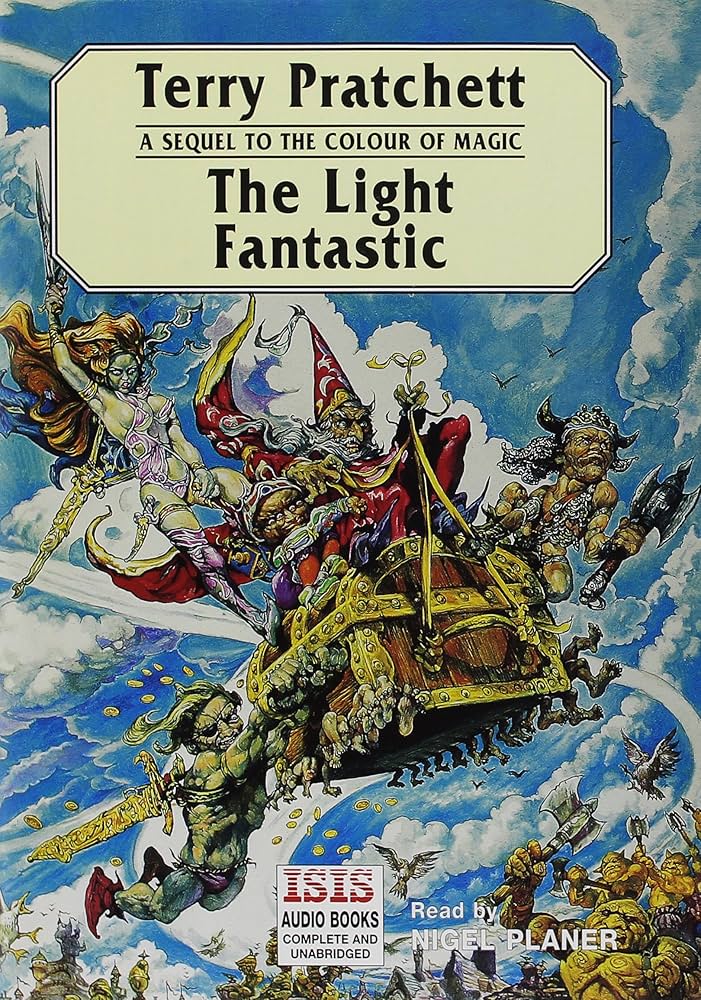
engAudiobook CDNarrated by Nigel Planer
ISIS Audio Books20069780753107393
Cover of The Light Fantastic

The Light Fantastic

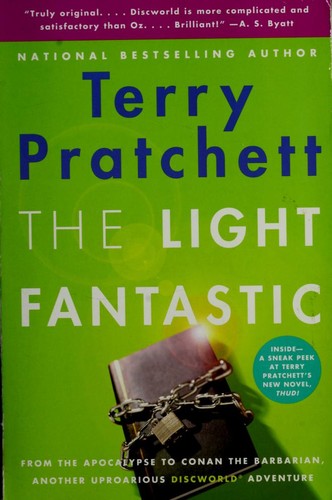
engPaperback
Harper Perennial19869780060855888
§Genres
adventure1classics1comic fantasy1discworld (imaginary place)1fantasy1fiction1humor1
§Moods
adventurous1funny1inspiring1lighthearted1mysterious1reflective1relaxing1
§Tags
#diverse characters1#loveable characters1#male author1#not diverse characters1#plot driven1#strong character development1#united states1

Metadata

ISBN-139781804990254
ISBN-101804990256
ASIN1804990256

Editions and availability

Find The Light Fantastic Terry Pratchett in PDF, EPUB, ebook, audiobook, print, or library editions.

View on Amazon
Bookshop.orgGoogle Play BooksBarnes & NobleOpen Library