

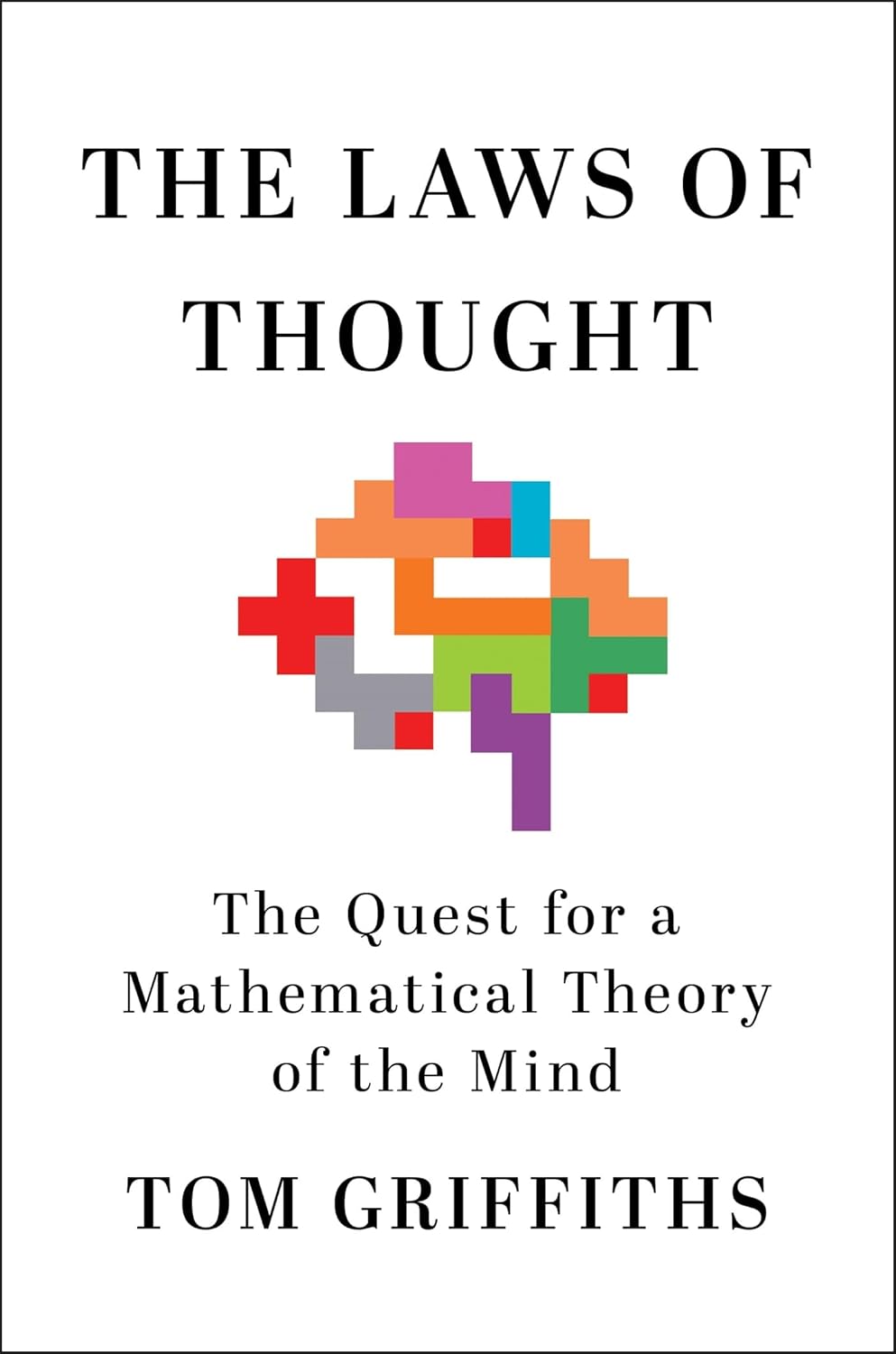
From the coauthor of Algorithms to Live By, an exploration of the quest to use mathematics to describe the ways we think, from its origins three hundred years ago to the ideas behind modern AI systems and the ways in which they still differ from human minds
Everyone has a basic understanding of how the physical world works. We learn about physics and chemistry in school, letting us explain the world around us in terms of concepts like force, acceleration, and gravity—the Laws of Nature. But we don’t have the same fluency with concepts needed to understand the world inside us—the Laws of Thought. While the story of how mathematics has been used to reveal the mysteries of the universe is familiar, the story of how it has been used to study the mind is not.
There is no one better to tell that story than Tom Griffiths, the head of Princeton’s AI Lab and a renowned expert in the field of cognitive science. In this groundbreaking book, he explains the three major approaches to formalizing thought—rules and symbols, neural networks, and probability and statistics—introducing each idea through the stories of the people behind it. As informed conversations about thought, language, and learning become ever more pressing in the age of AI, The Laws of Thought is an essential read for anyone interested in the future of technology.
From the coauthor of Algorithms to Live By, an exploration of the quest to use mathematics to describe the ways we think, from its origins three hundred years ago to the ideas behind modern AI systems and the ways in which they still differ from human minds
Everyone has a basic understanding of how the physical world works. We learn about physics and chemistry in school, letting us explain the world around us in terms of concepts like force, acceleration, and gravity—the Laws of Nature. But we don’t have the same fluency with concepts needed to understand the world inside us—the Laws of Thought. While the story of how mathematics has been used to reveal the mysteries of the universe is familiar, the story of how it has been used to study the mind is not.
There is no one better to tell that story than Tom Griffiths, the head of Princeton’s AI Lab and a renowned expert in the field of cognitive science. In this groundbreaking book, he explains the three major approaches to formalizing thought—rules and symbols, neural networks, and probability and statistics—introducing each idea through the stories of the people behind it. As informed conversations about thought, language, and learning become ever more pressing in the age of AI, The Laws of Thought is an essential read for anyone interested in the future of technology.
Add to your library to track progress and write reviews
Find The Laws of Thought: The Quest for a Mathematical Theory of the Mind Tom Griffiths in PDF, EPUB, ebook, audiobook, print, or library editions.
2 books in catalog
Examining how computer science and mathematical algorithms can explain human cognition provides a practical framework for tackling complex daily decisions and understanding cognitive processing. Tom Griffiths explores the intersection of artificial intelligence, cognitive psychology, and computational modeling to unpack how the human mind solves everyday problems. Through works like Algorithms to Live By: The Computer Science of Human Decisions, his writing translates sophisticated computational theories into accessible guidance for human choices.
Griffiths serves as the Henry R. Luce Professor of Information Technology, Consciousness, and Culture at Princeton University, holding joint academic appointments in the Department of Psychology and the Department of Computer Science. At Princeton, he directs the Computational Cognitive Science Lab and the Princeton Laboratory for Artificial Intelligence. His academic work brings together graduate researchers across psychology, computer science, and neuroscience to explore the mathematical foundations of cognition.
His research and writing examine how mathematical structures and machine learning principles apply to human psychology. Rather than treating human cognition as inherently flawed, Griffiths explores how people solve complex computational challenges under bounded time and resources. His work bridges computer science and human behavior, examining themes such as optimal stopping, memory organization, decision-making under uncertainty, and the formal principles underlying intuitive thought.
2 books in catalog
Examining how computer science and mathematical algorithms can explain human cognition provides a practical framework for tackling complex daily decisions and understanding cognitive processing. Tom Griffiths explores the intersection of artificial intelligence, cognitive psychology, and computational modeling to unpack how the human mind solves everyday problems. Through works like Algorithms to Live By: The Computer Science of Human Decisions, his writing translates sophisticated computational theories into accessible guidance for human choices.
Griffiths serves as the Henry R. Luce Professor of Information Technology, Consciousness, and Culture at Princeton University, holding joint academic appointments in the Department of Psychology and the Department of Computer Science. At Princeton, he directs the Computational Cognitive Science Lab and the Princeton Laboratory for Artificial Intelligence. His academic work brings together graduate researchers across psychology, computer science, and neuroscience to explore the mathematical foundations of cognition.
His research and writing examine how mathematical structures and machine learning principles apply to human psychology. Rather than treating human cognition as inherently flawed, Griffiths explores how people solve complex computational challenges under bounded time and resources. His work bridges computer science and human behavior, examining themes such as optimal stopping, memory organization, decision-making under uncertainty, and the formal principles underlying intuitive thought.