TG
§Author· 2 books
Tom Griffiths
Examining how computer science and mathematical algorithms can explain human cognition provides a practical framework for tackling complex daily decisions and understanding cognitive processing. Tom Griffiths explores the intersection of artificial intelligence, cognitive psychology, and computational modeling to unpack how the human mind solves everyday problems. Through works like Algorithms to Live By: The Computer Science of Human Decisions, his writing translates sophisticated computational theories into accessible guidance for human choices.
Career & Background
Griffiths serves as the Henry R. Luce Professor of Information Technology, Consciousness, and Culture at Princeton University, holding joint academic appointments in the Department of Psychology and the Department of Computer Science. At Princeton, he directs the Computational Cognitive Science Lab and the Princeton Laboratory for Artificial Intelligence. His academic work brings together graduate researchers across psychology, computer science, and neuroscience to explore the mathematical foundations of cognition.
Writing Style & Themes
His research and writing examine how mathematical structures and machine learning principles apply to human psychology. Rather than treating human cognition as inherently flawed, Griffiths explores how people solve complex computational challenges under bounded time and resources. His work bridges computer science and human behavior, examining themes such as optimal stopping, memory organization, decision-making under uncertainty, and the formal principles underlying intuitive thought.
Major Works
- Algorithms to Live By: The Computer Science of Human Decisions — Co-authored with Brian Christian, this book demonstrates how fundamental algorithms from computer science can illuminate human decision-making, covering topics such as scheduling, memory organization, and optimal stopping strategies in daily life.
- The Laws of Thought: The Quest for a Mathematical Theory of the Mind — This work examines the historical and contemporary efforts to formulate mathematical and computational theories of human cognition, tracing how formal models explain intelligence and thought processes.
§All Books
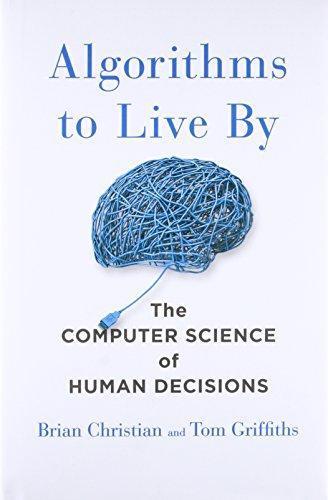
Algorithms to Live By: The Computer Science of Human Decisions
Brian Christian, 2016
179 ratings
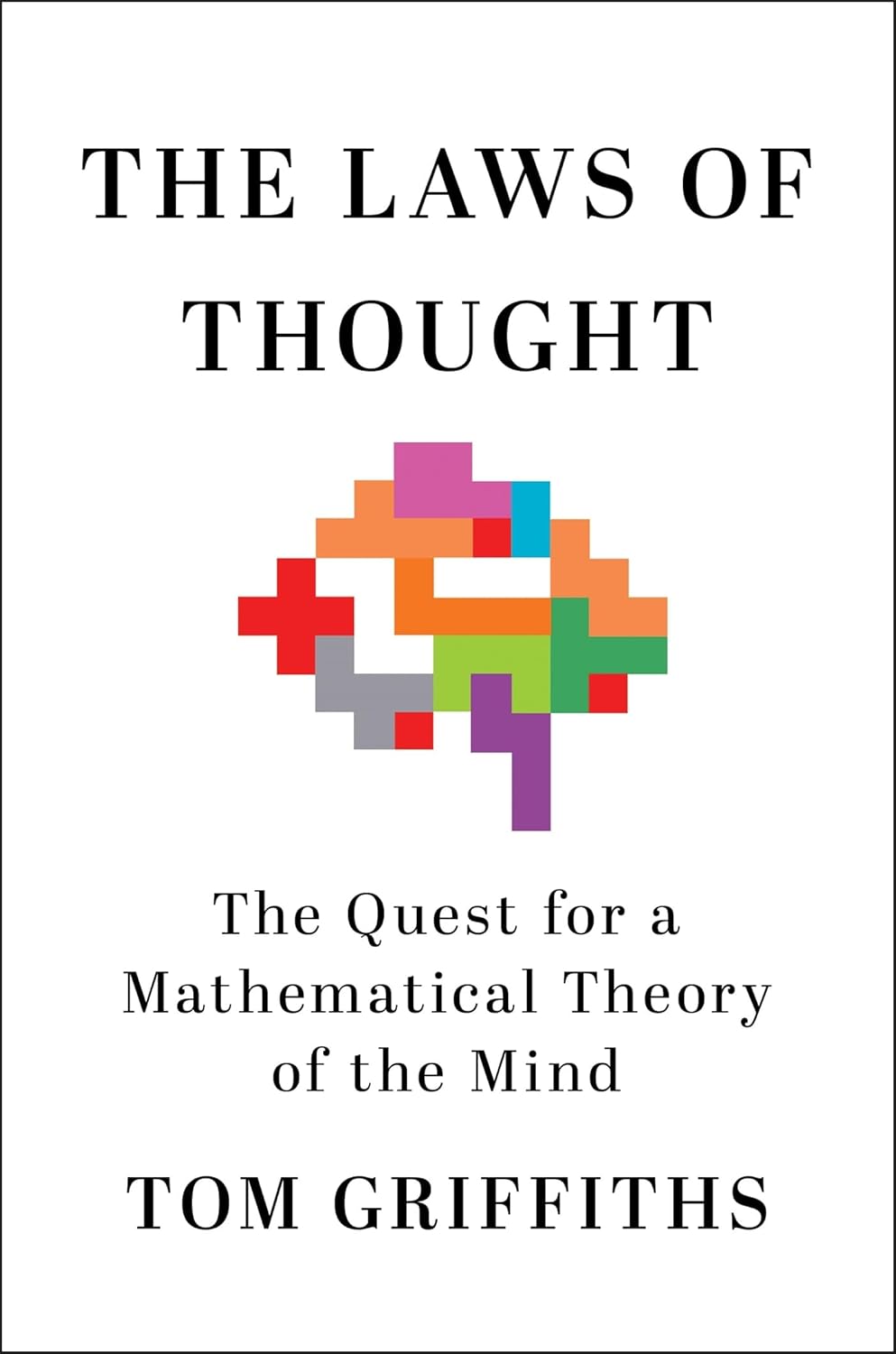
The Laws of Thought: The Quest for a Mathematical Theory of the Mind
Tom Griffiths, 2026
§ About Tom Griffiths's books
- Books on SansFiction
- 2
- Published
- 2016–2026
- Average rating
- 4.0 / 5 across 179 ratings
- Genres
- Social Aspects Of Technology, Algorithms, Applied, Artificial Intelligence
Start here: Algorithms to Live By: The Computer Science of Human Decisions (2016)
Algorithms to Live By looks at the simple, precise algorithms that computers use to solve the complex 'human' problems that we face, and discovers what they can tell us about the nature and origin of the mind. An audiobook version can be found at [here][1] [1]: https://archive.org/details/AlgorithmstoLiveBy
Common questions about Tom Griffiths
- Who is Tom Griffiths?
- Griffiths serves as the Henry R. Luce Professor of Information Technology, Consciousness, and Culture at Princeton University, holding joint academic appointments in the Department of Psychology and the Department of Computer Science. At Princeton, he directs the Computational Cognitive Science Lab and the Princeton Laboratory for Artificial Intelligence.
- What is Tom Griffiths best known for?
- Tom Griffiths is best known for Algorithms to Live By: The Computer Science of Human Decisions, published in 2016 with 179 ratings and a 4.0 average. It is the most-rated of Tom Griffiths's books on SansFiction.
- How many books has Tom Griffiths written?
- SansFiction lists 2 books by Tom Griffiths, published between 2016 and 2026. The most popular are Algorithms to Live By: The Computer Science of Human Decisions and The Laws of Thought: The Quest for a Mathematical Theory of the Mind.
- Which Tom Griffiths book should I read first?
- Algorithms to Live By: The Computer Science of Human Decisions is the usual place to start: it is Tom Griffiths's most-rated book here, with a 4.0 average.
- What genres does Tom Griffiths write?
- Tom Griffiths's books on SansFiction are tagged Social Aspects Of Technology, Algorithms, Applied and Artificial Intelligence.
Explore: Social Aspects Of Technology · Algorithms · Applied · Artificial Intelligence