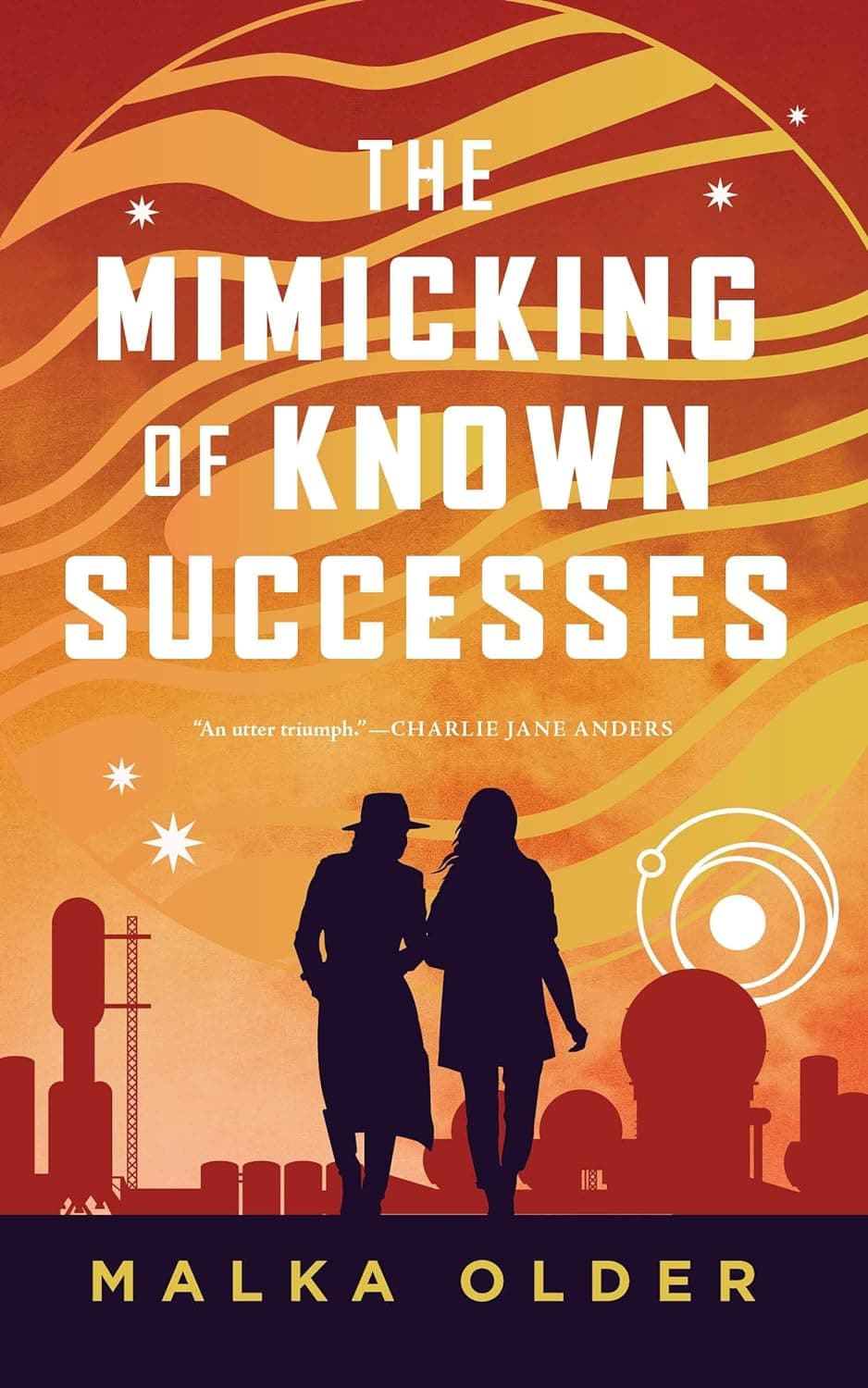
Investigator Mossa and Scholar Pleiti reunite to solve a brand-new mystery in the follow-up to the fan-favorite cozy space opera detective mystery “The Mimicking of Known Successes” that Hugo Award-winning author Charlie Jane Anders called “an utter triumph.”
Mossa has returned to Valdegeld on a missing person’s case, for which she’ll once again need Pleiti’s insight.
Seventeen students and staff members have disappeared from Valdegeld University—yet no one has noticed. The answers to this case could be found in the outer reaches of the Jovian system—Mossa’s home—and the history of Jupiter’s original settlements. But Pleiti’s faith in her life’s work as scholar of the past has grown precarious, and this new case threatens to further destabilize her dreams for humanity’s future, as well as her own.
Add to your library to track progress and write reviews
The Investigations of Mossa and Pleiti

6 books in catalog
Micro-democracy and global information networks frame the political science fiction of The Centenal Cycle, a speculative novel series that begins with Infomocracy. Author Malka Older integrates deep expertise in sociology, governance, and international humanitarian response to craft imaginative narratives about global information management, institutional design, and political systems.
Malka Older is a writer, sociologist, and humanitarian aid worker who earned degrees from Harvard University, Johns Hopkins University, and Sciences Po. Prior to establishing her literary career, she spent over eight years in international humanitarian aid and development, eventually serving as the 2015 Senior Fellow for Technology and Risk at the Carnegie Council for Ethics in International Affairs. She serves as the Executive Director of Global Voices, an international network of writers, editors, and translators providing community journalism while advocating for indigenous and minority languages, media literacy, digital rights, and online freedom of expression. Older is also a Faculty Associate at Arizona State University's School for the Future of Innovation in Society, where she teaches courses on predictive fictions and the humanitarian-development spectrum, hosts the Science Fiction Sparkle Salon, and acts as an Associate Researcher at the Centre de Sociologie des Organisations.
Older's fiction examines the structural mechanisms of governance, technology, institutional resilience, and social cohesion across complex future societies. In The Centenal Cycle—comprising Infomocracy, Null States, and State Tectonics—she analyzes micro-democracies driven by global search engines and data algorithms. Her shorter fiction, including the collection ...And Other Disasters and the standalone work Narrative Disorder, focuses on themes of identity, otherness, artificial intelligence, and human adaptation during crisis. In her Jupiter-based science-fiction mystery series starring investigator Mossa and academic Pleiti, Older combines traditional detective procedural elements with scholarly inquiry and romance, investigating societal structures on a terraformed gas giant.