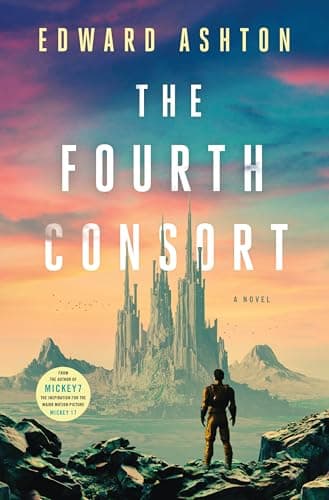
Dalton Greaves is a hero. He’s one of humankind’s first representatives to Unity, a pan-species confederation working to bring all sentient life into a single benevolent brotherhood.
That’s what they told him, anyway. The only actual members of Unity that he’s ever met are Boreau, a giant snail who seems more interested in plunder than spreading love and harmony, and Boreau’s human sidekick, Neera, who Dalton strongly suspects roped him into this gig so that she wouldn’t become the next one of Boreau’s crew to get eaten by locals while prospecting.
Funny thing, though—turns out there actually is a benevolent confederation out there, working for the good of all life. They call themselves the Assembly, and they really don’t like Unity. More to the point, they really, really don’t like Unity’s new human minions.
When an encounter between Boreau’s scout ship and an Assembly cruiser over a newly discovered world ends badly for both parties, Dalton finds himself marooned, caught between a stickman, one of the Assembly’s nightmarish shock troops, the planet’s natives, who aren’t winning any congeniality prizes themselves, and Neera, who might actually be the most dangerous of the three. To survive, he’ll need to navigate palace intrigue, alien morality, and a proposal that he literally cannot refuse, all while making sure Neera doesn’t come to the conclusion that he’s worth more to her dead than alive.
Part first contact story, part dark comedy, and part bizarre love triangle, The Fourth Consort asks an important question: how far would you go to survive? And more importantly, how many drinks would you need to go there?
Add to your library to track progress and write reviews
Find The Fourth Consort Edward Ashton in PDF, EPUB, ebook, audiobook, print, or library editions.
3 books in catalog
Exploring human identity, mortality, and technological progress through high-concept science fiction, the novel Mickey7 brought widespread recognition to author Edward Ashton prior to its film adaptation directed by Bong Joon-ho. Ashton combines speculative genre premises—ranging from expendable human clones to body-hopping artificial intelligence—with grounded, often dark humor and authentic scientific insights.
Born on January 10, 1968, in Fairfax, Virginia, Edward Ashton developed a career that spans both speculative fiction writing and scientific research. Alongside his literary work, Ashton works as a research scientist involved in medical studies, including participating on a team that achieved approval for a novel pediatric glioblastoma treatment, while also teaching quantum physics to graduate students. His career in fiction began with short stories appearing in venues such as Perihelion, Escape Pod, Analog, and Fireside Fiction, starting with his 2014 publication 'Midnight in Absheron.' He published his debut novel, Three Days in April, in 2015, followed by the genetic-engineering novel The End of Ordinary in 2017. Ashton currently resides in a cabin in upstate New York.
Ashton's writing is defined by its blend of rigorous scientific concepts, moral dilemmas, and satirical character perspectives. Drawing directly from his background in physics and medical research, he constructs science fiction narratives that probe ethical questions surrounding artificial intelligence, human consciousness transfer, genetic manipulation, and interstellar exploration. His prose balances high-stakes technological crises with dry humor, existential pragmatism, and grounded character dynamics. Whether depicting an expendable clone calculating his own survival or an indifferent AI navigating human warfare, Ashton continuously examines how individuals adapt to extreme environments and disruptive technologies.