
§Author· 1 book
David Wengrow
Also known as D. Wengrow
Comparative archaeology and deep human history offer radically new perspectives on how early human societies organized themselves, challenging traditional narratives about the inevitability of social inequality and central state authority. Through extensive archaeological fieldwork across Africa and the Middle East alongside sweeping comparative scholarship, David Wengrow has re-examined the foundational histories of early civilizations and political forms. His most widely recognized book, The Dawn of Everything: A New History of Humanity, co-authored with anthropologist David Graeber, became an international bestseller that reframed public discussions around the origins of human social structure and political freedom.
Career & Background
David Wengrow was born on July 25, 1972. He trained in archaeology and anthropology at the University of Oxford, completing his doctorate (DPhil) and serving as a Junior Research Fellow at Christ Church. He later joined the faculty at University College London (UCL), becoming Professor of Comparative Archaeology at the UCL Institute of Archaeology. Throughout his career, Wengrow has conducted extensive archaeological fieldwork across Africa and the Middle East, examining the development of early complex societies and material culture. In addition to his primary academic position at UCL, he has held visiting professorships at New York University, the University of Auckland, the University of Freiburg, and the University of Cologne, and was elected a Fellow of the Society of Antiquaries of London (FSA).
Writing Style & Themes
Wengrow's scholarly work integrates empirical archaeological evidence with anthropological theory to critique linear accounts of social evolution. He frequently challenges early assumptions regarding the creation of cities, monarchies, and state bureaucracy, demonstrating that ancient societies experimented with diverse and flexible political systems. In addition to technical monographs, Wengrow writes accessible public scholarship, publishing op-eds and essays in major news outlets including The Guardian and The New York Times to connect archaeological insights with contemporary conversations about social organization.
Major Works
- The Dawn of Everything: A New History of Humanity — Co-authored with David Graeber, this New York Times bestseller re-evaluates long-standing assumptions about early human social organization, state formation, and social inequality. The book won the J.I. Staley Prize for outstanding scholarship in anthropology and the 20th Wenjin Book Prize, and was named a finalist for the 2022 Orwell Prize.
- What Makes Civilization? — This work analyzes the origins and development of early complex societies in the Ancient Near East and Egypt, examining material culture, trade networks, and early urbanization.
- The Archaeology of Early Egypt: Social Transformations in North-East Africa — An academic study that explores social changes, material culture, and political centralization in prehistoric and early historic Egypt and northeastern Africa.
§All Books
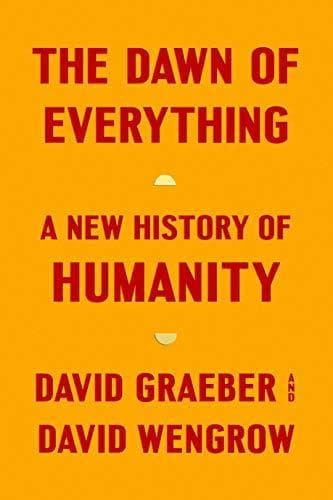
The Dawn of Everything: A New History of Humanity
David Graeber, 2021
118 ratings