§Synopsis
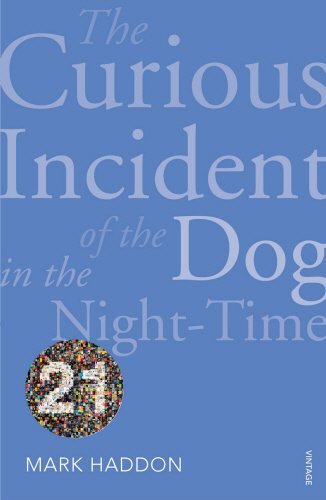
01This is Christopher's murder mystery story. There are no lies in this story because Christopher can't tell lies. Christopher does not like strangers or the colours yellow or brown or being touched. On the other hand, he knows all the countries in the world and their capital cities and every prime number up to 7507. When Christopher decides to find out who killed the neighbour's dog, his mystery story becomes more complicated than he could ever have predicted.
§Our take
The best trick here isn't the mystery, it's the narration. Christopher tells you exactly what he sees — no metaphors, thank you, he distrusts them — and omission does the emotional work: family tension bleeds through the seams of a voice that can't read it. The form is part of the story too. Chapters are numbered with primes, maps and diagrams do the explaining, and it all fits the boy rather than decorating the page.
Two caveats before you buy the hype. The parents are thin, and Kirkus said so back when — vivid narrator, cutout adults. And the book's reputation has split over time: autistic writers and advocates argue it teaches stereotypes rather than a real picture, while some autism experts and a special-education reading group found the portrayal believable. Haddon himself says it isn't about Asperger's, that he did little research, and that he regrets the early cover copy that named the condition. The text never says what Christopher has. Judge it accordingly.
§Themes
- Reading past the narrator
- Christopher reports without interpreting, so the reader sees the emotional undercurrents he misses.
- A structure you can see
- Prime-numbered chapters, maps, diagrams and smileys make the form part of Christopher's worldview.
- The detective as homage
- The title is a line from Conan Doyle's 'Silver Blaze', and the dog investigation opens onto family truth.
- Literal mind, metaphorical book
- Christopher distrusts metaphor while the prose around him is quietly full of it.
- Who gets to represent whom
- The book names no condition, the cover did, and the argument about stereotyping has never quite gone away.
§How it was received
Kirkus called it a simple, moving, likely-to-be-a-hit novel, likening Christopher to a Holden Caulfield speaking from inside autism, with the parents as its one weak point. It was a mass-market crossover success and made The Guardian's 2019 list of the 100 best books of the century. Over time, autistic critics pushed back hard, arguing the portrait reinforces stereotype rather than reflecting real lives.
§Read it if
- You like narrators whose blind spots become the reader's job to fill in
- Playful structure appeals to you: prime-numbered chapters and diagrams are load-bearing, not decoration
- You want a short, quick first-person novel that a teen and an adult can argue about afterwards
§Skip it if
- Thin parent characters ruin a book for you — even Kirkus flagged them
- You read for authentic autistic representation and don't want to contend with the criticisms of this one
§Before you start
- Reading experience
- Short and quick at around 274 pages, told in plain, literal first-person sentences — but the maps and diagrams matter, so check how your ebook or audiobook handles them.
- Content notes
- A killed dog drives the plot; A family secret about the narrator's mother (kept vague to avoid spoilers); Strong language; the book has been repeatedly challenged over language, age suitability and religious viewpoint.
§Common questions
- Is the book about autism or Asperger's?
- The text never names Christopher's condition. Early cover copy did say Asperger's, and Haddon has since said the book isn't about it, that he did little research, and that he regrets the label. Readers still argue about the portrayal.
- Is it a children's book or an adult book?
- Both, awkwardly. Haddon considered it his first adult novel, yet a separate children's edition was published and it won children's prizes alongside adult ones.
- Why are the chapters numbered 2, 3, 5, 7?
- Christopher numbers them with primes instead of consecutively. It's his worldview made visible, and the odd numbering throws people who pick it up cold.
§If you liked this
- The Catcher in the Rye by J. D. Salinger — Kirkus likens Christopher to a Holden Caulfield speaking from inside autism — a first-person voice you follow into uncomfortable places.
- The Adventure of Silver Blaze (short story) by Arthur Conan Doyle — The Conan Doyle story the title comes from; a fun thirty minutes for anyone who wants the source of the line.
Track this book
Add to your library to track progress and write reviews