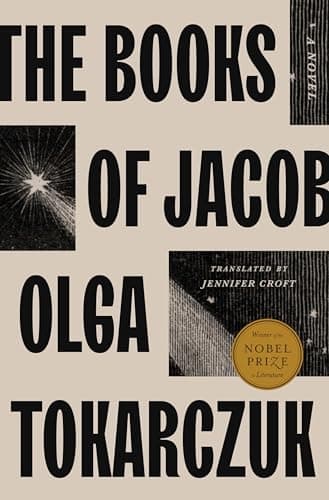
A NEW YORKER “ESSENTIAL READ” “Just as awe-inspiring as the Nobel judges claimed.” – The Washington Post “Olga Tokarczuk is one of our greatest living fiction writers. . . This could well be a decade-defining book akin to Bolaño’s 2666.” –AV Club “Sophisticated and ribald and brimming with folk wit. . . The comedy in this novel blends, as it does in life, with genuine tragedy.” –Dwight Garner, The New York Times LONGLISTED FOR THE 2022 NATIONAL BOOK AWARD NAMED A BEST BOOK OF THE YEAR BY THE NEW YORK TIMES, THE WALL STREET JOURNAL, TIME, THE NEW YORKER, AND NPR The Nobel Prize–winner’s richest, most sweeping and ambitious novel yet follows the comet-like rise and fall of a mysterious, messianic religious leader as he blazes his way across eighteenth-century Europe. In the mid-eighteenth century, as new ideas—and a new unrest—begin to sweep the Continent, a young Jew of mysterious origins arrives in a village in Poland. Before long, he has changed not only his name but his persona; visited by what seem to be ecstatic experiences, Jacob Frank casts a charismatic spell that attracts an increasingly fervent following. In the decade to come, Frank will traverse the Hapsburg and Ottoman empires with throngs of disciples in his thrall as he reinvents himself again and again, converts to Islam and then Catholicism, is pilloried as a heretic and revered as the Messiah, and wreaks havoc on the conventional order, Jewish and Christian alike, with scandalous rumors of his sect’s secret rituals and the spread of his increasingly iconoclastic beliefs. The story of Frank—a real historical figure around whom mystery and controversy swirl to this day—is the perfect canvas for the genius and unparalleled reach of Olga Tokarczuk. Narrated through the perspectives of his contemporaries—those who revere him, those who revile him, the friend who betrays him, the lone woman who sees him for what he is—The Books of Jacob captures a world on the cusp of precipitous change, searching for certainty and longing for transcendence. In a nod to books written in Hebrew, The Books of Jacob is paginated in reverse, beginning on p. 955 and ending on p. 1 – but read traditionally, front cover to back.
A NEW YORKER “ESSENTIAL READ” “Just as awe-inspiring as the Nobel judges claimed.” – The Washington Post “Olga Tokarczuk is one of our greatest living fiction writers. . . This could well be a decade-defining book akin to Bolaño’s 2666.” –AV Club “Sophisticated and ribald and brimming with folk wit. . . The comedy in this novel blends, as it does in life, with genuine tragedy.” –Dwight Garner, The New York Times LONGLISTED FOR THE 2022 NATIONAL BOOK AWARD NAMED A BEST BOOK OF THE YEAR BY THE NEW YORK TIMES, THE WALL STREET JOURNAL, TIME, THE NEW YORKER, AND NPR The Nobel Prize–winner’s richest, most sweeping and ambitious novel yet follows the comet-like rise and fall of a mysterious, messianic religious leader as he blazes his way across eighteenth-century Europe. In the mid-eighteenth century, as new ideas—and a new unrest—begin to sweep the Continent, a young Jew of mysterious origins arrives in a village in Poland. Before long, he has changed not only his name but his persona; visited by what seem to be ecstatic experiences, Jacob Frank casts a charismatic spell that attracts an increasingly fervent following. In the decade to come, Frank will traverse the Hapsburg and Ottoman empires with throngs of disciples in his thrall as he reinvents himself again and again, converts to Islam and then Catholicism, is pilloried as a heretic and revered as the Messiah, and wreaks havoc on the conventional order, Jewish and Christian alike, with scandalous rumors of his sect’s secret rituals and the spread of his increasingly iconoclastic beliefs. The story of Frank—a real historical figure around whom mystery and controversy swirl to this day—is the perfect canvas for the genius and unparalleled reach of Olga Tokarczuk. Narrated through the perspectives of his contemporaries—those who revere him, those who revile him, the friend who betrays him, the lone woman who sees him for what he is—The Books of Jacob captures a world on the cusp of precipitous change, searching for certainty and longing for transcendence. In a nod to books written in Hebrew, The Books of Jacob is paginated in reverse, beginning on p. 955 and ending on p. 1 – but read traditionally, front cover to back.
Add to your library to track progress and write reviews
Add to your library to track progress and write reviews
Find The Books of Jacob Olga Tokarczuk in PDF, EPUB, ebook, audiobook, print, or library editions.
Find The Books of Jacob Olga Tokarczuk in PDF, EPUB, ebook, audiobook, print, or library editions.

4 books in catalog
Constellation novels, philosophical murder mysteries, and mythic historical chronicles offer readers intricate explorations of geography, identity, and human memory, as seen in the internationally celebrated book Flights. Written by Polish novelist Olga Tokarczuk, these works have been translated into more than thirty languages, earning her both the Nike Award—Poland's highest literary honor—and the Nobel Prize in Literature.
Born on January 29, 1962, in Sulechów, Poland, Tokarczuk grew up in Klenica, where her parents worked as teachers and her father managed a school library that fostered her early reading habits. She studied psychology at the University of Warsaw before debuting as a fiction writer in 1993 with the novel Podróż ludzi Księgi (The Journey of the Book-People), which received the Polish Publisher's Prize for best debut. Tokarczuk eventually settled in Wrocław and published eight novels alongside multiple short story collections, developing into one of Poland's most prominent literary authors.
Tokarczuk gained broad international prominence in 2018 when her novel Flights won the Man Booker International Prize, making her the first Polish writer to receive the award. That same year, the Swedish Academy selected her for the 2018 Nobel Prize in Literature (awarded in 2019), honoring her narrative imagination that represents the crossing of boundaries as a form of life.
Tokarczuk's prose is known for its wry perspective and non-linear narrative structures that leap between centuries, mythologies, and shifting viewpoints. Drawing on Gnosticism, Kabbalah, folklore, tarot, and regional history, her books frequently examine environmental ethics, human migration, fluid identity, and the historic entwinement of Central and Eastern European cultures.
4 books in catalog
Constellation novels, philosophical murder mysteries, and mythic historical chronicles offer readers intricate explorations of geography, identity, and human memory, as seen in the internationally celebrated book Flights. Written by Polish novelist Olga Tokarczuk, these works have been translated into more than thirty languages, earning her both the Nike Award—Poland's highest literary honor—and the Nobel Prize in Literature.
Born on January 29, 1962, in Sulechów, Poland, Tokarczuk grew up in Klenica, where her parents worked as teachers and her father managed a school library that fostered her early reading habits. She studied psychology at the University of Warsaw before debuting as a fiction writer in 1993 with the novel Podróż ludzi Księgi (The Journey of the Book-People), which received the Polish Publisher's Prize for best debut. Tokarczuk eventually settled in Wrocław and published eight novels alongside multiple short story collections, developing into one of Poland's most prominent literary authors.
Tokarczuk gained broad international prominence in 2018 when her novel Flights won the Man Booker International Prize, making her the first Polish writer to receive the award. That same year, the Swedish Academy selected her for the 2018 Nobel Prize in Literature (awarded in 2019), honoring her narrative imagination that represents the crossing of boundaries as a form of life.
Tokarczuk's prose is known for its wry perspective and non-linear narrative structures that leap between centuries, mythologies, and shifting viewpoints. Drawing on Gnosticism, Kabbalah, folklore, tarot, and regional history, her books frequently examine environmental ethics, human migration, fluid identity, and the historic entwinement of Central and Eastern European cultures.