SSansFiction
The libraryCollectionsJournalStatsFor authors
Sign inJoin now
Sansfiction,

A digital library for books. Made by readers, for readers.

v 2.0 · 2026
The library
  • Discover
  • Collections
  • Book tracker
  • Journal
  • Stats
For authors
  • SF Links
  • Analytics
  • How it works
  • FAQ
Elsewhere
  • X / @sansfiction
  • Privacy
  • Terms
  • Contact
© 2026 SansFiction · Digital · GlobalA quiet room for your reading life.
The libraryCollectionsJournalStatsFor authors
Sign inJoin now →
Navigation
Library
Bookshelf
Journal
Discover
Collections
Tierlists
Stats
Profile
Author Page
Link Builder
Account
Sign in
S
G
Booksartificial intelligenceThe Alignment Problem: Machine Learning and Human Values
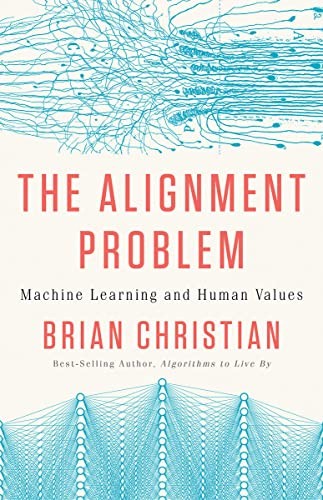
Cover of The Alignment Problem: Machine Learning and Human Values by Brian Christian

The Alignment Problem: Machine Learning and Human Values,

by Brian Christian

Ask AI
Rating4.3/ 5
Ratings37
Pages496
Reading Hours10h
Published2020
LanguageEnglish

§Synopsis

01

"If you’re going to read one book on artificial intelligence, this is the one." ―Stephen Marche, New York Times

A jaw-dropping exploration of everything that goes wrong when we build AI systems and the movement to fix them.Today’s “machine-learning” systems, trained by data, are so effective that we’ve invited them to see and hear for us―and to make decisions on our behalf. But alarm bells are ringing. Recent years have seen an eruption of concern as the field of machine learning advances. When the systems we attempt to teach will not, in the end, do what we want or what we expect, ethical and potentially existential risks emerge. Researchers call this the alignment problem.Systems cull résumés until, years later, we discover that they have inherent gender biases. Algorithms decide bail and parole―and appear to assess Black and White defendants differently. We can no longer assume that our mortgage application, or even our medical tests, will be seen by human eyes. And as autonomous vehicles share our streets, we are increasingly putting our lives in their hands.The mathematical and computational models driving these changes range in complexity from something that can fit on a spreadsheet to a complex system that might credibly be called “artificial intelligence.” They are steadily replacing both human judgment and explicitly programmed software.In best-selling author Brian Christian’s riveting account, we meet the alignment problem’s “first-responders,” and learn their ambitious plan to solve it before our hands are completely off the wheel. In a masterful blend of history and on-the ground reporting, Christian traces the explosive growth in the field of machine learning and surveys its current, sprawling frontier. Readers encounter a discipline finding its legs amid exhilarating and sometimes terrifying progress. Whether they―and we―succeed or fail in solving the alignment problem will be a defining human story.The Alignment Problem offers an unflinching reckoning with humanity’s biases and blind spots, our own unstated assumptions and often contradictory goals. A dazzlingly interdisciplinary work, it takes a hard look not only at our technology but at our culture―and finds a story by turns harrowing and hopeful.

Track this book

Add to your library to track progress and write reviews

§Genres
artificial intelligence1business & economics1business ethics1computers1general1nonfiction1philosophy & social aspects1
§Moods
gray2informative1inspiring1reflective1
§Tags
#ai safety2#alignment2#machine learning2#values2

§About the Author

Brian Christian
Brian Christian

2 books in catalog

Exploring the interdisciplinary boundary where computer science, philosophy, and human behavior intersect, non-fiction writing on artificial intelligence and human cognition provides essential tools for understanding modern technology. Author Brian Christian gained widespread acclaim for translating complex algorithmic concepts into practical insights for everyday life, most notably in his co-authored book Algorithms to Live By: The Computer Science of Human Decisions. His award-winning books examine how computational systems impact human decision-making, psychology, ethics, and society.

Career & Background

Born in 1984 in Wilmington, Delaware, Christian pursued a unique multidisciplinary education, earning undergraduate degrees in computer science and philosophy from Brown University before completing a Master of Fine Arts in poetry at the University of Washington. He later earned his DPhil at the University of Oxford and served as a Visiting Scholar and Postdoctoral Scholar at the Center for Human-Compatible AI (CHAI) at the University of California, Berkeley. Across his career, Christian's written work has appeared in publications such as The New Yorker, The Atlantic, Wired, The Wall Street Journal, The Guardian, The Paris Review, and peer-reviewed journals including Cognitive Science, PNAS, and Dædalus. He has been featured on The Daily Show and Radiolab, and has delivered lectures at major institutions including Google, Facebook, Microsoft, the Santa Fe Institute, and the London School of Economics. Based in San Francisco, his work has been translated into nineteen languages and selected for Best American Science & Nature Writing.

Writing Style & Themes

Christian's work bridges technical computer science, cognitive science, and humanistic philosophy through accessible, narrative-driven prose. Rather than treating computational theories as isolated academic principles, he frames algorithms and machine learning architecture as mirrors reflecting fundamental questions about human nature, morality, and cognitive limitations. His writing examines how humanity can maintain agency and alignment with ethical values as artificial systems become increasingly integrated into daily life and governance.

Major Works

  • Algorithms to Live By: The Computer Science of Human Decisions — Co-authored with cognitive scientist Tom Griffiths, this popular science book demonstrates how computer algorithms can solve human decision-making problems, ranging from searching and sorting to optimal stopping and scheduling. The book was a #1 Audible bestseller, an Amazon Best Science Book of the Year, and an MIT Technology Review Best Book of the Year.
  • The Alignment Problem: Machine Learning and Human Values — This comprehensive investigation details the technical and ethical challenges of ensuring artificial intelligence systems remain aligned with human values, safety, and intentions. It traces the history and progress of machine learning while analyzing bias, reinforcement learning, and safety research.
  • The Most Human Human — Christian's debut non-fiction book explores his experience participating as a human confederate in the Turing Test at the Loebner Prize competition. The work investigates artificial intelligence, natural language processing, and what truly distinguishes human intelligence from machine behavior. It was named a New York Times Editors' Choice, a Wall Street Journal bestseller, and a New Yorker Favorite Book of the Year.

§Editions

Showing 3 of 6 editions
Cover of The Alignment Problem: Machine Learning and Human Values

The Alignment Problem: Machine Learning and Human Values

engHardcover
National Geographic Books20209780393635829
Cover of The Alignment Problem

The Alignment Problem

496 pgs
W. W. Norton & Company20219780393868333
Amazon
Cover of The Alignment Problem

The Alignment Problem

20219781786494337
§Genres
artificial intelligence1business & economics1business ethics1computers1general1nonfiction1philosophy & social aspects1
§Moods
gray2informative1inspiring1reflective1
§Tags
#ai safety2#alignment2#machine learning2#values2

Metadata

ISBN-139780393635829
ISBN-100393635821
ASIN0393868338

Editions and availability

Find The Alignment Problem: Machine Learning and Human Values Brian Christian in PDF, EPUB, ebook, audiobook, print, or library editions.

View on Amazon
Bookshop.orgGoogle Play BooksBarnes & NobleOpen Library

Featured In Lists

Book cover from this collectionBook cover from this collectionBook cover from this collectionBook cover from this collection
Book cover from this collection

AI & ML Now: Society, Power & Human Judgment

6 books•@sansfictionbot