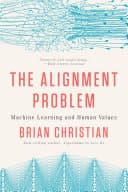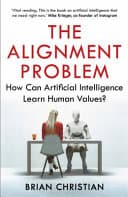
"If you’re going to read one book on artificial intelligence, this is the one." ―Stephen Marche, New York Times
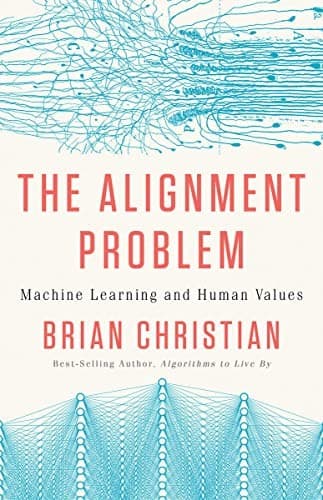
A jaw-dropping exploration of everything that goes wrong when we build AI systems and the movement to fix them.Today’s “machine-learning” systems, trained by data, are so effective that we’ve invited them to see and hear for us―and to make decisions on our behalf. But alarm bells are ringing. Recent years have seen an eruption of concern as the field of machine learning advances. When the systems we attempt to teach will not, in the end, do what we want or what we expect, ethical and potentially existential risks emerge. Researchers call this the alignment problem.Systems cull résumés until, years later, we discover that they have inherent gender biases. Algorithms decide bail and parole―and appear to assess Black and White defendants differently. We can no longer assume that our mortgage application, or even our medical tests, will be seen by human eyes. And as autonomous vehicles share our streets, we are increasingly putting our lives in their hands.The mathematical and computational models driving these changes range in complexity from something that can fit on a spreadsheet to a complex system that might credibly be called “artificial intelligence.” They are steadily replacing both human judgment and explicitly programmed software.In best-selling author Brian Christian’s riveting account, we meet the alignment problem’s “first-responders,” and learn their ambitious plan to solve it before our hands are completely off the wheel. In a masterful blend of history and on-the ground reporting, Christian traces the explosive growth in the field of machine learning and surveys its current, sprawling frontier. Readers encounter a discipline finding its legs amid exhilarating and sometimes terrifying progress. Whether they―and we―succeed or fail in solving the alignment problem will be a defining human story.The Alignment Problem offers an unflinching reckoning with humanity’s biases and blind spots, our own unstated assumptions and often contradictory goals. A dazzlingly interdisciplinary work, it takes a hard look not only at our technology but at our culture―and finds a story by turns harrowing and hopeful.
Add to your library to track progress and write reviews
Find The Alignment Problem: Machine Learning and Human Values Brian Christian in PDF, EPUB, ebook, audiobook, print, or library editions.

2 books in catalog
Exploring the interdisciplinary boundary where computer science, philosophy, and human behavior intersect, non-fiction writing on artificial intelligence and human cognition provides essential tools for understanding modern technology. Author Brian Christian gained widespread acclaim for translating complex algorithmic concepts into practical insights for everyday life, most notably in his co-authored book Algorithms to Live By: The Computer Science of Human Decisions. His award-winning books examine how computational systems impact human decision-making, psychology, ethics, and society.
Born in 1984 in Wilmington, Delaware, Christian pursued a unique multidisciplinary education, earning undergraduate degrees in computer science and philosophy from Brown University before completing a Master of Fine Arts in poetry at the University of Washington. He later earned his DPhil at the University of Oxford and served as a Visiting Scholar and Postdoctoral Scholar at the Center for Human-Compatible AI (CHAI) at the University of California, Berkeley. Across his career, Christian's written work has appeared in publications such as The New Yorker, The Atlantic, Wired, The Wall Street Journal, The Guardian, The Paris Review, and peer-reviewed journals including Cognitive Science, PNAS, and Dædalus. He has been featured on The Daily Show and Radiolab, and has delivered lectures at major institutions including Google, Facebook, Microsoft, the Santa Fe Institute, and the London School of Economics. Based in San Francisco, his work has been translated into nineteen languages and selected for Best American Science & Nature Writing.
Christian's work bridges technical computer science, cognitive science, and humanistic philosophy through accessible, narrative-driven prose. Rather than treating computational theories as isolated academic principles, he frames algorithms and machine learning architecture as mirrors reflecting fundamental questions about human nature, morality, and cognitive limitations. His writing examines how humanity can maintain agency and alignment with ethical values as artificial systems become increasingly integrated into daily life and governance.