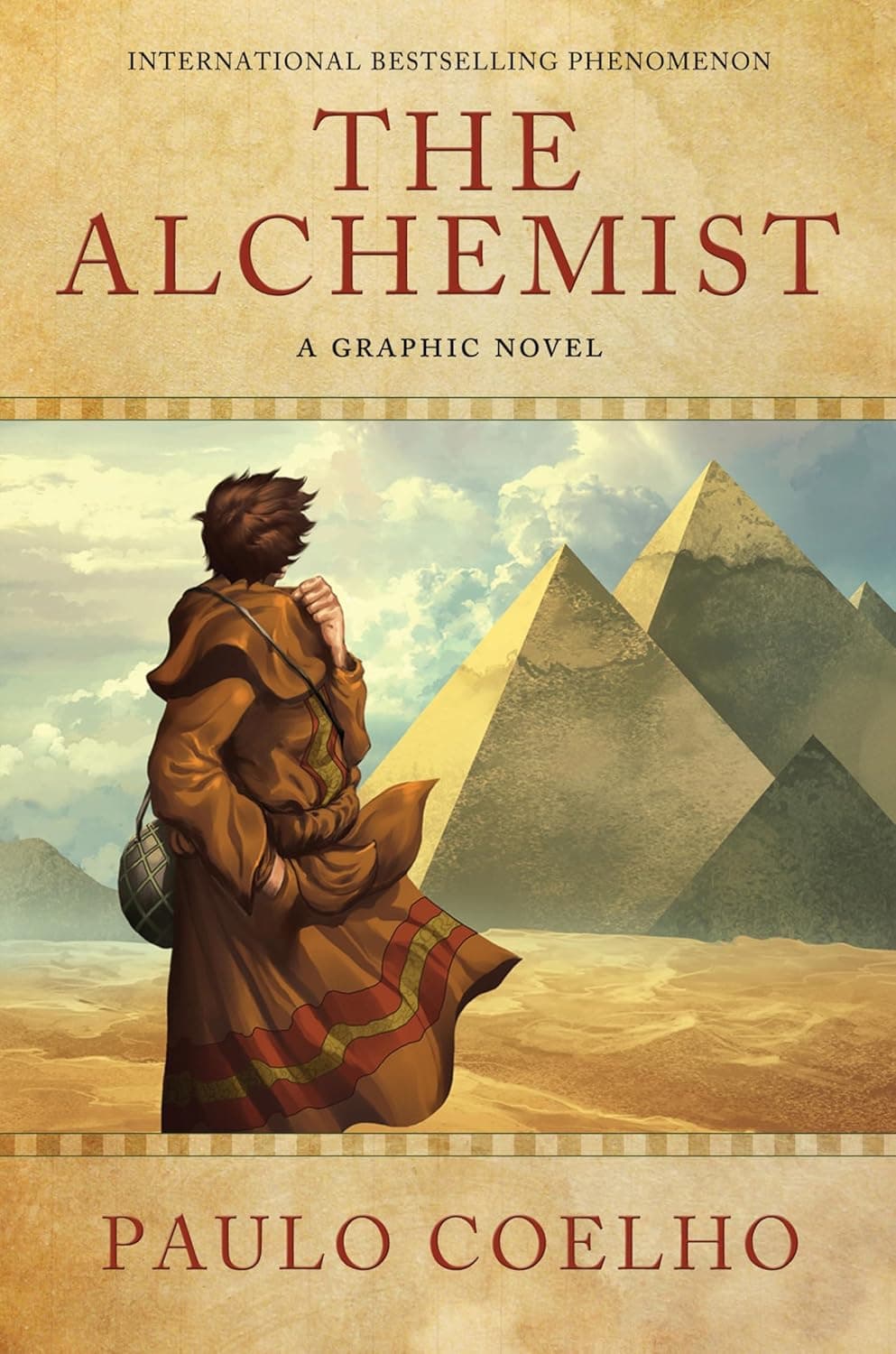
Andalusian shepherd boy Santiago travels from his homeland in Spain to the Egyptian desert in search of a treasure buried in the Pyramids. Along the way he meets a Gypsy woman, a man who calls himself king, and an alchemist, all of whom point Santiago in the direction of his quest. No one knows what the treasure is, or if Santiago will be able to surmount the obstacles along the way. But what starts out as a journey to find worldly goods turns into a discovery of the treasure found within. Since its first printing The Alchemist has been translated into seventy-one languages and sold forty million copies worldwide, establishing itself as a modern classic that will enchant and inspire readers for generations to come. Beautifully rendered, The Alchemist: A Graphic Novel is a must have for any collector's library.
Add to your library to track progress and write reviews
Find The Alchemist: A Graphic Novel Paulo Coelho in PDF, EPUB, ebook, audiobook, print, or library editions.

3 books in catalog
Philosophical fiction and fable-like narrative prose came to define a major strand of global contemporary literature through the massive readership of The Alchemist. Written by Brazilian lyricist and novelist Paulo Coelho de Souza, this 1988 novel became an international best-seller, telling the story of an Andalusian shepherd boy embarking on a quest across North Africa in search of a hidden treasure while discovering spiritual wisdom.
Born on August 24, 1947, in Rio de Janeiro, Brazil, Paulo Coelho spent his youth navigating intense personal conflict over his creative ambitions, leading his parents to commit him to a psychiatric hospital three times during his adolescence. He briefly enrolled in law school before dropping out in 1970 to travel extensively across South America and Europe. Returning to Brazil, he established himself as a theater director, actor, journalist, and lyricist composing songs for well-known Brazilian musicians. In 1974, his political involvement and artistic work led to a brief imprisonment under Brazil's military regime.
Coelho turned decisively toward literary writing following a 1986 journey along the Road to Santiago in Spain, an experience that inspired his early book The Pilgrimage. After The Alchemist achieved global success following its 1988 publication, he dedicated himself to fiction and built an extensive body of translated work. In 2002, he was elected to the Brazilian Academy of Letters, occupying Chair No. 21. His public work also includes global advocacy as a United Nations Messenger of Peace and a UNESCO Special Counselor for Intercultural Dialogues.
Coelho's writing style relies on parabolic storytelling, accessible narrative structures, and central themes of personal transformation, spiritual seeking, and moral choice. Drawing heavily on allegory and fable, his books usually feature protagonists embarking on physical and internal quests that test their faith and self-knowledge. His narratives frequently examine the balance between individual free will and fate, integrating elements of mysticism, folklore, and drama to address fundamental questions of human identity and purpose.