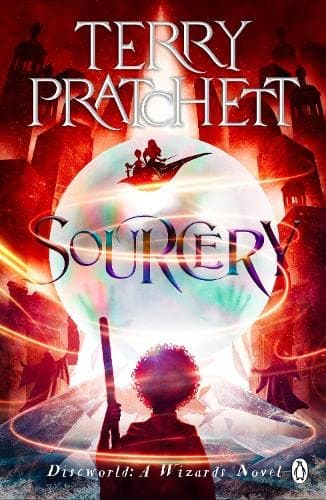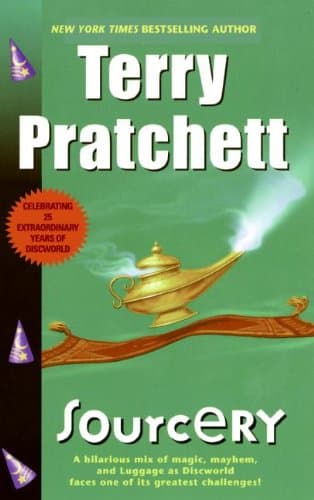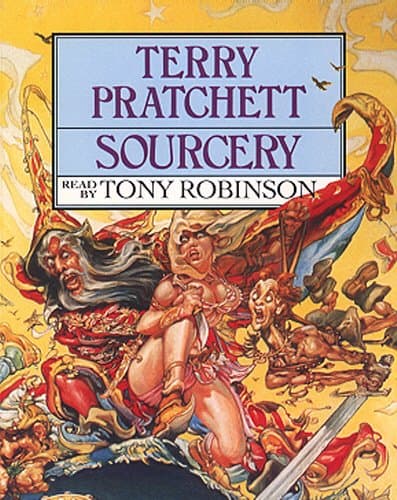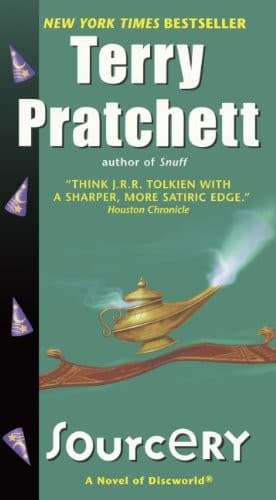
'It's vital to remember who you really are . . . it isn't a good idea to rely on other people or things to do it for you, you see. They always get it wrong.' An eighth son of an eighth son is born, a wizard squared, a source of magic. A sourcerer. Unseen University, the Discworld's most magical establishment, has finally got its wish: the emergence of a wizard more powerful than ever before. You'd think they would have been a little more careful what they wished for . . . As the sourcerer takes over the University and sets his sights on the rest of the world, only one wizard manages to escape his influence. Unfortunately for everyone, it's Rincewind. Once again the cowardly wizard must embark on a quest: to deliver a precious artefact - the very embodiment of magic itself - halfway across the Disc to safety. If he doesn't make it, the death of all wizardry is at hand. And the end of the world, depending on who you listen to. 'One of our greatest fantasists, and beyond a doubt the funniest' George R.R. Martin 'May well be considered his masterpiece . . . Humour such as his is an endangered species' The Times Sourcery is the third book in the Wizards series, but you can read the Discworld novels in any order.
Add to your library to track progress and write reviews
Find Sourcery Terry Pratchett in PDF, EPUB, ebook, audiobook, print, or library editions.

11 books in catalog
Comic fantasy gained one of its most expansive settings with the creation of the Discworld series, a flat world balanced on four elephants resting atop a giant cosmic turtle. English novelist Sir Terence David John Pratchett, OBE, widely known as Terry Pratchett, authored over forty novels set in this humorous universe, beginning with The Colour of Magic in 1983. Over his career, Pratchett produced an average of two books a year, blending satire, slapstick, and philosophical inquiry to construct a vast literary universe.
By the late 1990s, Pratchett was the UK's best-selling author of the decade, and as of December 2007 had sold more than 55 million books worldwide with translations into 36 languages. His literary achievements include winning the Carnegie Medal in 2001 for his young adult novel The Amazing Maurice and his Educated Rodents. At various points in his career, he was recorded as the second most-read writer in the UK and the seventh most-read non-US author in the United States.
Born Terence David John Pratchett on 28 April 1948 in Beaconsfield, Buckinghamshire, he published his first short story as a teenager before leaving school at age seventeen to work as a journalist for the Bucks Free Press. While working in journalism and later public relations, he casually mentioned a manuscript to publisher Peter Bander van Duren, leading to the publication of his debut novel, The Carpet People, in 1971. Pratchett followed his debut with two standalone science-fiction novels, The Dark Side of the Sun (1976) and Strata (1981), before pivoting permanently toward comic fantasy.
The launch of the Discworld series in 1983 redirected his writing career, leading him to resign from his public relations position to focus entirely on writing fiction full-time. Between 1983 and 2015, Pratchett published 41 Discworld novels alongside collaborative projects such as the 1990 apocalyptic comedy Good Omens: The Nice and Accurate Prophecies of Agnes Nutter, Witch, written with Neil Gaiman. His output remained prolific throughout his life, generating tens of millions of book sales and adapting his works into television shows, plays, and video games.
Pratchett's writing is distinguished by its satirical sharpness, parody of traditional fantasy tropes, and extensive use of inventive footnotes. His narrative settings serve as mirrors for real-world institutions, exploring complex subjects such as religious dogma, political bureaucracy, journalism, death, and human nature through a humorous lens. Rather than presenting pure escapism, his narrative arcs frequently feature deeply practical, fallible characters navigating social and ethical dilemmas on a world carried through space by Great A'Tuin.
Through sub-series featuring distinct casts—such as the inept wizard Rincewind, the Witches of Lancre, the City Watch, and the anthropomorphic personification of Death—Pratchett examined how myth and storytelling shape reality. His young adult fiction, including The Amazing Maurice and his Educated Rodents and the Tiffany Aching sequence starting with The Wee Free Men, brought these same thematic complexities to younger audiences while maintaining his signature wit.
Discworld - Rincewind