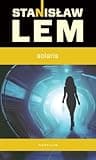
The cult-classic by Stanislaw Lem that spawned the movie is now available for your Kindle! Until now the only English edition was a 1970 version, which was translated from French and which Lem himself described as a "poor translation." This wonderful new English translation (by Bill Johnston) of Lem's classic Solaris is a must-have for fans of Lem's classic novel.
Telling of humanity's encounter with an alien intelligence on the planet Solaris, the 1961 novel is a cult classic, exploring the ultimate futility of attempting to communicate with extra-terrestrial life.
When Kris Kelvin arrives at the planet Solaris to study the ocean that covers its surface, he finds a painful, hitherto unconscious memory embodied in the living physical likeness of a long-dead lover. Others examining the planet, Kelvin learns, are plagued with their own repressed and newly corporeal memories. The Solaris ocean may be a massive brain that creates these incarnate memories, though its purpose in doing so is unknown, forcing the scientists to shift the focus of their quest and wonder if they can truly understand the universe without first understanding what lies within their hearts.
Add to your library to track progress and write reviews
Find Solaris Stanisław Lem in PDF, EPUB, ebook, audiobook, print, or library editions.

3 books in catalog
Philosophical science fiction often explores the limits of human cognition, artificial intelligence, and the daunting challenges of communicating with non-human intelligence. Works within this domain examine how technology intersects with human nature, offering deep critiques of scientific arrogance and epistemological certainty. The celebrated 1961 novel Solaris exemplarizes this tradition by depicting scientists struggling to comprehend an enigmatic, sentient planetary ocean.
Stanisław Lem authored numerous groundbreaking books, essays, and satirical stories that sold over forty million copies and were translated into more than fifty languages. His intellectual depth and vast imagination established him as a premier voice in world speculative literature and futurology.
Born in Lvov on September 12, 1921, to the family of a laryngologist, Lem grew up in an affluent environment before his medical education was disrupted by World War II. He studied medicine at the Lvov Medical Institute from 1940 to 1941 during the Soviet occupation, later working as a mechanic's assistant and welder for a German raw-materials recycling firm during the Nazi occupation. Following the return of Soviet forces in 1944, he resumed his medical studies, but moved to Kraków in 1946 when Lvov was incorporated into Ukrainian territory.
In Kraków, Lem transitioned from medicine to writing, producing science fiction novels, philosophical treatises, and literary criticism. Following the declaration of martial law in Poland, he lived in exile in Vienna with his family from 1983 to 1988, returning home as political reforms unfolded. His extensive literary contributions earned him international acclaim, including a nomination for the inaugural Man Booker International Prize in 2005, before his death in 2006.
Lem's writing bridges rigorous hard science fiction, satirical cybernetic fables, and deep philosophical inquiry. His narratives repeatedly investigate the limitations of human reason, the absurdities of bureaucracy, and the unintended consequences of advanced technology. In works like The Cyberiad, he employed playful storytelling and robot protagonists to satire human flaw, while The Futurological Congress presented a dark, surreal vision of a society conditioned by mind-altering chemicals.