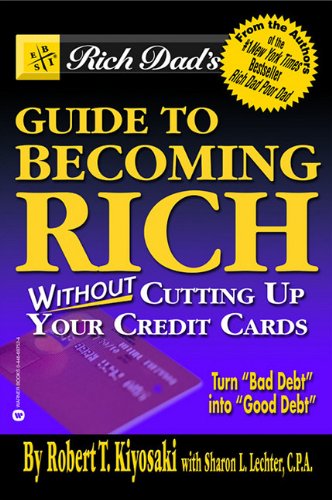
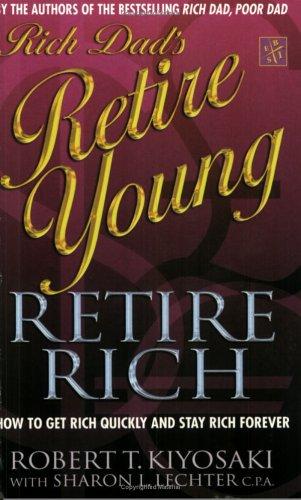
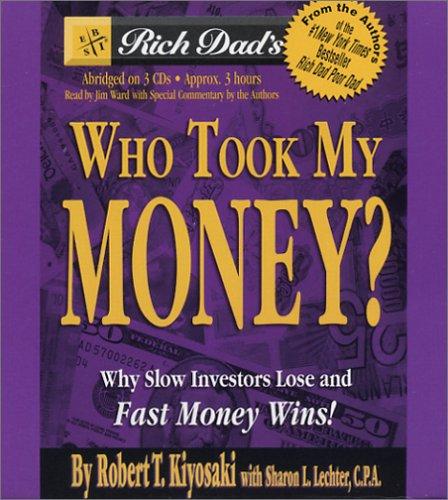
Why cutting up your credit cards won't make you rich A popular TV personality often says, "Take out your credit cards and cut them into pieces." While that is sound advice for people who are not financially responsible, it is inadequate advice for anyone who wants to become rich or financially free. In other words, just cutting up your credit cards will not make you rich. What does make you rich is financial education...unfortunately a type of education we do not receive in school. If a person has a solid financial education, they would know that there are two kinds of debt...good debt and bad debt. A person with a sound financial education would know how to use good debt to make them richer faster...much faster than a person who only saves money and has no debt. Rich Dad's Guide to Becoming Rich * Are you in credit card debt? * Is job security dead? * Is your financial security threatened? * Is a high-paying job the answer? * Is your money working for you? * Do you have good debt or bad debt? We all need more financial education. We need to know how to have our money work hard for us so we don't have to spend our lives working for money. That is why we need more sophisticated financial education...not oversimplified and childish financial tips such as cut up your credit cards or save more money. If you are ready to increase your financial education and enjoy your credit cards, then this book is for you.
Add to your library to track progress and write reviews
Find Rich Dad's Guide to Becoming (Oeb) Rich Without Cutting Robert T. Kiyosaki in PDF, EPUB, ebook, audiobook, print, or library editions.
20 books in catalog
Personal finance literature was fundamentally reshaped in 1997 by a self-published guide that challenged traditional assumptions about employment, saving, and wealth accumulation through direct, practical advice. Robert Toru Kiyosaki reached millions of readers by introducing concepts of financial literacy, asset creation, and passive income that contrasted sharply with conventional career guidance.
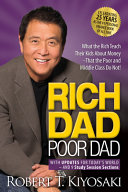
Best known as the author of Rich Dad Poor Dad—frequently cited as the top personal finance book of all time—Robert Kiyosaki has challenged and changed the way tens of millions of people around the world think about money. He operates as an entrepreneur, educator, and investor who believes that individuals have the power to control their financial future and that the world needs more entrepreneurs who will create jobs.
Born on April 8, 1947, in Hilo, Hawaii, Kiyosaki attended the United States Merchant Marine Academy before serving as a helicopter gunship pilot in the military. He later transitioned into business as an entrepreneur, educator, and investor, founding the Rich Dad Company to deliver business and personal finance education through books, videos, board games, and seminars. Beyond authoring books, he has expanded his financial education media through coaching programs, courses, and hosting the Rich Dad Radio Show podcast, where he discusses global economics, banking, and wealth strategies.
Throughout his multi-decade career as an author and speaker, Kiyosaki has written more than two dozen books, including notable co-authored works with Donald Trump prior to his presidency. His publishing endeavors have achieved global reach, selling tens of millions of copies translated into 46 languages across North America, Europe, Asia, South America, Australia, and Africa. Three of his primary titles simultaneously occupied top best-seller lists across major publications including The Wall Street Journal, USA Today, and The New York Times.
Kiyosaki's writing style is characterized by straight talk, conversational delivery, and an irreverent critique of traditional financial advice. Rather than advocating standard practices such as relying solely on job security, mutual funds, or traditional savings accounts, his books emphasize building income-generating assets, understanding cash flow, and leveraging financial intelligence. He frequently uses contrast—most famously comparing the opposing perspectives of his real father and his mentor's father—to illustrate how mindsets dictate long-term financial outcomes.
Key themes across his work include the distinction between assets and liabilities, the importance of tax and business knowledge, and the necessity of calculated risk-taking. His instructional philosophy urges readers to take control of their financial destiny by stepping outside the traditional education system, which he argues fails to teach practical money management, and instead adopting an active entrepreneurial approach.
20 books in catalog
Personal finance literature was fundamentally reshaped in 1997 by a self-published guide that challenged traditional assumptions about employment, saving, and wealth accumulation through direct, practical advice. Robert Toru Kiyosaki reached millions of readers by introducing concepts of financial literacy, asset creation, and passive income that contrasted sharply with conventional career guidance.
Best known as the author of Rich Dad Poor Dad—frequently cited as the top personal finance book of all time—Robert Kiyosaki has challenged and changed the way tens of millions of people around the world think about money. He operates as an entrepreneur, educator, and investor who believes that individuals have the power to control their financial future and that the world needs more entrepreneurs who will create jobs.
Born on April 8, 1947, in Hilo, Hawaii, Kiyosaki attended the United States Merchant Marine Academy before serving as a helicopter gunship pilot in the military. He later transitioned into business as an entrepreneur, educator, and investor, founding the Rich Dad Company to deliver business and personal finance education through books, videos, board games, and seminars. Beyond authoring books, he has expanded his financial education media through coaching programs, courses, and hosting the Rich Dad Radio Show podcast, where he discusses global economics, banking, and wealth strategies.
Throughout his multi-decade career as an author and speaker, Kiyosaki has written more than two dozen books, including notable co-authored works with Donald Trump prior to his presidency. His publishing endeavors have achieved global reach, selling tens of millions of copies translated into 46 languages across North America, Europe, Asia, South America, Australia, and Africa. Three of his primary titles simultaneously occupied top best-seller lists across major publications including The Wall Street Journal, USA Today, and The New York Times.
Kiyosaki's writing style is characterized by straight talk, conversational delivery, and an irreverent critique of traditional financial advice. Rather than advocating standard practices such as relying solely on job security, mutual funds, or traditional savings accounts, his books emphasize building income-generating assets, understanding cash flow, and leveraging financial intelligence. He frequently uses contrast—most famously comparing the opposing perspectives of his real father and his mentor's father—to illustrate how mindsets dictate long-term financial outcomes.
Key themes across his work include the distinction between assets and liabilities, the importance of tax and business knowledge, and the necessity of calculated risk-taking. His instructional philosophy urges readers to take control of their financial destiny by stepping outside the traditional education system, which he argues fails to teach practical money management, and instead adopting an active entrepreneurial approach.
Rich Dad
Rich Dad