An Instant New York Times Bestseller
A BEST BOOK OF 2025: TIME • SCIENTIFIC AMERICAN • SMITHSONIAN MAGAZINE • KiRKUS • SHELF AWARENESS • CHICAGO PUBLIC LIBRARY
A Goodreads Choice Awards Nominee
From the New York Times best-selling author of Stiff and Fuzz, a rollicking exploration of the quest to re-create the impossible complexities of human anatomy.
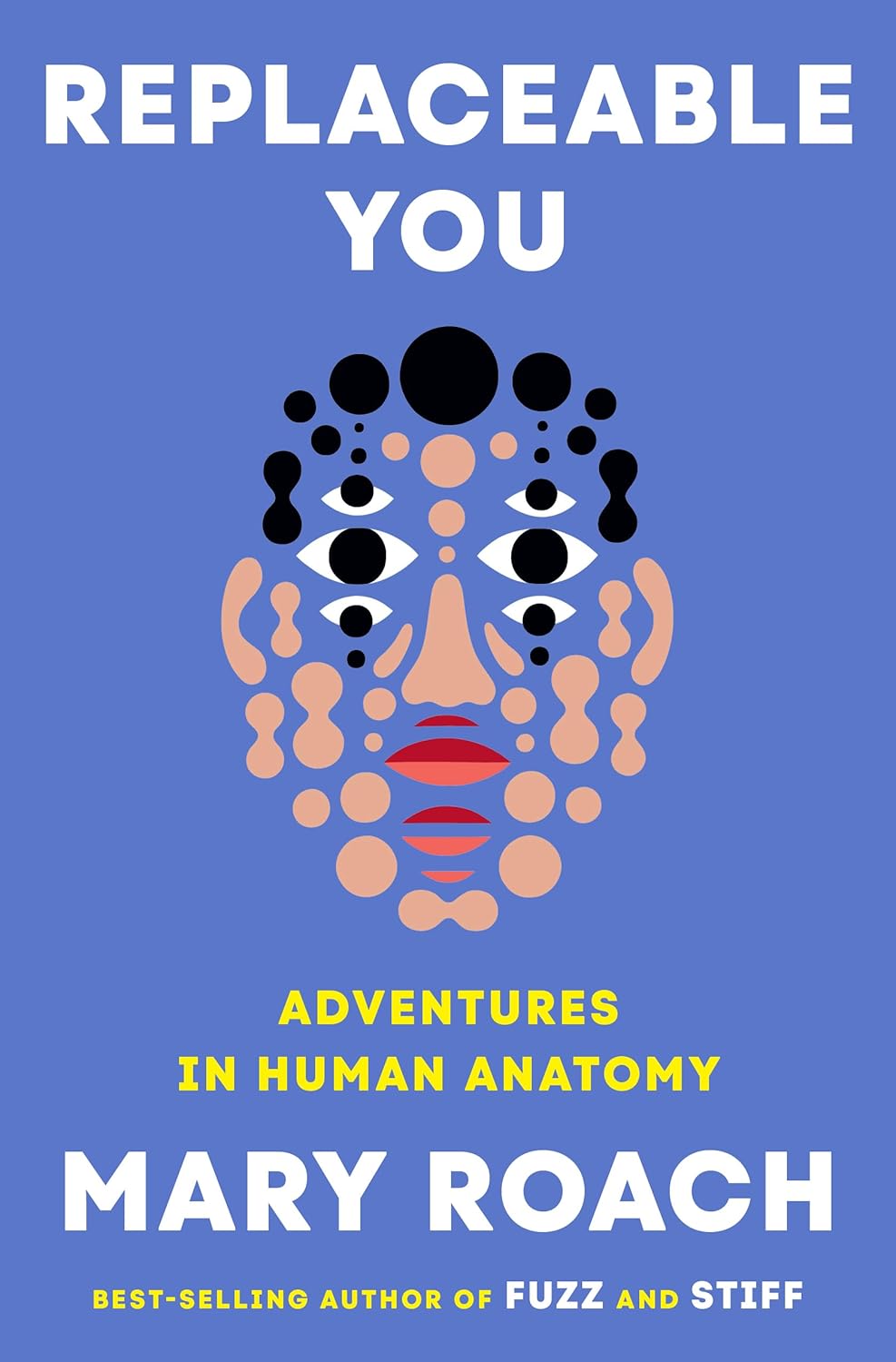
The body is the most complex machine in the world, and the only one for which you cannot get a replacement part from the manufacturer. For centuries, medicine has reached for what’s available—sculpting noses from brass, borrowing skin from frogs and hearts from pigs, crafting eye parts from jet canopies and breasts from petroleum by-products. Today we’re attempting to grow body parts from scratch using stem cells and 3D printers. How are we doing? Are we there yet? In Replaceable You, Mary Roach explores the remarkable advances and difficult questions prompted by the human body’s failings. When and how does a person decide they’d be better off with a prosthetic than their existing limb? Can a donated heart be made to beat forever? Can an intestine provide a workable substitute for a vagina? Roach dives in with her characteristic verve and infectious wit. Her travels take her to the OR at a legendary burn unit in Boston, a “superclean” xeno-pigsty in China, and a stem cell “hair nursery” in the San Diego tech hub. She talks with researchers and surgeons, amputees and ostomates, printers of kidneys and designers of wearable organs. She spends time in a working iron lung from the 1950s, stays up all night with recovery techs as they disassemble and reassemble a tissue donor, and travels across Mongolia with the cataract surgeons of Orbis International. Irrepressible and accessible, Replaceable You immerses readers in the wondrous, improbable, and surreal quest to build a new you.
An Instant New York Times Bestseller
A BEST BOOK OF 2025: TIME • SCIENTIFIC AMERICAN • SMITHSONIAN MAGAZINE • KiRKUS • SHELF AWARENESS • CHICAGO PUBLIC LIBRARY
A Goodreads Choice Awards Nominee
From the New York Times best-selling author of Stiff and Fuzz, a rollicking exploration of the quest to re-create the impossible complexities of human anatomy.
The body is the most complex machine in the world, and the only one for which you cannot get a replacement part from the manufacturer. For centuries, medicine has reached for what’s available—sculpting noses from brass, borrowing skin from frogs and hearts from pigs, crafting eye parts from jet canopies and breasts from petroleum by-products. Today we’re attempting to grow body parts from scratch using stem cells and 3D printers. How are we doing? Are we there yet? In Replaceable You, Mary Roach explores the remarkable advances and difficult questions prompted by the human body’s failings. When and how does a person decide they’d be better off with a prosthetic than their existing limb? Can a donated heart be made to beat forever? Can an intestine provide a workable substitute for a vagina? Roach dives in with her characteristic verve and infectious wit. Her travels take her to the OR at a legendary burn unit in Boston, a “superclean” xeno-pigsty in China, and a stem cell “hair nursery” in the San Diego tech hub. She talks with researchers and surgeons, amputees and ostomates, printers of kidneys and designers of wearable organs. She spends time in a working iron lung from the 1950s, stays up all night with recovery techs as they disassemble and reassemble a tissue donor, and travels across Mongolia with the cataract surgeons of Orbis International. Irrepressible and accessible, Replaceable You immerses readers in the wondrous, improbable, and surreal quest to build a new you.
Add to your library to track progress and write reviews
Find Replaceable You: Adventures in Human Anatomy Mary Roach in PDF, EPUB, ebook, audiobook, print, or library editions.
2 books in catalog
Popular science writing often bypasses the unusual, tactile, and unconventional corners of biological research, but detailed investigative reporting into human anatomy and physical phenomena brings these forgotten subjects into sharp focus. Stiff: The Curious Lives of Human Cadavers demonstrated how rigorous science journalism could blend meticulous research with accessible, humorous prose to explain complex medical and scientific topics. Mary Roach built a wide readership by exploring taboo, overlooked, or seemingly bizarre topics ranging from postmortem scientific contributions to space medicine, digestive anatomy, and wildlife law enforcement.
Born in Hanover, New Hampshire, on March 20, 1959, Roach graduated with a degree in psychology from Wesleyan University before relocating to San Francisco. Her professional writing career began in 1986 when she sold a humor piece regarding the IRS to the San Francisco Chronicle. This publication opened doors to freelance feature writing and first-person humor essays for major periodicals, including National Geographic, Wired, Vogue, GQ, The New York Times Magazine, and the Journal of Clinical Anatomy. She also authored a monthly humor column, "My Planet," for Reader's Digest. Although she writes primarily about science, she initially had no intention of turning it into her career; in an interview, she noted that science assignments consistently yielded the most intriguing stories. Between 1996 and 2005, she worked as part of the San Francisco writing community known as the Grotto, which provided the encouragement needed to transition into book-length non-fiction. Her engaging commentary has also made her a frequent guest on television and radio programs, including Coast to Coast AM, The Daily Show, and The Colbert Report.
Roach's approach to science writing is defined by firsthand reporting, deep archival research, and an irreverent, curiosity-driven humor that demystifies offbeat and taboo scientific topics. Rather than focusing on abstract theoretical frameworks, her work explores human physiology, bodily functions, and the practical challenges faced by researchers and technicians. Her narrative style relies heavily on immersion—visiting specialized laboratories, interviewing field experts, and investigating unconventional scientific questions with persistent enthusiasm. Across her titles, which have been translated into 21 languages, she translates complex medical, anatomical, and physical concepts into clear, engaging prose while highlighting the human element behind scientific discovery.
2 books in catalog
Popular science writing often bypasses the unusual, tactile, and unconventional corners of biological research, but detailed investigative reporting into human anatomy and physical phenomena brings these forgotten subjects into sharp focus. Stiff: The Curious Lives of Human Cadavers demonstrated how rigorous science journalism could blend meticulous research with accessible, humorous prose to explain complex medical and scientific topics. Mary Roach built a wide readership by exploring taboo, overlooked, or seemingly bizarre topics ranging from postmortem scientific contributions to space medicine, digestive anatomy, and wildlife law enforcement.
Born in Hanover, New Hampshire, on March 20, 1959, Roach graduated with a degree in psychology from Wesleyan University before relocating to San Francisco. Her professional writing career began in 1986 when she sold a humor piece regarding the IRS to the San Francisco Chronicle. This publication opened doors to freelance feature writing and first-person humor essays for major periodicals, including National Geographic, Wired, Vogue, GQ, The New York Times Magazine, and the Journal of Clinical Anatomy. She also authored a monthly humor column, "My Planet," for Reader's Digest. Although she writes primarily about science, she initially had no intention of turning it into her career; in an interview, she noted that science assignments consistently yielded the most intriguing stories. Between 1996 and 2005, she worked as part of the San Francisco writing community known as the Grotto, which provided the encouragement needed to transition into book-length non-fiction. Her engaging commentary has also made her a frequent guest on television and radio programs, including Coast to Coast AM, The Daily Show, and The Colbert Report.
Roach's approach to science writing is defined by firsthand reporting, deep archival research, and an irreverent, curiosity-driven humor that demystifies offbeat and taboo scientific topics. Rather than focusing on abstract theoretical frameworks, her work explores human physiology, bodily functions, and the practical challenges faced by researchers and technicians. Her narrative style relies heavily on immersion—visiting specialized laboratories, interviewing field experts, and investigating unconventional scientific questions with persistent enthusiasm. Across her titles, which have been translated into 21 languages, she translates complex medical, anatomical, and physical concepts into clear, engaging prose while highlighting the human element behind scientific discovery.