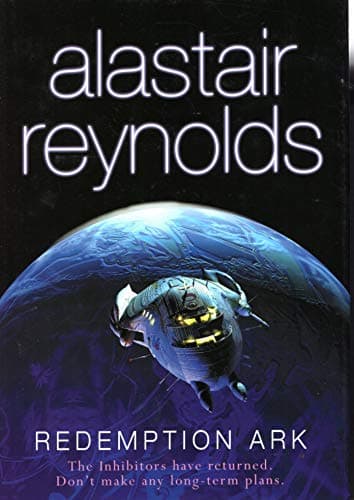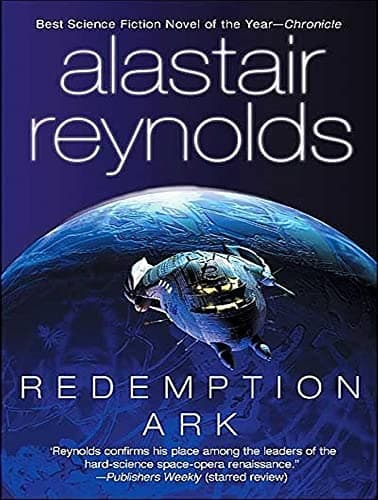
Alastair Reynolds pushes the boundaries of science fiction and “confirms his place among the leaders of the hard-science space-opera renaissance” (Publishers Weekly) in this novel in his Revelation Space universe. Late in the twenty-sixth century, the human race has advanced enough to accidentally trigger the Inhibitors—alien killing machines designed to detect intelligent life and destroy it. The only hope for humanity lies in the recovery of a secret cache of doomsday weapons—and a renegade named Clavain who is determined to find them. But other factions want the weapons for their own purposes—and the weapons themselves have another agenda altogether...
Add to your library to track progress and write reviews
Find Redemption Ark Alastair Reynolds in PDF, EPUB, ebook, audiobook, print, or library editions.

11 books in catalog
Hard science fiction and sprawling space opera intersect in expansive far-future universes where real orbital mechanics, deep-time stretches, and uncompromising astrophysics shape human destiny. Welsh author Alastair Reynolds established his reputation with Revelation Space, a seminal novel that launched a dark, intricate future history spanning millennia.
Drawing directly on his professional background in astronomy, Reynolds brings scientific rigor to grand interstellar scale, creating complex narratives grounded in realistic physical constraints such as the speed of light.
Born in Barry, South Wales, in 1966, Reynolds spent his early years in Wales and Cornwall before studying physics and astronomy at Newcastle University. He went on to earn a PhD in astronomy from the University of St Andrews in Scotland.
Reynolds moved to the Netherlands in 1991 to work as a research astronomer for the European Space Agency (ESA), where he contributed to astrophysics research while writing science fiction in his spare time. After publishing his first short story, "Nunivak Snowflakes," in Interzone in 1990, he steadily built a extensive body of work before leaving ESA to become a full-time writer. He has won the British Science Fiction Award and received nominations for the Hugo Award, Arthur C. Clarke Award, John W. Campbell Memorial Award, Theodore Sturgeon Award, and Locus Award.
Reynolds's writing is characterized by hard science fiction anchored in real-world physics, deep time, artificial intelligence, nanotechnology, and high-concept space exploration. His narratives routinely avoid faster-than-light travel, forcing starships to rely on relativistic travel across centuries and emphasizing the immense physical distances of interstellar space.
His works frequently explore themes of post-humanity, cybernetic evolution, archaeological discovery among dead alien civilizations, and existential threats to intelligence. These elements appear both in his standalone novels and across his extensive catalog of short fiction.
Revelation Space