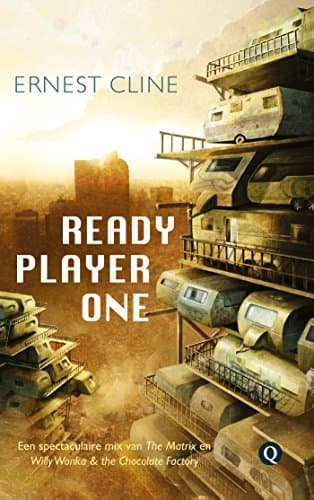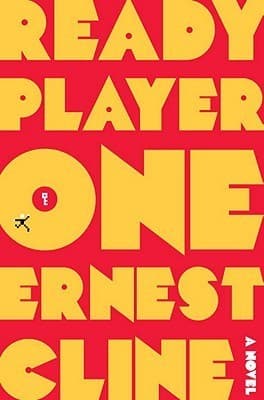
In the year 2045, reality is an ugly place. The only time Wade Watts really feels alive is when he’s jacked into the OASIS, a vast virtual world where most of humanity spends their days.
When the eccentric creator of the OASIS dies, he leaves behind a series of fiendish puzzles, based on his obsession with the pop culture of decades past. Whoever is first to solve them will inherit his vast fortune—and control of the OASIS itself.
Then Wade cracks the first clue. Suddenly he’s beset by rivals who’ll kill to take this prize. The race is on—and the only way to survive is to win.
For Wade, remembering the right 1980s games, films and music isn't trivia for its own sake. It's how he opens the dead creator's puzzles. That design is why the book delights some readers and wears out others. Publishers Weekly called it a high-energy adventure with an appealing, self-deprecating narrator but noted the references pile up; Kirkus liked the Easter eggs but found the puzzle-solving heavy and the suspense fading before the end. Readers split the same way: some finish it in a day or two, others groan at name-dropping that serves no story purpose. The escapism question cuts deeper than the plot admits. Goodreads readers praise the OASIS as a place where poor, shy or disabled people compete on equal terms, yet critics notice the story insists real life matters while spending most of its energy on the virtual one.
On its August 2011 release from Crown the book was warmly received by mainstream and genre outlets and became a bestseller, and it won the American Library Association's 2012 Alex Award for adult books with teen appeal. Kirkus was cooler, finding too much puzzle-solving and too little suspense, and Publishers Weekly flagged references that pile up. Around the 2018 Spielberg film, retrospective criticism attacked its nostalgia and prose, though at least one defender reportedly thought the backlash overshot.
Add to your library to track progress and write reviews
Find Ready Player One Ernest Cline in PDF, EPUB, ebook, audiobook, print, or library editions.
Ready Player One

15 books in catalog
Pop culture trivia, arcade gaming nostalgia, and dystopian virtual worlds came together to define a landmark era of contemporary science fiction when Ready Player One hit shelves. American novelist, screenwriter, and former slam poet Ernest Cline established his reputation through immersive speculative fiction that celebrates retro technology and media culture. His fiction has been published in over fifty countries, translated into more than three dozen languages, and spent more than 100 weeks on The New York Times bestseller list.
Born on March 29, 1972, in Ashland, Ohio, Ernest Christy Cline spent his early creative career performing as a slam poet before transitioning into screenwriting and novel writing. He later relocated to Austin, Texas, where he resides with his family, a time-traveling DeLorean automobile, and an extensive collection of classic video games. His debut novel, Ready Player One, became an international bestseller and was adapted into a 2018 feature film directed by Steven Spielberg, with Cline co-writing the screenplay. Following his debut, Cline published Armada—a science fiction novel whose film adaptation entered development at Universal Pictures—and returned to his flagship franchise with Ready Player Two. He expanded his bibliography into middle-grade fiction with Bridge to Bat City.
Cline's writing style is characterized by fast-paced adventure narratives interwoven with dense pop-culture references, particularly from 1980s video games, films, and music. His works frequently examine virtual reality, artificial environments, gaming mechanics, and the tension between digital escapism and real-world human connection. By embedding classic gaming lore, simulation technology, and fan culture directly into his plotlines, Cline creates speculative settings where trivia knowledge and gamer skills become essential for survival and solving high-stakes mysteries.