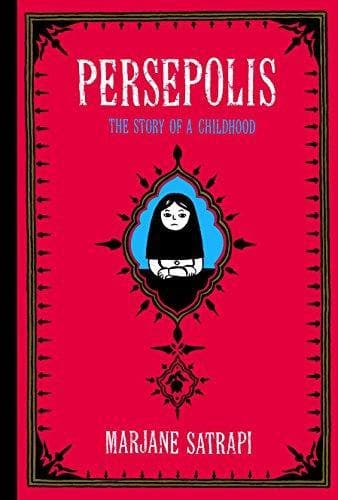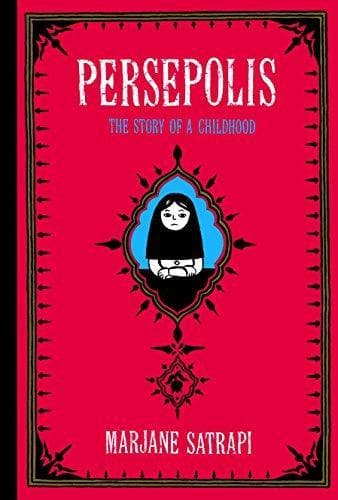
Wise, funny, and heartbreaking, Persepolis is Marjane Satrapi's memoir of growing up in Iran during the Islamic Revolution. In powerful black-and-white comic strip images, Satrapi tells the story of her life from ages six to fourteen, years that saw the overthrow of the Shah's regime, the triumph of the Islamic Revolution, and the devastating effects of war with Iraq. The intelligent and outspoken only child of committed Marxists and the great-granddaughter of one of Iran's last emperors, Marjane bears witness to a childhood uniquely entwined with the history of her country.
Persepolis paints an unforgettable portrait of daily life in Iran and of the bewildering contradictions between home life and public life. Marjane's child's-eye view of dethroned emperors, state-sanctioned whippings, and heroes of the revolution allows us to learn as she does the history of this fascinating country and of her own extraordinary family. Intensely personal, profoundly political, and wholly original, Persepolis is at once a story of growing up and a reminder of the human cost of war and political repression. It shows how we carry on, with laughter and tears, in the face of absurdity. And, finally, it introduces us to a little girl with whom we cannot help but fall in love.
Add to your library to track progress and write reviews
Find Persepolis: The Story of a Childhood Marjane Satrapi in PDF, EPUB, ebook, audiobook, print, or library editions.

2 books in catalog
The graphic memoir series Persepolis transformed autobiographical comics by depicting childhood and adolescence during the 1979 Islamic Revolution and the Iran-Iraq War. Iranian-French author, illustrator, and director Marjane Satrapi gained worldwide recognition for portraying the personal and political realities of growing up in Tehran before relocating to Europe.
Her graphic narratives combine high-contrast monochrome artwork with sharp humor and personal history to examine cultural identity, displacement, and social restriction.
Born on November 22, 1969, in Rasht, Iran, Satrapi grew up in Tehran and attended the French-language Razi High School. During her teenage years, amidst the political instability following the 1979 revolution and the Iran-Iraq War, her family sent her to Vienna, Austria, to continue her education. She later returned to Iran to study art before moving to France in 1994, where she studied illustration in Strasbourg and subsequently established her home in Paris.
In France, she contributed illustrations to major international publications, including The New Yorker and The New York Times, while also writing children's books. The release of her graphic memoir series Persepolis, beginning in 2000, established her prominent position in graphic literature. Satrapi later expanded into film, co-writing and co-directing the 2007 animated movie adaptation of Persepolis, which won the Jury Prize at the Cannes Film Festival and received an Academy Award nomination for Best Animated Feature. Her subsequent filmmaking projects included a live-action movie adaptation of Chicken with Plums and the Marie Curie biographical drama Radioactive.
Satrapi's graphic literature utilizes clean, high-contrast black-and-white drawings combined with expressive character design. By grounding large historical events in intimate personal experiences, her storytelling addresses totalizing regimes, exile, family dynamics, and cross-cultural identity without relying on melodrama.
Her work frequently uses satirical dialogue and observational wit to critique political oppression and social constraints, particularly those imposed on Iranian women. This mixture of humor and frank historical detail makes complex geopolitical events readable and human.
Persepolis