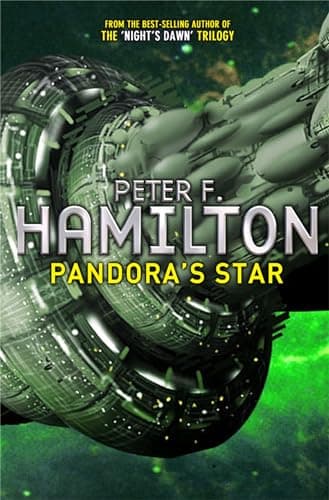
Critics have compared the engrossing space operas of Peter F. Hamilton to the classic sagas of such sf giants as Isaac Asimov and Frank Herbert. But Hamilton's bestselling fiction--powered by a fearless imagination and world-class storytelling skills--has also earned him comparison to Tolstoy and Dickens. Hugely ambitious, wildly entertaining, philosophically stimulating: the novels of Peter F. Hamilton will change the way you think about science fiction. Now, with Pandora's Star, he begins a new multivolume adventure, one that promises to be his most mind-blowing yet. The year is 2380. The Intersolar Commonwealth, a sphere of stars some four hundred light-years in diameter, contains more than six hundred worlds, interconnected by a web of transport "tunnels" known as wormholes. At the farthest edge of the Commonwealth, astronomer Dudley Bose observes the impossible: Over one thousand light-years away, a star . . . vanishes. It does not go supernova. It does not collapse into a black hole. It simply disappears. Since the location is too distant to reach by wormhole, a faster-than-light starship, the Second Chance, is dispatched to learn what has occurred and whether it represents a threat. In command is Wilson Kime, a five-time rejuvenated ex-NASA pilot whose glory days are centuries behind him.Opposed to the mission are the Guardians of Selfhood, a cult that believes the human race is being manipulated by an alien entity they call the Starflyer. Bradley Johansson, leader of the Guardians, warns of sabotage, fearing the Starflyer means to use the starship's mission for its own ends,.Pursued by a Commonwealth special agent convinced the Guardians are crazy but dangerous, Johansson flees. But the danger is not averted. Aboard the Second Chance, Kime wonders if his crew has been infiltrated. Soon enough, he will have other worries. A thousand light-years away, something truly incredible is waiting: a deadly discovery whose unleashing will threaten to destroy the Commonwealth . . . and humanity itself. Could it be that Johansson was right?From the Hardcover edition.
Add to your library to track progress and write reviews
Find Pandora's Star Peter F. Hamilton in PDF, EPUB, ebook, audiobook, print, or library editions.

1 books in catalog
Expansive space operas featuring intricate multi-planet civilizations, advanced biotechnology, and far-reaching interstellar conflicts define a major current in modern science fiction. Peter F. Hamilton entered the genre with near-future detective fiction before establishing his reputation for massive, multi-volume galactic epics. By the publication of his tenth novel in 2004, his published books had sold over two million copies worldwide, highlighted by foundational universe-building efforts such as Pandora's Star.
Born in Rutland, England, on 2 March 1960, Hamilton studied science until age eighteen and did not attend university. He began writing fiction in 1987 and made his first sale with the short story "Deathday" to Fear magazine, followed by short fiction in Dream Magazine and Interzone, where his story "The Suspect Genome" won a BSFA Award. His novel debut arrived in 1993 with Mindstar Rising, initiating the Greg Mandel trilogy set in a post-industrial Britain and centered on a psychic ex-commando investigator. He expanded his scope with the Night's Dawn trilogy—comprising The Reality Dysfunction (1996), The Neutronium Alchemist (1997), and The Naked God—a sequence of massive 1,000-page novels. His extensive bibliography also includes the Commonwealth Saga, the Void trilogy, the Chronicle of the Fallers, and the Salvation Sequence, as well as standalone novels like Fallen Dragon and Great North Road and universe consultancy for EXODUS: The Archimedes Engine.
Hamilton's narrative approach blends high-concept hard science fiction, political extrapolation, and fast-paced procedural mystery across vast interstellar scales. His works regularly explore the long-term technological evolution of humanity, incorporating themes of neural implants, wormhole transport networks, cybernetics, artificial intelligence, and distinct alien species. Instead of relying on a single central character, his broad storylines connect dozens of character perspectives across distant star systems, grounding galactic conflicts in detailed technological and social world building.
Commonwealth Universe