
§Author· 1 book
Peter F. Hamilton
Expansive space operas featuring intricate multi-planet civilizations, advanced biotechnology, and far-reaching interstellar conflicts define a major current in modern science fiction. Peter F. Hamilton entered the genre with near-future detective fiction before establishing his reputation for massive, multi-volume galactic epics. By the publication of his tenth novel in 2004, his published books had sold over two million copies worldwide, highlighted by foundational universe-building efforts such as Pandora's Star.
Career & Background
Born in Rutland, England, on 2 March 1960, Hamilton studied science until age eighteen and did not attend university. He began writing fiction in 1987 and made his first sale with the short story "Deathday" to Fear magazine, followed by short fiction in Dream Magazine and Interzone, where his story "The Suspect Genome" won a BSFA Award. His novel debut arrived in 1993 with Mindstar Rising, initiating the Greg Mandel trilogy set in a post-industrial Britain and centered on a psychic ex-commando investigator. He expanded his scope with the Night's Dawn trilogy—comprising The Reality Dysfunction (1996), The Neutronium Alchemist (1997), and The Naked God—a sequence of massive 1,000-page novels. His extensive bibliography also includes the Commonwealth Saga, the Void trilogy, the Chronicle of the Fallers, and the Salvation Sequence, as well as standalone novels like Fallen Dragon and Great North Road and universe consultancy for EXODUS: The Archimedes Engine.
Writing Style & Themes
Hamilton's narrative approach blends high-concept hard science fiction, political extrapolation, and fast-paced procedural mystery across vast interstellar scales. His works regularly explore the long-term technological evolution of humanity, incorporating themes of neural implants, wormhole transport networks, cybernetics, artificial intelligence, and distinct alien species. Instead of relying on a single central character, his broad storylines connect dozens of character perspectives across distant star systems, grounding galactic conflicts in detailed technological and social world building.
Major Works
- Pandora's Star — The opening novel of the Commonwealth Saga, following a human civilization reliant on wormholes as an astronomical discovery triggers an encounter with an unprecedented alien threat.
- Mindstar Rising — The 1993 debut novel that introduced Greg Mandel, a telepathic ex-commando investigating corporate and political conspiracy in a flood-damaged future Britain.
- The Reality Dysfunction — The 1996 initial volume of the Night's Dawn trilogy, introducing a massive universe facing an existential force capable of altering reality.
- Great North Road — A standalone science fiction mystery following a high-profile murder investigation that spans Earth and an interstellar gateway world.
§All Books
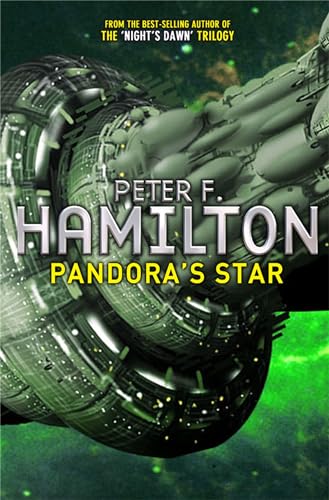
Pandora's Star
Peter F. Hamilton, 2004
321 ratings
§ About Peter F. Hamilton's books
- Books on SansFiction
- 1
- Published
- 2004
- Average rating
- 4.1 / 5 across 321 ratings
- Genres
- Adventure, Aliens, Fantasy, Science Fiction
The book: Pandora's Star (2004)
Critics have compared the engrossing space operas of Peter F. Hamilton to the classic sagas of such sf giants as Isaac Asimov and Frank Herbert. But Hamilton's bestselling fiction--powered by a fearless imagination and world-class storytelling skills--has also earned him comparison to Tolstoy and Dickens.
Common questions about Peter F. Hamilton
- Who is Peter F. Hamilton?
- Born in Rutland, England, on 2 March 1960, Hamilton studied science until age eighteen and did not attend university. He began writing fiction in 1987 and made his first sale with the short story "Deathday" to Fear magazine, followed by short fiction in Dream Magazine and Interzone, where his story "The Suspect Genome" won a BSFA Award.
- What is Peter F. Hamilton best known for?
- Peter F. Hamilton is best known for Pandora's Star, published in 2004 with 321 ratings and a 4.1 average. It is the most-rated of Peter F. Hamilton's books on SansFiction.
- What genres does Peter F. Hamilton write?
- Peter F. Hamilton's books on SansFiction are tagged Adventure, Aliens, Fantasy and Science Fiction.
Explore: Adventure · Aliens · Fantasy · Science Fiction