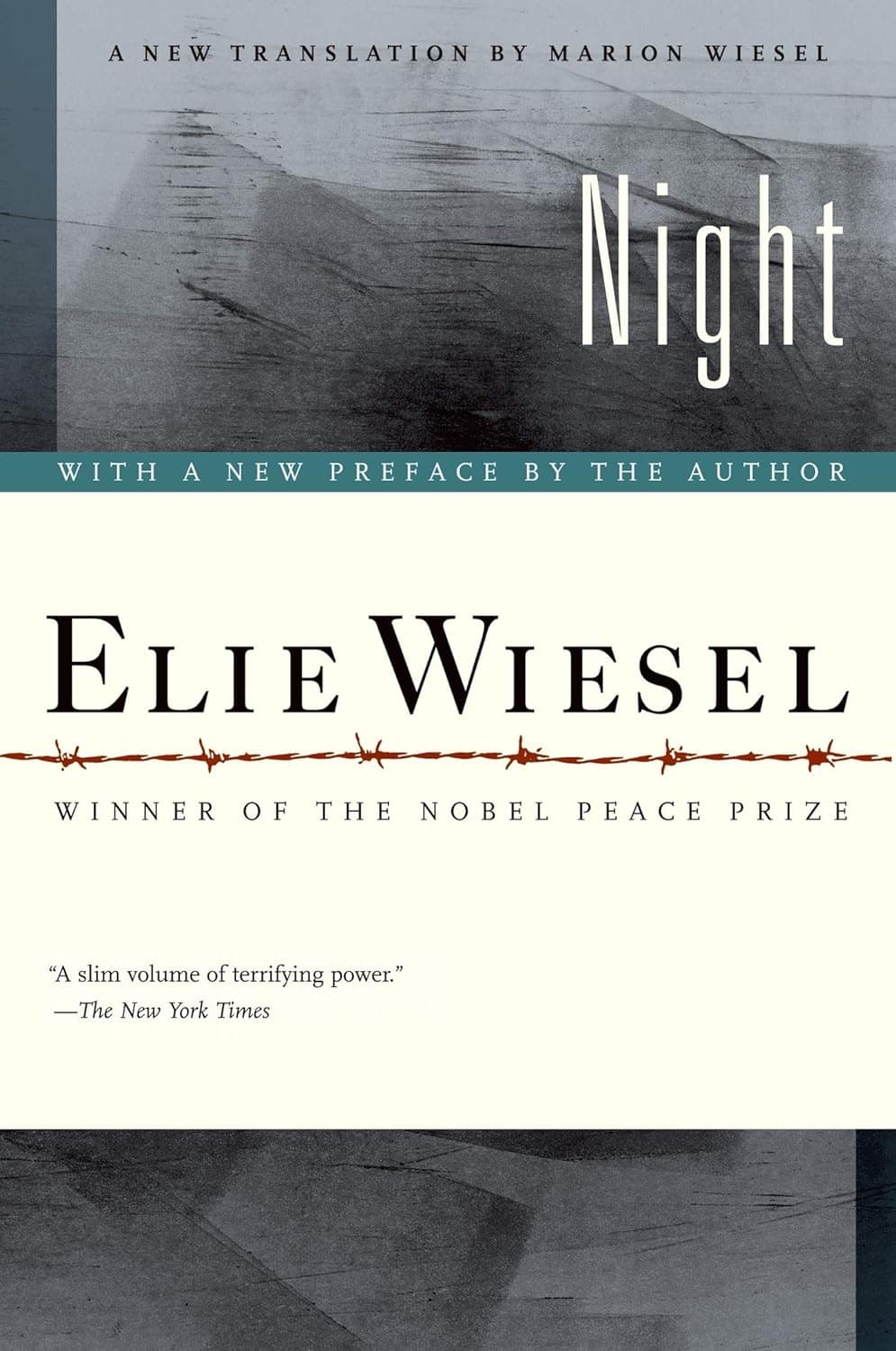
Night is Elie Wiesel's masterpiece, a candid, horrific, and deeply poignant autobiographical account of his survival as a teenager in the Nazi death camps. This new translation by Marion Wiesel, Elie's wife and frequent translator, presents this seminal memoir in the language and spirit truest to the author's original intent. And in a substantive new preface, Elie reflects on the enduring importance of Night and his lifelong, passionate dedication to ensuring that the world never forgets man's capacity for inhumanity to man.
Night offers much more than a litany of the daily terrors, everyday perversions, and rampant sadism at Auschwitz and Buchenwald; it also eloquently addresses many of the philosophical as well as personal questions implicit in any serious consideration of what the Holocaust was, what it meant, and what its legacy is and will be.
Add to your library to track progress and write reviews
Find Night Elie Wiesel in PDF, EPUB, ebook, audiobook, print, or library editions.
2 books in catalog
The French author François Mauriac (1885-1970), a fervent Catholic, is best known for his novels, usually set in Bordeaux or the Landes district of southwestern France, with their central themes of faith, sin, and divine grace.
François Mauriac was born in Bordeaux on Nov. 11, 1885, of a prosperous middle-class family. He lost his father in infancy, but the influence of his mother, a stern and puritanical Catholic, pervades his literary works. Educated at a Catholic school and at Bordeaux University, Mauriac moved to Paris in 1906, determined to become a writer. He published his first volume of poems in 1909; more poetry and two novels followed before he was mobilized as an army medical orderly in 1914. He was invalided out 3 years later. From 1920 date Mauriac's most productive years as a novelist, his novels including Le Baiser au lépreux (1922; A Kiss for the Leper), Genitrix (1923; Genitrix), Le Désert de l'amour (1925; The Desert of Love), and Thérèse Desqueyroux (1927; Thérèse ).
About 1928 came a religious crisis in Mauriac's life, with a corresponding change of emphasis in his works. Earlier he had been criticized for portraying sinners more attractively than believers in the narrow, provincial, middle-class families of his novels, where, as all sexuality implies sin, love and happiness become impossible. Now he began to stress the possibility of divine grace, even for the hardened atheist and family tyrant who is the hero of Le Noeud de vipères (1932; Vipers' Tangle), the most successful of the later novels. In 1933 Mauriac was elected to the French Academy. Other works of this period include biographies, more poetry, and religious essays.
In the late 1930s Mauriac found politics coming to the forefront of his attention: he denounced Gen. Franco's insurrection in Spain and later, after the German defeat of France in 1940, helped the cause of the French Resistance with his pen. After the Liberation he continued to write hard-hitting political articles in several newspapers. More novels, stage plays, volumes of criticism, memoirs, and diaries brought Mauriac's total number of books to over 60. Awarded the Nobel Prize for literature in 1952, Mauriac became, after De Gaulle's return to power in 1958, one of the President's most passionate supporters. Mauriac died on Sept. 1, 1970.
Mauriac's fictional world is that of his childhood and adolescence in the Landes region in the period about 1900, which he evokes with poetic intensity; his primary theme, the clash between sin and the desire for religious salvation. "I try to make the Catholic universe of evil palpable, tangible, odorous." This powerful creation of atmosphere and shrewd psychological insight--if perhaps in a somewhat narrow field--have brought Mauriac an extremely high reputation as a novelist.
Source: Encyclopedia of World Biography
The Night Trilogy