SSansFiction
The libraryCollectionsJournalStatsFor authors
Sign inJoin now
Sansfiction,

A digital library for books. Made by readers, for readers.

v 2.0 · 2026
The library
  • Discover
  • Collections
  • Book tracker
  • Journal
  • Stats
For authors
  • SF Links
  • Analytics
  • How it works
  • FAQ
Elsewhere
  • X / @sansfiction
  • Privacy
  • Terms
  • Contact
© 2026 SansFiction · Digital · GlobalA quiet room for your reading life.
The libraryCollectionsJournalStatsFor authors
Sign inJoin now →
Navigation
Library
Bookshelf
Journal
Discover
Collections
Tierlists
Stats
Profile
Author Page
Link Builder
Account
Sign in
S
G
BooksNeil Gaiman and Charles Vess' Stardust #1

Neil Gaiman and Charles Vess' Stardust #1

NEIL GAIMAN

№ 1 · Neil Gaiman and Charles Vess' Stardust

Neil Gaiman and Charles Vess' Stardust #1,

by Neil Gaiman, Charles Vess

Ask AI
Rating4.3/ 5
Ratings10
Pages—
Reading Hours—
Published1997
LanguageEnglish

§Synopsis

01

In the quiet English village of Wall, life is defined by a literal stone barrier that separates the mundane world of 19th-century Britain from the uncharted realm of Faerie. For most residents, the wall is a boundary to be respected, save for one day every nine years when a fair allows the two worlds to mingle in a brief, regulated exchange of magic and commerce. The story begins with a young man named Tristran Thorn, who, driven by a desperate and naive desire to win the hand of the beautiful Victoria Forester, makes a reckless vow: he will cross the wall and retrieve a fallen star that they witnessed streaking across the night sky.

What follows is a deconstruction of the traditional "quest" narrative, as Tristran discovers that the laws of Faerie bear little resemblance to the romanticized folk tales of his youth. Upon crossing the threshold, he enters a landscape where the geography is fluid and the inhabitants operate under ancient, often perilous, social contracts. The narrative focuses on the logistical and moral complications of his mission, moving away from the simple "fetch quest" toward a study of how the mundane and the magical collide when a human attempts to claim a piece of the heavens for his own terrestrial gain.

The Mechanics of Faerie and Wall

The world-building hinges on the stark contrast between the Victorian sensibilities of Wall—where industrialization is beginning to stir—and the timeless, predatory nature of Faerie. Gaiman establishes a world governed by "pre-Tolkien" fantasy logic, where magic is not a system of spells but a fundamental law of existence. In this realm, stars are not cold celestial bodies but sentient beings, and the act of falling from the sky is a traumatic, physical event. The atmosphere is further enriched by Charles Vess’s illustrations, which emphasize the organic, often jagged beauty of a world that is as dangerous as it is enchanting.

Main Characters

  • Tristran Thorn: A clumsy, well-meaning shopboy whose journey into Faerie is fueled by an idealistic and somewhat selfish understanding of love.
  • Yvaine: The fallen star, who is found not as a glowing jewel but as a woman with a sharp tongue and a broken leg, resentful of her forced descent.
  • The Witch-Queen (of the Lilim): An ancient, powerful being seeking the star’s heart to restore her youth and the magical potency of her sisters.
  • The Lords of Stormhold: The surviving sons of the 81st Lord, engaged in a ruthless, fratricidal competition to recover a lost royal heirloom that fell with the star.
  • The Hairy Little Man: A pragmatic inhabitant of Faerie who provides Tristran with essential survival items and cryptic guidance on the rules of the realm.

The Evolution of the Quest

The initial character arc focuses on Tristran’s realization that his "prize" is a living person with her own agency and suffering. His development is marked by a shift from viewing the star as a token to be traded for Victoria’s affection to acknowledging the weight of his own responsibility toward another being. The relationship between Tristran and Yvaine begins with profound friction; she is a victim of his ambition, and he is an interloper in a world he does not understand. Their dynamic is defined by the physical toll of their journey and the constant threat of the various factions hunting them.

Subverting the Fairy Tale

Gaiman utilizes and subsequently subverts the "damsel in distress" and "hero’s journey" tropes. While the story uses the trappings of a traditional fairy tale, it introduces grit and moral ambiguity. The "prize" of the quest, Yvaine, actively resists her role in Tristran's narrative, forcing him to confront the ethics of his promise. Furthermore, the inclusion of the Lords of Stormhold adds a layer of political intrigue and dark humor, as the ghosts of murdered brothers provide a cynical commentary on the quest, stripping away the nobility often associated with high fantasy successions.

Track this book

Add to your library to track progress and write reviews

§About the Author

Neil Gaiman
Neil Gaiman

44 books in catalog

Groundbreaking dark fantasy comic books and dark, whimsical prose fiction have reshaped speculative literature, most famously through the comic book series The Sandman. English author Neil Gaiman, born Neil Richard Gaiman on 10 November 1960, created this influential series before publishing widely acclaimed fantasy novels including Stardust, American Gods, Coraline, and The Graveyard Book.

Career & Background

Born Neil Richard Gaiman in Portchester, Hampshire, UK, he spent much of his childhood reading in public libraries, where he discovered the works of C.S. Lewis, J.R.R. Tolkien, Edgar Allan Poe, Ursula K. LeGuin, and G.K. Chesterton. He began his professional career in journalism before transitioning into comic book writing in the late 1980s, gaining prominence with Black Orchid in 1988 and launching The Sandman series for DC Comics' Vertigo imprint in 1989. Over the subsequent decades, he expanded into writing novels, short fiction, audio theatre, screenplays, and films, eventually taking up residence in the United States near Minneapolis.

His fiction has earned widespread critical recognition, receiving Hugo, Nebula, and Bram Stoker awards. In 2008, he published The Graveyard Book, becoming the first author to win both the American Newbery Medal and the British Carnegie Medal for the same work. In 2013, his novel The Ocean at the End of the Lane was voted Book of the Year in the British National Book Awards. His extensive bibliography and media adaptations continued to draw major critical attention through 2017 and beyond.

Writing Style & Themes

Gaiman's literary work is noted for combining imaginative fantasy with a darkly humorous tone, fusing modern settings with classical mythology, folklore, and fairy tale motifs. His stories frequently explore themes of memory, childhood innocence, ancient gods navigating contemporary society, and the fundamental power of stories. Across all age categories, his narratives balance gothic atmosphere with warm human empathy and sharp observational wit.

Major Works

  • The Graveyard Book — Published in 2008, this novel tells the story of an orphaned boy raised by supernatural inhabitants of a cemetery, winning both the Newbery Medal and Carnegie Medal.
  • Good Omens: The Nice and Accurate Prophecies of Agnes Nutter, Witch — Co-authored with Terry Pratchett in 1990, this comedic novel follows an angel and a demon collaborating to prevent the coming apocalypse.
  • Anansi Boys — First published in 2005, this fantasy novel explores West African mythology and family dynamics through the sons of the trickster god Anansi.
  • Fragile Things: Short Fictions and Wonders — A 2006 collection of short stories and poetry highlighting Gaiman's range in urban fantasy, horror, and speculative fiction.
  • The Sandman #1: Sleep of the Just — The 1989 premiere issue of the landmark Vertigo comic book series that introduced Lord Morpheus, the King of Dreams.
§Featured Series

Neil Gaiman and Charles Vess' Stardust

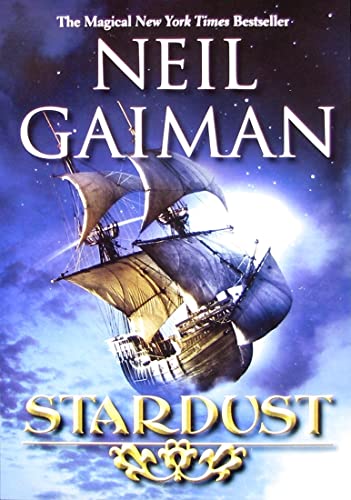
Cover of Stardust by Neil Gaiman

Stardust

Neil Gaiman, 1997