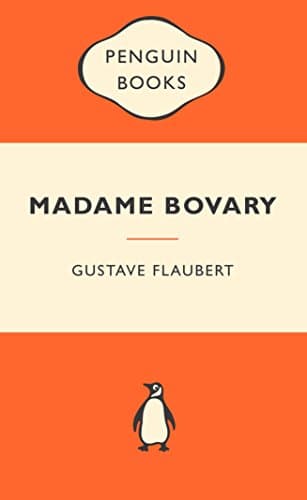
Gustave Flaubert's "Madame Bovary" is the classic tale of its title character, Emma Bovary, the second wife of Charles Bovary, a well meaning yet plodding and clumsy doctor. Emma is an educated young woman who longs for the luxury and romance that she reads about in the popular novels of the day. When the two attend an elegant ball given by the Marquis d'Andervilliers, her longing for something more than the dullness provided by her own marriage can no longer be contained. In order to escape the banalities and emptiness of her everyday life a series of adulterous affairs ensue. "Madame Bovary" is considered by many as one of the greatest novels ever written. Although it was attacked for obscenity when it first appeared in Paris in 1856, "Madame Bovary" became an instant success for the author. Flaubert's quest for literary perfection is greatly exemplified in the craft of this work, which has been heralded as a seminal work of literary realism. This edition is printed on premium acid-free paper, follows the translation of Eleanor Marx-Aveling, and includes an introduction by Ferdinand Brunetière.
Add to your library to track progress and write reviews
Find Madame Bovary Gustave Flaubert in PDF, EPUB, ebook, audiobook, print, or library editions.

3 books in catalog
The development of nineteenth-century literary realism was fundamentally shaped by the publication of Madame Bovary in 1857, a novel depicting bourgeois provincial life with dispassionate psychological accuracy. French writer Gustave Flaubert created this masterpiece after years of painstaking drafting, setting a new standard for narrative objectivity and prose composition in modern fiction.
Born on December 12, 1821, in Rouen, France, Gustave Flaubert grew up in the hospital where his father served as chief surgeon. He began writing plays, historical narratives, and early texts as a child before devoting his adult life entirely to literary craft. His debut novel, Madame Bovary, brought him immediate prominence and an unsuccessful prosecution for obscenity in 1857. Over the following decades, he published major works such as the historical novel Salammbô and the contemporary Parisian narrative Sentimental Education. Flaubert maintained an extensive correspondence, including thousands of detailed letters, and served as a dedicated mentor to younger writers such as Guy de Maupassant.
Known for extreme stylistic precision, Flaubert spent days polishing individual pages to achieve aesthetic cadences, exact word choice, and structural harmony. His writing combines detailed observation of everyday social experiences with a commitment to authorial objectivity. In works like his posthumously published comic novel Bouvard and Pecuchet, he explored human fallibility, bourgeois pretension, and the limits of intellectual ambition while avoiding overt moralizing or sentimentality.