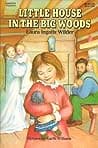
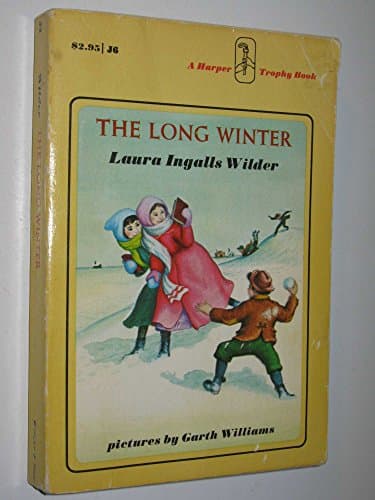
The first in a series of truly charming tales of life on the early American frontier, Little House in the Big Woods introduces us to Laura Ingalls, her Ma and Pa, big sister Mary and Baby Carrie. She lives in an isolated cabin in the Big Woods of Wisconsin and spends her days helping Ma with household chores, learning how to care for a house, farm and family. The descriptions of typical activities on a farm in that era will captivate the imaginations of young and old alike. This series also contains the titles Little House on the Prairie, On The Banks of Plum Creek, By the Shores of Silver Lake, The Long Winter, Farmer Boy, Little Town on the Prairie, These Happy Golden Years, and The First Four Years. They inspired the popular, 1970s television series Little House on the Prairie.
The first in a series of truly charming tales of life on the early American frontier, Little House in the Big Woods introduces us to Laura Ingalls, her Ma and Pa, big sister Mary and Baby Carrie. She lives in an isolated cabin in the Big Woods of Wisconsin and spends her days helping Ma with household chores, learning how to care for a house, farm and family. The descriptions of typical activities on a farm in that era will captivate the imaginations of young and old alike. This series also contains the titles Little House on the Prairie, On The Banks of Plum Creek, By the Shores of Silver Lake, The Long Winter, Farmer Boy, Little Town on the Prairie, These Happy Golden Years, and The First Four Years. They inspired the popular, 1970s television series Little House on the Prairie.
Add to your library to track progress and write reviews
Add to your library to track progress and write reviews
Find Little House in the Big Woods Laura Ingalls Wilder in PDF, EPUB, ebook, audiobook, print, or library editions.
Find Little House in the Big Woods Laura Ingalls Wilder in PDF, EPUB, ebook, audiobook, print, or library editions.
2 books in catalog
American frontier life in the nineteenth century found lasting narrative representation in the autobiographical children's fiction series Little House on the Prairie, published between 1932 and 1943. Laura Ingalls Wilder drew directly from her youth in a pioneer family to document the realities of homesteading, farming, and community building across the American Midwest. The popular books later served as the basis for the adaptation television series Little House on the Prairie during the 1970s and early 1980s.
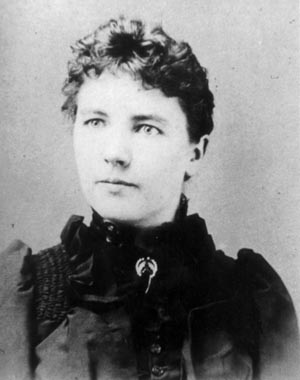
Born Laura Elizabeth Ingalls in Wisconsin in 1867 to Charles and Caroline Ingalls, she spent her childhood traveling with her family as they relocated across the frontier. Their journeys took them through Wisconsin, Kansas, Indian Territory, Iowa, Minnesota, and South Dakota, where the family took up a homestead in De Smet. In these rural environments, homesteading families endured severe weather, grueling physical labor, isolated living conditions, and natural disasters. At age fifteen, she began teaching in rural schools to assist her family financially. She married Almanzo J. Wilder in 1885, and in 1894 they established a permanent farm in Mansfield, Missouri, where she worked as a journalist and writer. Encouraged by her daughter, she began transforming her early memories into prose, publishing Little House in the Big Woods in 1932 and concluding her multi-volume book series in 1943. She lived in Mansfield until her death in 1957 at age ninety.
Wilder wrote with a clear focus on detailed daily routines, describing pioneer survival, family cooperation, and the changing landscape of the American Midwest. Her narratives blend personal recollections with framed historical fiction, chronicling both the beauty and the severe hardships of pioneer living. While her works recount historical events, Wilder noted that her accounts contained factual truths shaped into structured narratives. Her realistic depictions of winter blizzards, agricultural work, rural schoolhouses, and family resilience provide young readers with an intimate window into frontier history.
2 books in catalog
American frontier life in the nineteenth century found lasting narrative representation in the autobiographical children's fiction series Little House on the Prairie, published between 1932 and 1943. Laura Ingalls Wilder drew directly from her youth in a pioneer family to document the realities of homesteading, farming, and community building across the American Midwest. The popular books later served as the basis for the adaptation television series Little House on the Prairie during the 1970s and early 1980s.
Born Laura Elizabeth Ingalls in Wisconsin in 1867 to Charles and Caroline Ingalls, she spent her childhood traveling with her family as they relocated across the frontier. Their journeys took them through Wisconsin, Kansas, Indian Territory, Iowa, Minnesota, and South Dakota, where the family took up a homestead in De Smet. In these rural environments, homesteading families endured severe weather, grueling physical labor, isolated living conditions, and natural disasters. At age fifteen, she began teaching in rural schools to assist her family financially. She married Almanzo J. Wilder in 1885, and in 1894 they established a permanent farm in Mansfield, Missouri, where she worked as a journalist and writer. Encouraged by her daughter, she began transforming her early memories into prose, publishing Little House in the Big Woods in 1932 and concluding her multi-volume book series in 1943. She lived in Mansfield until her death in 1957 at age ninety.
Wilder wrote with a clear focus on detailed daily routines, describing pioneer survival, family cooperation, and the changing landscape of the American Midwest. Her narratives blend personal recollections with framed historical fiction, chronicling both the beauty and the severe hardships of pioneer living. While her works recount historical events, Wilder noted that her accounts contained factual truths shaped into structured narratives. Her realistic depictions of winter blizzards, agricultural work, rural schoolhouses, and family resilience provide young readers with an intimate window into frontier history.
Unsere kleine Farm
Unsere kleine Farm