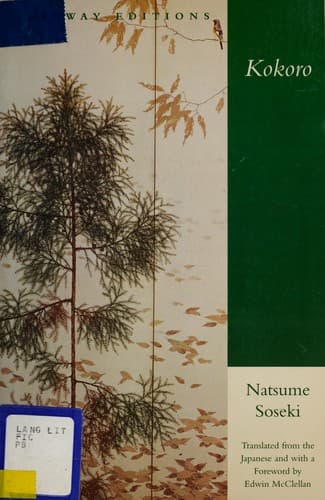
Natsume Soseki's importance to Japanese literature can be compared to that of Dickens to Britain or Henry James to America. Like these writers, his work now holds a hugely popular and important place in the literary imagination of his country. Unlike them, his work is only recently coming to the attention of readers from overseas. "Kokoro" joins the recent publications of "The Gate", "The Tower of London" and "the Three Cornered World" from Peter Owen as part of an international programme to bring one of Japan's best known authors to a new English speaking audience. As Damian Flanagan says in his new critical introduction "Kokoro" is the Soseki novel that has been given most attention by critics and the public in Japan. On one level, a meditation on the changing face of Japanese culture and its attitudes to honour, friendship, love, death, it is also a sly subversion of all of these things. The novel centres around the friendship between the narrator and the man he calls Sensei, who is haunted by mysterious events in his past. As the friendship grows and the narrator gets to know more about the man he so admires he is increasingly intrigued by this hidden history. The Sensei, however, refuses to reveal anything until the third part of the book when the narrator is called away to look after his sick father and the truth is revealed in tragic circumstances, etching itself onto the narrator - and the reader's - "Kokoro" : Heart.
Natsume Soseki's importance to Japanese literature can be compared to that of Dickens to Britain or Henry James to America. Like these writers, his work now holds a hugely popular and important place in the literary imagination of his country. Unlike them, his work is only recently coming to the attention of readers from overseas. "Kokoro" joins the recent publications of "The Gate", "The Tower of London" and "the Three Cornered World" from Peter Owen as part of an international programme to bring one of Japan's best known authors to a new English speaking audience. As Damian Flanagan says in his new critical introduction "Kokoro" is the Soseki novel that has been given most attention by critics and the public in Japan. On one level, a meditation on the changing face of Japanese culture and its attitudes to honour, friendship, love, death, it is also a sly subversion of all of these things. The novel centres around the friendship between the narrator and the man he calls Sensei, who is haunted by mysterious events in his past. As the friendship grows and the narrator gets to know more about the man he so admires he is increasingly intrigued by this hidden history. The Sensei, however, refuses to reveal anything until the third part of the book when the narrator is called away to look after his sick father and the truth is revealed in tragic circumstances, etching itself onto the narrator - and the reader's - "Kokoro" : Heart.
Add to your library to track progress and write reviews
Add to your library to track progress and write reviews
Find Kokoro Natsume Sōseki in PDF, EPUB, ebook, audiobook, print, or library editions.
Find Kokoro Natsume Sōseki in PDF, EPUB, ebook, audiobook, print, or library editions.

2 books in catalog
Satirical narrative perspective and psychological realism transformed twentieth-century Japanese fiction, best exemplified by the celebrated novel Kokoro. Natsume Sōseki, born Natsume Kinnosuke, created a pivotal body of work that bridged classic Asian aesthetic traditions and early modern Western literature.
Born on February 9, 1867, near the end of the Tokugawa shogunate epoch, Sōseki grew up during Japan's transformation into the Meiji era (1868–1912). After enduring a turbulent childhood during which he was given up for adoption, he became an accomplished scholar of British literature and classical Chinese texts before committing to full-time writing between 1905 and 1916.
Transitioning from academic scholarship to creative fiction, Sōseki published his debut novel I Am a Cat in 1905, followed by popular works including Botchan in 1906 and Sanshirō in 1908. In addition to his long-form novels, he was a prolific writer of haiku, composer of kanshi poetry, and author of fairy tales. His widespread cultural significance led to his portrait appearing on the Japanese 1,000 yen note from 1984 to 2004.
Sōseki's fiction focused heavily on individualism, egoism, emotional loneliness, and the tension between traditional Japanese values and rapid Westernization. His literary technique combined traditional classical Chinese learning, English narrative structure, and sharp psychological observation, allowing his characters to navigate the anxieties of modern life.
2 books in catalog
Satirical narrative perspective and psychological realism transformed twentieth-century Japanese fiction, best exemplified by the celebrated novel Kokoro. Natsume Sōseki, born Natsume Kinnosuke, created a pivotal body of work that bridged classic Asian aesthetic traditions and early modern Western literature.
Born on February 9, 1867, near the end of the Tokugawa shogunate epoch, Sōseki grew up during Japan's transformation into the Meiji era (1868–1912). After enduring a turbulent childhood during which he was given up for adoption, he became an accomplished scholar of British literature and classical Chinese texts before committing to full-time writing between 1905 and 1916.
Transitioning from academic scholarship to creative fiction, Sōseki published his debut novel I Am a Cat in 1905, followed by popular works including Botchan in 1906 and Sanshirō in 1908. In addition to his long-form novels, he was a prolific writer of haiku, composer of kanshi poetry, and author of fairy tales. His widespread cultural significance led to his portrait appearing on the Japanese 1,000 yen note from 1984 to 2004.
Sōseki's fiction focused heavily on individualism, egoism, emotional loneliness, and the tension between traditional Japanese values and rapid Westernization. His literary technique combined traditional classical Chinese learning, English narrative structure, and sharp psychological observation, allowing his characters to navigate the anxieties of modern life.