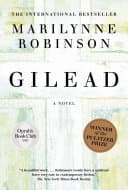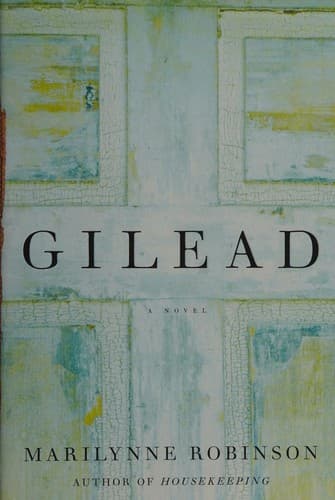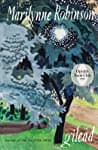
WINNER OF THE 2005 PULITZER PRIZE FOR FICTION.
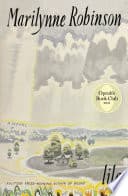
In 1956, toward the end of Reverend John Ames’s life, he begins a letter to his young son, an account of himself and his forebears. Ames is the son of an Iowan preacher and the grandson of a minister who, as a young man in Maine, saw a vision of Christ bound in chains and came west to Kansas to fight for abolition: He “preached men into the Civil War,” then, at age fifty, became a chaplain in the Union Army, losing his right eye in battle.
Reverend Ames writes to his son about the tension between his father—an ardent pacifist—and his grandfather, whose pistol and bloody shirts, concealed in an army blanket, may be relics from the fight between the abolitionists and those settlers who wanted to vote Kansas into the union as a slave state. And he tells a story of the sacred bonds between fathers and sons, which are tested in his tender and strained relationship with his namesake, John Ames Boughton, his best friend’s wayward son.
Gilead is the long-hoped-for second novel by one of our finest writers, a hymn of praise and lamentation to the God-haunted existence that Reverend Ames loves passionately, and from which he will soon part. Robinson gives us an intimate tale of three generations from the Civil War to the twentieth century: a story about fathers and sons and the spiritual battles that still rage at America's heart. Writing in the tradition of Emily Dickinson and Walt Whitman, Robinson's beautiful, spare, and spiritual prose allows "even the faithless reader to feel the possibility of transcendent order" (Slate). In the luminous and unforgettable voice of Congregationalist minister John Ames, Gilead reveals the human condition and the often unbearable beauty of an ordinary life.
Add to your library to track progress and write reviews
Find Gilead Marilynne Robinson in PDF, EPUB, ebook, audiobook, print, or library editions.
Gilead
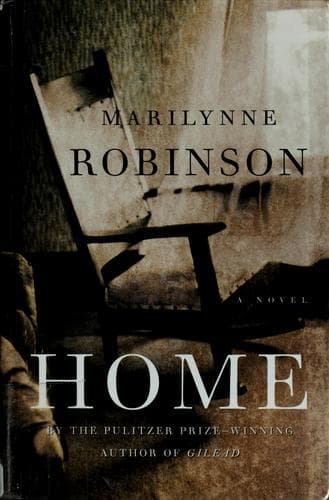

5 books in catalog
Profound explorations of faith, family, and spiritual transcendence in small-town American life define the fictional universe of the Gilead series, starting with the Pulitzer Prize-winning novel Gilead. American novelist and essayist Marilynne Robinson has built a celebrated body of work through quiet, deeply meditative prose that examines moral accountability, memory, and grace in everyday human existence.
Born Marilynne Summers on November 26, 1943, in Sandpoint, Idaho, she earned a Bachelor of Arts from Brown University and a PhD from the University of Washington. She published her debut novel, Housekeeping, in 1980, winning the PEN/Hemingway Award and earning a nomination for the Pulitzer Prize. Robinson began teaching at the Iowa Writers' Workshop in 1991, where she mentored generations of writers before her retirement in the spring of 2016. Across her writing career, she has received numerous honours, including the Pulitzer Prize for Fiction in 2005, the National Humanities Medal in 2012, and the 2016 Library of Congress Prize for American Fiction. In 2016, Robinson was also named in Time magazine's list of 100 most influential people.
Robinson's fiction and non-fiction feature luminous, plain-spoken language that balances rigorous intellectual thought with emotional resonance. Deeply informed by Calvinist theology and mainline Protestant traditions, her work uses religion as a framing mechanism to explore moral orientation, community, and human dignity. Her non-fiction works, including Mother Country (1989), The Death of Adam (1998), Absence of Mind (2010), When I Was a Child I Read Books (2012), and The Givenness of Things (2015), critique modern social thought and examine spiritual inwardness with clarity and ethical commitment.