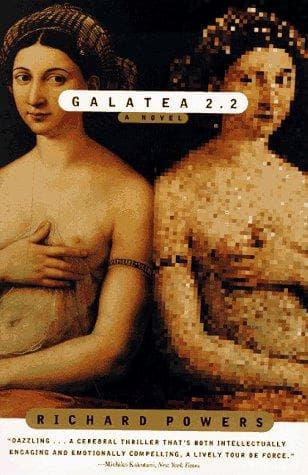
Read this thrilling and timely novel of the human soul from the Pulitzer Prize-winning author of The Overstory. After many years of living abroad, a young writer returns to the United States to take up a position at his former college. There he encounters Philip Lentz, an outspoken neurologist intent on using computers to model the human brain. Lentz involves the writer in an outlandish and irresistible project - to train a computing system by reading a canonical list of Great Books. Through repeated tutorials, the machine grows gradually more worldly, until it demands to know its own age, sex, race and reason for existing. 'An ingenious, ambitious, at times dizzily cerebral work... It soars and spins... The novel attains an aching, melancholy beauty' New York Times
Add to your library to track progress and write reviews
Find Galatea 2.2 Richard Powers in PDF, EPUB, ebook, audiobook, print, or library editions.

3 books in catalog
Exploring the intricate intersections of modern science, technology, music, and the natural world, fiction that bridges human emotion and intellectual discipline has redefined contemporary American literature. Richard Powers has constructed a sprawling body of work that addresses complex topics ranging from artificial intelligence to forest ecology, earning the 2019 Pulitzer Prize for Fiction for his environmental novel The Overstory.
Born on June 18, 1957, in Evanston, Illinois, Richard Powers developed an early interest in both the humanities and the sciences. He pursued his higher education at the University of Illinois, where he later served as the CAS and Swanlund Professor of English. Over the course of his career, he has held academic appointments at both the University of Illinois and Stanford University while producing fourteen novels.
Throughout his career, Powers has received significant critical recognition, including a MacArthur Fellowship, the James Fenimore Cooper Prize for Historical Fiction, a Lannan Literary Award, and four nominations as a National Book Critics Circle Award finalist. His 2006 novel The Echo Maker won the National Book Award for Fiction and was a finalist for the Pulitzer Prize, while his 2018 novel The Overstory secured the 2019 Pulitzer Prize for Fiction. He currently resides in the foothills of the Great Smoky Mountains.
Powers is noted for employing complex, multi-layered narrative structures that connect diverse academic disciplines, including genomics, game theory, artificial intelligence, virtual reality, photography, and music. His prose examines how human beings navigate large systemic networks, exploring the tension between individual connection and systemic dislocation.
A recurring theme across his fiction is the human reliance on technological systems and the ethical implications of technological and environmental changes. By embedding scientific principles within deeply character-driven narratives, Powers investigates neurology, memory, machine consciousness, and ecological interdependence.