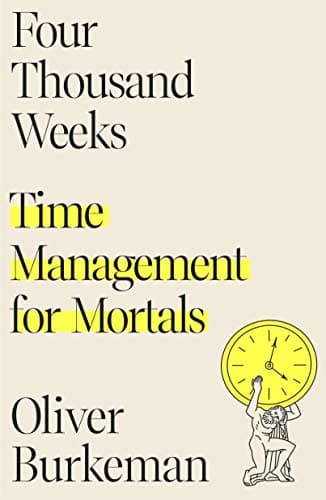
The average human lifespan is absurdly, outrageously, insultingly brief: if you live to 80, you have about four thousand weeks on earth. How should we use them best?
Of course, nobody needs telling that there isn't enough time. We're obsessed by our lengthening to-do lists, our overfilled inboxes, the struggle against distraction, and the sense that our attention spans are shrivelling. Yet we rarely make the conscious connection that these problems only trouble us in the first place thanks to the ultimate time-management problem: the challenge of how best to use our four thousand weeks.
Four Thousand Weeks is an uplifting, engrossing and deeply realistic exploration of this problem. Rejecting the futile modern obsession with 'getting everything done,' it introduces readers to tools for constructing a meaningful life, showing how the unhelpful ways we've come to think about time aren't inescapable, unchanging truths, but choices we've made, as individuals and as a society - and its many revelations will transform the reader's worldview.
Drawing on the insights of both ancient and contemporary philosophers, psychologists, and spiritual teachers, Oliver Burkeman sets out to realign our relationship with time - and in doing so, to liberate us from its grasp.
Add to your library to track progress and write reviews
Find Four Thousand Weeks: Time Management for Mortals Oliver Burkeman in PDF, EPUB, ebook, audiobook, print, or library editions.

2 books in catalog
Philosophical investigations into productivity and time management offer a grounded counterweight to conventional self-help narratives by examining the reality of human finitude. Oliver Burkeman established a distinct presence in contemporary non-fiction by encouraging readers to embrace their natural limitations rather than striving for impossible efficiency, a perspective popularized in his bestselling book Four Thousand Weeks: Time Management for Mortals.
Through long-running journalism and widely read books, Burkeman's work addresses the psychological friction of modern living. His writing provides accessible, counterintuitive insights into productivity, mortality, and happiness without relying on rigid motivational formulas.
Born in 1975 in Liverpool, England, Burkeman attended Huntington School in York before studying at the University of Cambridge. He began his career in journalism, serving for many years as a feature writer and columnist for The Guardian. There he wrote the popular weekly psychology column 'This Column Will Change Your Life', where he critically examined self-improvement theories, mindfulness, and practical philosophy. Over his career, he has also contributed to publications such as The Observer and The New York Times.
Burkeman published early non-fiction books including Help! How to Become Slightly Happier and Get a Bit More Done and The Antidote: Happiness for People Who Can't Stand Positive Thinking. After living in Brooklyn for a decade, he shifted toward writing full-length books and publishing The Imperfectionist, a twice-monthly email newsletter focusing on mortality, attention, and building a meaningful life amidst modern distractions.
Burkeman's writing style blends journalistic reporting, psychological research, and practical philosophy with a dry, humorous tone. Rather than promising total control over time or emotions, his work centers on the concept of 'the power of limits'—arguing that accepting uncertainty, insecurity, and impermanence leads to greater mental clarity and fulfillment.
A recurring theme across his books and essays is the critique of relentless positivity and obsessive productivity. By encouraging readers to confront uncomfortable truths—such as the brevity of an average human lifespan—Burkeman advocates for choosing what truly matters and letting go of the illusion that everything can be accomplished.