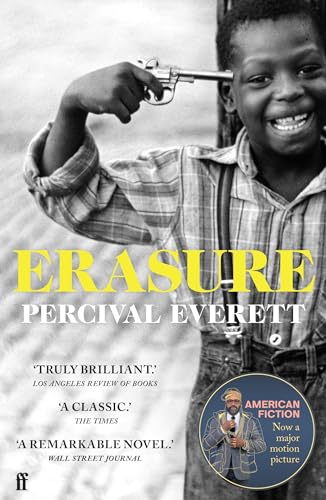
Thelonius "Monk" Ellison is an erudite, accomplished but seldom-read author who insists on writing obscure literary papers rather than the so-called "ghetto prose" that would make him a commercial success. He finally succumbs to temptation after seeing the Oberlin-educated author of We's Lives in da Ghetto during her appearance on a talk show, firing back with a parody called My Pafology, which he submits to his startled agent under the gangsta pseudonym of Stagg R. Leigh.
Ellison quickly finds himself with a six-figure advance from a major house, a multimillion-dollar offer for the movie rights and a monster bestseller on his hands. The money helps with a family crisis, allowing Ellison to care for his widowed mother as she drifts into the fog of Alzheimer's, but it doesn't ease the pain after his sister, a physician, is shot by right-wing fanatics for performing abortions. The dark side of wealth surfaces when both the movie mogul and talk-show host demand to meet the nonexistent Leigh, forcing Ellison to don a disguise and invent a sullen, enigmatic character to meet the demands of the market. The final indignity occurs when Ellison becomes a judge for a major book award and My Pafology (title changed to Fuck) gets nominated, forcing the author to come to terms with his perverse literary joke. Percival's talent is multifaceted, sparked by a satiric brilliance that could place him alongside Wright and Ellison as he skewers the conventions of racial and political correctness.
Thelonius "Monk" Ellison is an erudite, accomplished but seldom-read author who insists on writing obscure literary papers rather than the so-called "ghetto prose" that would make him a commercial success. He finally succumbs to temptation after seeing the Oberlin-educated author of We's Lives in da Ghetto during her appearance on a talk show, firing back with a parody called My Pafology, which he submits to his startled agent under the gangsta pseudonym of Stagg R. Leigh.
Ellison quickly finds himself with a six-figure advance from a major house, a multimillion-dollar offer for the movie rights and a monster bestseller on his hands. The money helps with a family crisis, allowing Ellison to care for his widowed mother as she drifts into the fog of Alzheimer's, but it doesn't ease the pain after his sister, a physician, is shot by right-wing fanatics for performing abortions. The dark side of wealth surfaces when both the movie mogul and talk-show host demand to meet the nonexistent Leigh, forcing Ellison to don a disguise and invent a sullen, enigmatic character to meet the demands of the market. The final indignity occurs when Ellison becomes a judge for a major book award and My Pafology (title changed to Fuck) gets nominated, forcing the author to come to terms with his perverse literary joke. Percival's talent is multifaceted, sparked by a satiric brilliance that could place him alongside Wright and Ellison as he skewers the conventions of racial and political correctness.
Add to your library to track progress and write reviews
Find Erasure Percival Everett in PDF, EPUB, ebook, audiobook, print, or library editions.

2 books in catalog
Satirical fiction, philosophical parables, revisionist westerns, and reimagined American classics reflect a wide range of storytelling traditions, notably seen in novels like Erasure and James. Percival Everett has built an extensive bibliography across multiple decades, consistently examining issues of race, identity, logic, and literary form in the United States while defying traditional genre boundaries.
Born in Fort Gordon, Georgia, in 1956 and raised in Columbia, South Carolina, Everett earned a bachelor's degree in philosophy from the University of Miami before completing graduate coursework in philosophy at the University of Oregon and earning a Master of Arts in fiction from Brown University in 1982. He subsequently joined academia, serving on the faculties of the University of Kentucky, the University of Notre Dame, and the University of California, Riverside, before becoming a Distinguished Professor of English at the University of Southern California. In his university role, he teaches courses in creative writing, American studies, and critical theory, describing himself as a demanding instructor who learns alongside his students. Over his career, he has earned prestigious recognition, including the Academy Award for Literature of the American Academy of Arts and Letters, the New American Writing Award for his 1990 novel Zulus, the PEN/Oakland-Josephine Miles Award for Excellence in Literature for his 1996 story collection Big Picture, the Hurston/Wright Legacy Award for his 2001 novel Erasure, and the PEN USA 2006 Literary Award for his 2005 novel Wounded. Additionally, he served as a judge for the PEN/Faulkner Award for Fiction in 1991 and the 1997 National Book Award for fiction.
Characterized by structural experimentation and ironical humor, Everett's writing spans a remarkable range of forms, including a farcical Western, a savage satire of the publishing industry, a children's story spoofing counting books, retellings of Greek myths involving Medea and Dionysus, and a philosophical tract narrated by a four-year-old child. Critics have frequently noted his adventurous narrative approach; The Washington Post described him as 'one of the most adventurously experimental of modern American novelists,' while The Boston Globe wrote that 'He's literature's NASCAR champion, going flat out, narrowly avoiding one seemingly inevitable crash only to steer straight for the next.' Everett writes extensively about subjects that provoke his curiosity, frequently blending semiotics, critical theory, absurd humor, and sharp social commentary to challenge readers' expectations regarding African American identity and cultural categorization.

2 books in catalog
Satirical fiction, philosophical parables, revisionist westerns, and reimagined American classics reflect a wide range of storytelling traditions, notably seen in novels like Erasure and James. Percival Everett has built an extensive bibliography across multiple decades, consistently examining issues of race, identity, logic, and literary form in the United States while defying traditional genre boundaries.
Born in Fort Gordon, Georgia, in 1956 and raised in Columbia, South Carolina, Everett earned a bachelor's degree in philosophy from the University of Miami before completing graduate coursework in philosophy at the University of Oregon and earning a Master of Arts in fiction from Brown University in 1982. He subsequently joined academia, serving on the faculties of the University of Kentucky, the University of Notre Dame, and the University of California, Riverside, before becoming a Distinguished Professor of English at the University of Southern California. In his university role, he teaches courses in creative writing, American studies, and critical theory, describing himself as a demanding instructor who learns alongside his students. Over his career, he has earned prestigious recognition, including the Academy Award for Literature of the American Academy of Arts and Letters, the New American Writing Award for his 1990 novel Zulus, the PEN/Oakland-Josephine Miles Award for Excellence in Literature for his 1996 story collection Big Picture, the Hurston/Wright Legacy Award for his 2001 novel Erasure, and the PEN USA 2006 Literary Award for his 2005 novel Wounded. Additionally, he served as a judge for the PEN/Faulkner Award for Fiction in 1991 and the 1997 National Book Award for fiction.
Characterized by structural experimentation and ironical humor, Everett's writing spans a remarkable range of forms, including a farcical Western, a savage satire of the publishing industry, a children's story spoofing counting books, retellings of Greek myths involving Medea and Dionysus, and a philosophical tract narrated by a four-year-old child. Critics have frequently noted his adventurous narrative approach; The Washington Post described him as 'one of the most adventurously experimental of modern American novelists,' while The Boston Globe wrote that 'He's literature's NASCAR champion, going flat out, narrowly avoiding one seemingly inevitable crash only to steer straight for the next.' Everett writes extensively about subjects that provoke his curiosity, frequently blending semiotics, critical theory, absurd humor, and sharp social commentary to challenge readers' expectations regarding African American identity and cultural categorization.