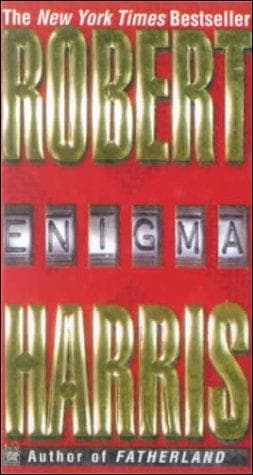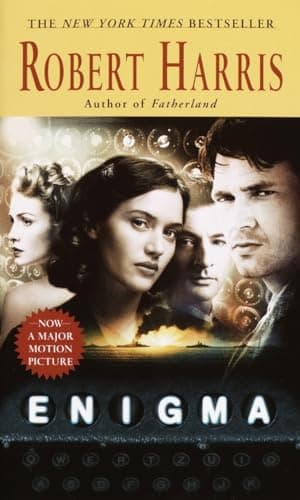
England 1943. Much of the infamous Nazi Enigma code has been cracked. But Shark, the impenetrable operational cipher used by Nazi U-boats, has masked the Germans' movements, allowing them to destroy a record number of Allied vessels. Feeling that the lives of Allied sailors are in their hands, a top-secret team of British cryptographers works feverishly around the clock to break Shark. And when brilliant mathematician Tom Jericho succeeds, it is the stuff of legend. . . .
Until the unthinkable happens: the Germans have somehow learned that Shark has been cracked. And they've changed the code. . . .
As an Allied convoy crosses the U-boat infested North Atlantic . . . as Jericho's ex-lover Claire disappears amid accusations that she is a Nazi collaborator . . . as Jericho strains his last resources to break Shark again, he cannot escape the ultimate truth: There is a traitor among them. . . .
Add to your library to track progress and write reviews
Find Enigma Robert Harris in PDF, EPUB, ebook, audiobook, print, or library editions.

2 books in catalog
Historical fiction and political thrillers centered on power, intelligence, and institutional secrets form the foundation of a widely read body of work. Robert Harris established his fiction career with the 1992 alternate-history thriller Fatherland, setting a benchmark for detailed historical research combined with narrative suspense.
His novels span ancient Rome, World War II intelligence battles, modern political intrigue, and speculative scenarios. Key works such as Enigma and Conclave highlight his focus on high-stakes decision-making behind closed doors.
Born on March 7, 1957, in Nottingham, England, Robert Dennis Harris grew up in a council house and later graduated from the University of Cambridge. He began his career in journalism, working as a television reporter on the BBC programs Newsnight and Panorama. He subsequently served as political editor of The Observer and wrote columns for The Sunday Times and The Daily Telegraph, alongside authoring five non-fiction books.
While working on a proposed biography of author John le Carré that was ultimately abandoned, Harris decided to write his first novel, Fatherland. Its publication in 1992 launched a fiction career that includes sixteen bestselling novels, such as Archangel, Pompeii, The Ghost, The Fear Index, Munich, The Second Sleep, V2, Act of Oblivion, and Precipice. His books have sold over fifteen million copies, been translated into forty languages, and yielded nine cinema and television adaptations. His novel An Officer and a Spy won four awards, including the Walter Scott Prize for Historical Fiction. Harris lives in West Berkshire with his wife, Gill Hornby.
Harris's writing style blends rigorous historical research with the pacing of modern political thrillers. His work frequently examines state secrecy, espionage, electoral intrigue, and moral compromise during periods of extreme crisis. Whether portraying ancient statesmen or twentieth-century codebreakers, his narratives emphasize the internal procedures, human frailties, and hidden power struggles that shape major historical events.