§Synopsis
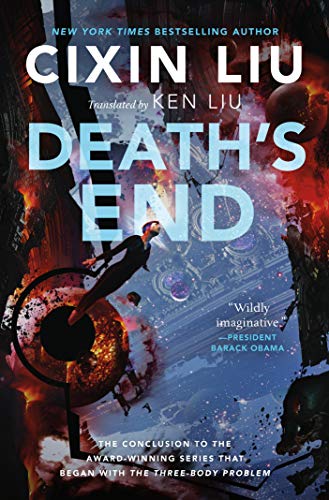
01Half a century after the Doomsday Battle, the uneasy balance of Dark Forest Deterrence keeps the Trisolaran invaders at bay. Earth enjoys unprecedented prosperity due to the infusion of Trisolaran knowledge. With human science advancing daily and the Trisolarans adopting Earth culture, it seems that the two civilizations will soon be able to co-exist peacefully as equals without the terrible threat of mutually assured annihilation. But the peace has also made humanity complacent.
Cheng Xin, an aerospace engineer from the early twenty-first century, awakens from hibernation in this new age. She brings with her knowledge of a long-forgotten program dating from the beginning of the Trisolar Crisis, and her very presence may upset the delicate balance between two worlds. Will humanity reach for the stars or die in its cradle?
§Our take
Death's End is a grand finale that keeps enlarging the universe while its human beings grow conspicuously small, and that tension is both the pleasure and the problem. NPR's Jason Heller calls it a satisfying close whose ending pays off the trilogy, even if the dense science and politics can read like nonfiction. The book's scale is enormous; its human scale is not.
Michael A. Morrison, writing in World Literature Today, thinks that ambition outruns Liu's novelistic skill, while Peter Berard finds the characters thin once the action leaves Earth and the allegory heavy-handed. Ken Liu's return as translator brings the prose back into smoother shape. Read it for the ideas and the scale, not for conventional character development.
§Themes
- Survival outranks morality
- The dark forest premise hardens into a rule: every civilization may be a threat, so survival can outrank moral restraint.
- Scale devours the cast
- Hibernation stretches the story across centuries, so the cast changes while the characters increasingly serve as vessels for ideas.
- Compassion under trial
- Some critics read Cheng Xin's compassion as liability; others see a critique of leadership rather than a gender-essentialist stereotype.
- Physics as a weapon
- Scientific knowledge becomes strategic leverage, and even the laws of physics can be weaponized.
- Fairy tales with hidden freight
- Nested stories carry cosmic information, turning folklore into part of the book's hard-SF machinery.
§How it was received
NPR's Jason Heller called it a satisfying close that pays off the trilogy, while Kirkus praised its moral and cosmic scope but found little interest in linear plot or conventional character interaction. Later critics were sharper about the cast: World Literature Today's Michael A. Morrison found Cheng Xin underdeveloped, and Peter Berard in LARB called the characters thin and the gender logic essentialist. It won the 2017 Locus Award for Best Science Fiction Novel and was a finalist for that year's Hugo.
§Read it if
- You want the trilogy's cosmic argument paid off across centuries and don't mind a demanding finale
- You prefer hard-science concepts and moral dilemmas to conventional character intimacy
- You enjoy translated fiction, nested fairy tales and an ending readers can argue about
§Skip it if
- You want a character-led novel. Cheng Xin and the rotating cast are often described as passive, underdeveloped or thin.
- Dense exposition, jargon, long hibernation gaps and a very bleak late stretch make this a poor fit for readers who want a clean plot
§Before you start
- Reading experience
- Expect a stately pace: long hibernation gaps, dense science and politics, and a rotating cast make the middle demanding even when the concepts are moving fast.
- Reading order
- Book 3 and finale of Remembrance of Earth's Past, commonly called the Three-Body trilogy. Read The Three-Body Problem, then The Dark Forest, then Death's End; this volume follows aerospace engineer Cheng Xin across centuries. The Chinese original appeared in 2010, and Ken Liu's English translation was published by Tor in 2016.
- Content notes
- Very bleak tone; Mass destruction on a cosmic scale; Death-trap scenes that LARB's reviewer compares to torture-porn horror.
§Common questions
- Do I need to read the first two books?
- Yes. The finale pays off ideas from the first two books, and NPR says readers who skip them should expect to be lost.
- Is the ending hopeful or nihilistic?
- Readers disagree. NPR's Jason Heller hears a hopeful note after a grim trilogy; others find the close cold or nihilistic.
- Did Ken Liu translate all three books?
- No. He translated The Three-Body Problem and Death's End; Joel Martinsen translated The Dark Forest.
§If you liked this
- The Three-Body Problem / The Dark Forest by Cixin Liu — The two books to read first; they establish the dark forest premise that this finale pays off.
- The Player of Games by Iain M. Banks — Peter Berard uses Banks's utopian Culture as the opposite of Liu's grim survivalist universe; this is the friendliest way in.
- Exhalation by Ted Chiang — Ted Chiang's stories swap Liu's cosmic sprawl for compact thought experiments, but share his appetite for physics and philosophy.
Sources
- Wikipedia
- Wikipedia
- Wikipedia
- The Hugo Awards (official site)
- Wikipedia (Locus Award list)
- Kirkus Reviews
- NPR (republished by NHPR), review by Jason Heller, 27 Sept 2016
- World Literature Today, review by Michael A. Morrison (University of Oklahoma), Jan 2017
- Los Angeles Review of Books, essay by Peter Berard (19 May 2018)
- Grimdark Magazine, review by John Mauro
- Goodreads
Track this book
Add to your library to track progress and write reviews