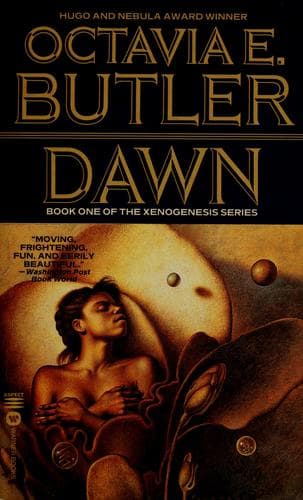
Lilith Iyapo has just lost her husband and son when atomic fire consumes Earth—the last stage of the planet’s final war. Hundreds of years later Lilith awakes, deep in the hold of a massive alien spacecraft piloted by the Oankali—who arrived just in time to save humanity from extinction. They have kept Lilith and other survivors asleep for centuries, as they learned whatever they could about Earth. Now it is time for Lilith to lead them back to her home world, but life among the Oankali on the newly resettled planet will be nothing like it was before.
The Oankali survive by genetically merging with primitive civilizations—whether their new hosts like it or not. For the first time since the nuclear holocaust, Earth will be inhabited. Grass will grow, animals will run, and people will learn to survive the planet’s untamed wilderness. But their children will not be human. Not exactly.
Add to your library to track progress and write reviews
Find Dawn Octavia E. Butler in PDF, EPUB, ebook, audiobook, print, or library editions.

5 books in catalog
Speculative fiction exploring power dynamics, human survival, and social transformation through a synthesis of science fiction, mythology, and African American experience marked the career of Octavia E. Butler. Best known for groundbreaking works such as Kindred and Parable of the Sower, Butler became one of the most prominent Black women writing science fiction, earning multiple Hugo, Locus, and Nebula awards during her life.
Born on June 22, 1947, in Pasadena, California, Octavia Estelle Butler was raised by her widowed mother and maternal grandmother after her father passed away. Extremely shy as a child, she found solace in libraries, reading fantasy and writing her own stories after deciding as a teenager that she could craft better fiction than the B-movies she watched on television. She attended Pasadena City College during the Black Power movement in the 1960s and later studied at California State University and the University of California, Los Angeles. While participating in a local writers workshop, she received encouragement from author Harlan Ellison to attend the Clarion Science Fiction Writers Workshop.
By the late 1970s, Butler had published her debut novel Patternmaster in 1976 and established a career as a full-time author. In 1995, she became the first science fiction writer to receive the MacArthur Foundation Grant. Throughout her career, she taught writing workshops and received a PEN Lifetime Achievement Award before eventually relocating to Washington state. Butler passed away in Seattle on February 24, 2006, at age 58 following a stroke. Her papers and literary manuscripts are preserved in the research collection at the Huntington Library in San Marino, California.
Butler's writing blends hard science fiction concepts with African American spiritualism, mythology, and psychological realism. Her works consistently explore themes of empathy, biological compromise, social hierarchy, and human adaptability under extreme environmental or social stress. Rather than relying on utopian tropes, she examined the difficult concessions required for community survival and the complex dynamics of power, consent, and bodily autonomy.
Xenogenesis