SSansFiction
The libraryCollectionsJournalStatsFor authors
Sign inJoin now
Sansfiction,

A digital library for books. Made by readers, for readers.

v 2.0 · 2026
The library
  • Discover
  • Collections
  • Book tracker
  • Journal
  • Stats
For authors
  • SF Links
  • Analytics
  • How it works
  • FAQ
Elsewhere
  • X / @sansfiction
  • Privacy
  • Terms
  • Contact
© 2026 SansFiction · Digital · GlobalA quiet room for your reading life.
The libraryCollectionsJournalStatsFor authors
Sign inJoin now →
Navigation
Library
Bookshelf
Journal
Discover
Collections
Tierlists
Stats
Profile
Author Page
Link Builder
Account
Sign in
S
G
BooksadventureArtemis
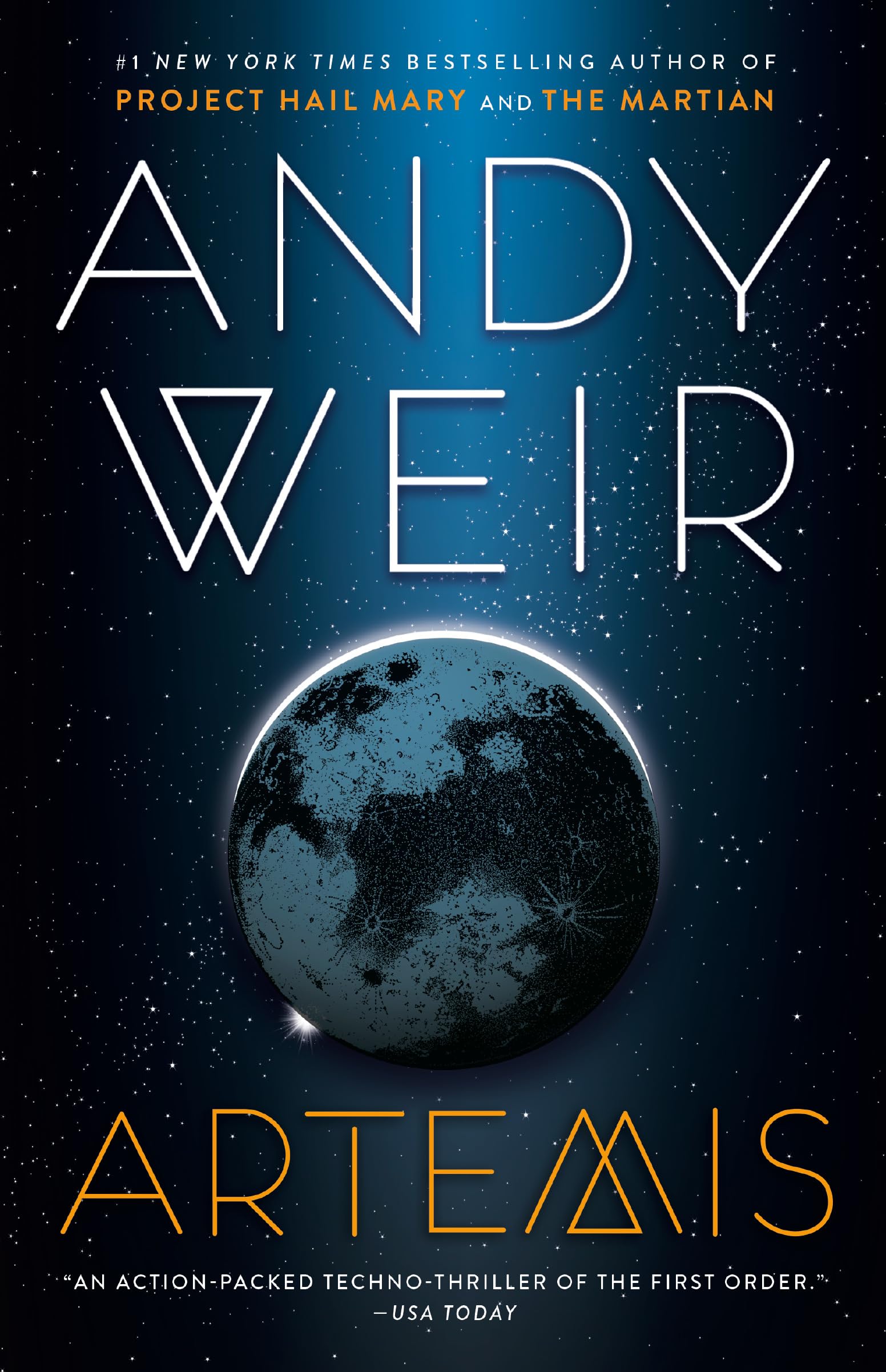
Cover of Artemis by Andy Weir

Artemis,

by Andy Weir

Ask AI
Rating3.6/ 5
Ratings1,614
Pages305
Reading Hours6h
Published2015
LanguageEnglish

§Synopsis

01

Artemis is not a pristine space utopia; it is a frontier town defined by the harsh realities of lunar economics and the crushing weight of its own gravity—or lack thereof. Located in the Sea of Tranquility, the city functions as a precarious ecosystem where oxygen is a commodity and living space is measured in centimeters. For Jasmine "Jazz" Bashara, survival in this pressurized environment requires a delicate balance between her legitimate job as a porter and her more lucrative side-hustle as a small-time smuggler.

The narrative explores the friction between the wealthy tourists in high-end bubbles and the working class living in "coffins"—capsule domiciles barely large enough to sit up in. When Jazz is offered a life-changing sum of money to commit a high-stakes act of industrial sabotage, the story shifts from a struggle for daily subsistence to a complex mechanical and political puzzle. It is a study of how human greed and ingenuity translate to a world where a single technical error doesn't just result in failure, but in total atmospheric collapse.

The Mechanics of Lunar Society

The world-building in Artemis is grounded in rigorous hard science and plausible economic theory. The city is composed of five interconnected spheres, or "bubbles," each named after an Apollo astronaut. Life revolves around the production of aluminum; the oxygen produced as a byproduct of smelting is what makes the city breathable. Weir emphasizes the physical reality of living in one-sixth gravity, detailing everything from the specialized gait required to walk to the "Gurgle"—the processed algae that serves as the primary food source for the lower class. The colony's independence is a central theme, as it operates under the jurisdiction of the Kenya Space Center, creating a unique socio-political landscape where traditional Earth laws are often superseded by the immediate needs of the habitat.

Main Characters

  • Jasmine "Jazz" Bashara: A brilliant but aimless porter with a talent for chemistry and a history of self-sabotage, she seeks financial freedom to settle a long-standing debt.
  • Ammar Bashara: Jazz’s estranged father and a master welder; he represents the traditional, hardworking moral center of the colony that Jazz has rebelled against.
  • Trond Landvik: A wealthy Norwegian businessman who offers Jazz the high-stakes contract that serves as the catalyst for the plot.
  • Rudy DuBois: The head of security for Artemis; a man who balances a professional duty to uphold the peace with a pragmatism born of the city's small-town atmosphere.
  • Svoboda: A socially awkward but genius scientist who assists Jazz with the technical requirements of her smuggling and engineering feats.

Character Dynamics and Internal Conflict

The protagonist’s development is rooted in her complicated history with her father and the guilt associated with a past catastrophe that ruined his workshop. Jazz is defined by a dichotomy of high intelligence and low impulse control. Her arc focuses on the transition from a cynical survivor who views the city as a series of systems to exploit, to someone who must reckon with the consequences of her technical brilliance. The tension between her Saudi heritage and the secular, gritty reality of the moon provides a subtle layer of cultural identity within the diaspora of the colony.

Subverting the Heist Trope

While the book utilizes the structure of a classic heist—the recruitment, the plan, and the execution—it subverts the trope by making the primary antagonist the environment itself. In a vacuum, there is no such thing as a simple break-in. Every action requires a calculation of thermal dynamics, air pressure, and resource management. Rather than relying on "movie magic" or high-tech gadgets, the success of the mission hinges on basic chemistry and civil engineering. The moral dilemma shifts from "can she get away with it" to "can she do it without killing everyone in the city," highlighting the fragility of human life in an environment that is actively trying to extinguish it.

§Our take

This is not The Martian, and the reviews split exactly on whether that's a problem. Publishers Weekly called it a superior near-future thriller with sophisticated worldbuilding; Kirkus dismissed it as a by-the-numbers caper with little suspense. The worldbuilding is the quiet star: a lunar economy built on aluminum smelting, a city run under Kenyan jurisdiction, and the small brutal details of one-sixth gravity, like the algae paste the poor eat. The heist is where opinions diverge. The sabotage plan is genuinely resourceful, but some readers found the beats predictable and the long science explanations slowing the thriller down. The loudest argument is Jazz herself. One camp finds her a funny, complex, relatable heroine who could carry a series; the other hears Mark Watney in a different body and doubts the voice. Read it as a crime-and-economics story rather than a survival puzzle and it works on its own terms.

§Themes

The frontier town, not the utopia
Artemis runs on lunar economics: oxygen is a commodity, space is scarce, and the poor sleep in capsule "coffins" while tourists live in the good bubbles.
Science as plot engine
As in The Martian, the fixes are improvised and grounded: chemistry, air pressure and thermal dynamics instead of gadgets.
The heist against the environment
The classic heist structure with a twist: the real obstacle is vacuum, and the question isn't whether Jazz gets caught but whether she kills the whole city.
Brilliance without discipline
Jazz is smart, broke and her own worst enemy, with a strained father and a past catastrophe she can't outrun.

§How it was received

The verdicts don't line up: Publishers Weekly recommended it as a superior near-future thriller with a heroine who could carry a series, while Kirkus called it a predictable caper where the problem-solving appeal of The Martian shows up only sporadically. NPR judged it breezy and propulsive but doubted it could match The Martian, and Salon called it a crowd-pleaser suited to film.

§Read it if

  • You liked the science-driven problem-solving in The Martian and want it in a crime plot instead of a survival story
  • Plausible lunar city-building, down to the economics of oxygen and aluminum, is the part you actually read for
  • You want a quick, funny, wisecracking read you can finish in a weekend

§Skip it if

  • You need a convincing female narrator's voice. Several reviewers and readers found Jazz's dialogue forced or too close to Mark Watney's.
  • You want an unpredictable heist. Kirkus and Bookreporter both found the beats predictable, with explanations slowing the suspense.

§Before you start

Reading experience
Quick and plot-driven at 309 pages, though the explanations of lunar gravity and vacuum can slow the thriller down.
Content notes
Violence including suit malfunctions, explosions, fights, threats at gunpoint and a murder; Strong, frequent language; Frequent drinking, drug use and smoking; Mild sexual content: a kiss, references to past partners and sex work, no graphic scenes.

§Common questions

Is Artemis a sequel to The Martian?
No. It's a standalone and a separate story, though it's Weir's second novel and every review compares the two.
Is Artemis as good as The Martian?
Critics disagree. Some call it a lesser follow-up following the same formula; others prefer its economic-thriller plot to the survival story. It's a different kind of book: more crime, more cast, less solitary problem-solving.
Who narrates the Artemis audiobook?
Rosario Dawson.

§If you liked this

  • The Martian by Andy Weir — The obvious companion and the benchmark every review uses: same science-driven problem-solving and wisecracking narrator, but a lone-survival story rather than a crime caper.
Sources
  • Wikipedia
  • Kirkus Reviews
  • Publishers Weekly
  • Common Sense Media
  • KAXE (public radio, carrying an NPR book review)
  • Bookreporter (Sarah Jackman)

Track this book

Add to your library to track progress and write reviews

§Genres
adventure1dystopian1fantasy1fiction1mystery1science fiction1space1
§Moods
adventurous1challenging1emotional1exciting1feel-good1funny1informative1
§Tags
#a mix driven1#character driven1#diverse characters1#loveable characters1#not diverse characters1#plot driven1

§About the Author

Andy Weir
Andy Weir

4 books in catalog

Rigorous orbital mechanics, botanical survival calculations, and realistic physics form the backbone of modern hard science fiction that blends dense technical accuracy with fast-paced thriller narrative structures. Andy Weir brought this meticulous approach to popular literature through his serialized online writing, demonstrating that complex mathematical problem-solving can drive high-stakes survival stories. His fiction bridges the gap between technical reference manuals and accessible mainstream thrillers, establishing a distinct subgenre where human ingenuity and adherence to physical laws serve as the primary engines of dramatic tension.

With millions of copies sold globally, his work has achieved widespread commercial success and critical recognition. His debut novel The Martian was adapted into a 2015 feature film directed by Ridley Scott that earned seven Academy Award nominations, while his interstellar survival epic Project Hail Mary became a Hugo Award finalist. From a viral short story exploring cosmic philosophy to detailed depictions of lunar societies and deep-space missions, his bibliography consistently highlights human adaptability, scientific reasoning, and collaborative problem-solving under extreme environmental pressure.

Career & Background

Born on June 16, 1972, in Davis, California, Andy Weir developed an early fascination with computer science, relativistic physics, orbital mechanics, and the history of manned spaceflight. He was hired as a software programmer for a national laboratory at age fifteen and spent the next two decades working as a software engineer for technology and software companies, including AOL, Palm, and Blizzard. Throughout his twenty-five years in the software industry, he viewed writing as a serious passion, continuously publishing short stories, webcomics, and serialized fiction on his personal website while maintaining his full-time engineering career.

His early online publishing efforts gained significant traction in 2009 with the release of "The Egg," a brief philosophical short story about the nature of the universe and human consciousness. The story became a viral internet phenomenon, ultimately being translated into more than thirty languages and adapted into numerous short films, animations, and stage productions. Despite two early unpublished novels that failed to attract literary representation, he continued writing for his personal blog audience, focusing on a highly technical serialized tale about an astronaut stranded on Mars.

That serialized narrative became The Martian. After receiving rejections from multiple traditional literary agents, he made the full text available for free on his website, calculating realistic orbital trajectories and Martian soil chemistry for each chapter. To satisfy requests from readers who wanted to read the story on e-readers, he self-published a 99-cent edition on Amazon in 2011. The e-book quickly climbed Amazon's bestseller charts, attracting the attention of major traditional publishers and Hollywood producers. A major publishing contract followed, allowing him to transition from a full-time software engineer into a full-time novelist, even as he remained at his programming job through the early stages of the book's commercial breakout.

Following the international success of The Martian, he expanded his literary output across different formats and subgenres. In 2017, he released his second novel, Artemis, a sci-fi heist story set in a lunar colony that examined frontier economics and social hierarchy. He also authored Cheshire Crossing, a graphic novel that combined classic literary characters into a crossover narrative. In 2021, he published Project Hail Mary, returning to deep-space survival and first-contact science fiction. The novel became a finalist for the 2022 Hugo Award for Best Novel, cementing his reputation for hard science fiction.

Writing Style & Themes

The defining characteristic of Andy Weir's fiction is its commitment to scientific realism, often categorized within the hard science fiction subgenre. His plots rely on accurate chemistry, classical mechanics, thermodynamics, and engineering principles rather than speculative technology or unverified physics. This approach gives rise to narrative structures centered on expert protagonists systematically solving life-threatening technical problems. Readers experience procedural problem-solving where every obstacle is analyzed through logic, mathematics, and empirical experimentation.

Thematic elements across his body of work repeatedly center on isolated individuals confronting existential threats in severe, unforgiving environments. Whether trapped on the cold surface of Mars, navigating the social and industrial hazards of a lunar settlement, or waking up with amnesia aboard a solitary starship in a distant solar system, his characters must rely entirely on their technical intellect and resourcefulness. These scenarios underscore a core philosophy throughout his bibliography: human ingenuity, when combined with scientific methodology, offers a viable path toward survival against extreme odds.

To balance the density of technical explanations and scientific exposition, his narrative style relies heavily on a distinctive first-person log format infused with dry, irreverent, and self-deprecating humor. This conversational narrative voice humanizes complex topics—such as calculating botanical yield in a Martian habitat, managing life-support chemistry, or calculating delta-v for orbital maneuvers—making intricate engineering concepts engaging and easily understandable for general audiences. His writing demonstrates that rigorous adherence to physical laws enhances dramatic tension rather than slowing narrative momentum.

Major Works

  • The Martian — First self-published online and released on Amazon in 2011, this debut novel follows astronaut Mark Watney as he uses botany, chemistry, and mechanical engineering to survive isolation on Mars. It was adapted into an Oscar-nominated 2015 film directed by Ridley Scott and starring Matt Damon.
  • Artemis — Published in 2017, this hard science fiction novel takes place in a bustling lunar colony, combining high-stakes heist dynamics with detailed explorations of frontier economics, gravity-specific engineering, and environmental life support.
  • Project Hail Mary — Released in 2021, this deep-space survival story features a solitary astronaut working to prevent an extinction-level solar crisis using scientific deduction and unexpected interstellar collaboration. The book was named a finalist for the 2022 Hugo Award for Best Novel.
  • Cheshire Crossing — Originally serialized as a webcomic and published as a graphic novel with art by Sarah Andersen, this crossover story blends classic literary heroines from Alice's Adventures in Wonderland, The Wonderful Wizard of Oz, and Peter Pan into a shared adventure.
  • Lacero — A short story written by Andy Weir set in the universe of Ernest Cline's Ready Player One, exploring the backstory of the primary antagonist faction, which was later included as an official canonical addition in published editions of the novel.
  • Digitocracy — An early standalone science fiction short story authored by Weir, exploring themes of computing, society, and automated control, illustrating his long-standing interest in technological systems and futuristic digital structures.

§Editions

Showing 3 of 51 editions
Cover of Artemis

Artemis

engReprint
Ballantine Books20179780553448139
Amazon
Cover of Artemis

Artemis

engAudible.comUnabridged Audiobook
Audible Studios20179781603932127
Amazon
Cover of Artemis

Artemis

engPaperback
Crown20179780525572664
§Genres
adventure1dystopian1fantasy1fiction1mystery1science fiction1space1
§Moods
adventurous1challenging1emotional1exciting1feel-good1funny1informative1
§Tags
#a mix driven1#character driven1#diverse characters1#loveable characters1#not diverse characters1#plot driven1

Metadata

ISBN-139780553448139
ISBN-100553448137
ASINB06Y55SB48

Editions and availability

Find Artemis Andy Weir in PDF, EPUB, ebook, audiobook, print, or library editions.

View on Amazon
Bookshop.orgGoogle Play BooksBarnes & NobleOpen Library