
Andy Weir
Also known as Jack Sharp
Rigorous orbital mechanics, botanical survival calculations, and realistic physics form the backbone of modern hard science fiction that blends dense technical accuracy with fast-paced thriller narrative structures. Andy Weir brought this meticulous approach to popular literature through his serialized online writing, demonstrating that complex mathematical problem-solving can drive high-stakes survival stories. His fiction bridges the gap between technical reference manuals and accessible mainstream thrillers, establishing a distinct subgenre where human ingenuity and adherence to physical laws serve as the primary engines of dramatic tension.
With millions of copies sold globally, his work has achieved widespread commercial success and critical recognition. His debut novel The Martian was adapted into a 2015 feature film directed by Ridley Scott that earned seven Academy Award nominations, while his interstellar survival epic Project Hail Mary became a Hugo Award finalist. From a viral short story exploring cosmic philosophy to detailed depictions of lunar societies and deep-space missions, his bibliography consistently highlights human adaptability, scientific reasoning, and collaborative problem-solving under extreme environmental pressure.
Career & Background
Born on June 16, 1972, in Davis, California, Andy Weir developed an early fascination with computer science, relativistic physics, orbital mechanics, and the history of manned spaceflight. He was hired as a software programmer for a national laboratory at age fifteen and spent the next two decades working as a software engineer for technology and software companies, including AOL, Palm, and Blizzard. Throughout his twenty-five years in the software industry, he viewed writing as a serious passion, continuously publishing short stories, webcomics, and serialized fiction on his personal website while maintaining his full-time engineering career.
His early online publishing efforts gained significant traction in 2009 with the release of "The Egg," a brief philosophical short story about the nature of the universe and human consciousness. The story became a viral internet phenomenon, ultimately being translated into more than thirty languages and adapted into numerous short films, animations, and stage productions. Despite two early unpublished novels that failed to attract literary representation, he continued writing for his personal blog audience, focusing on a highly technical serialized tale about an astronaut stranded on Mars.
That serialized narrative became The Martian. After receiving rejections from multiple traditional literary agents, he made the full text available for free on his website, calculating realistic orbital trajectories and Martian soil chemistry for each chapter. To satisfy requests from readers who wanted to read the story on e-readers, he self-published a 99-cent edition on Amazon in 2011. The e-book quickly climbed Amazon's bestseller charts, attracting the attention of major traditional publishers and Hollywood producers. A major publishing contract followed, allowing him to transition from a full-time software engineer into a full-time novelist, even as he remained at his programming job through the early stages of the book's commercial breakout.
Following the international success of The Martian, he expanded his literary output across different formats and subgenres. In 2017, he released his second novel, Artemis, a sci-fi heist story set in a lunar colony that examined frontier economics and social hierarchy. He also authored Cheshire Crossing, a graphic novel that combined classic literary characters into a crossover narrative. In 2021, he published Project Hail Mary, returning to deep-space survival and first-contact science fiction. The novel became a finalist for the 2022 Hugo Award for Best Novel, cementing his reputation for hard science fiction.
Writing Style & Themes
The defining characteristic of Andy Weir's fiction is its commitment to scientific realism, often categorized within the hard science fiction subgenre. His plots rely on accurate chemistry, classical mechanics, thermodynamics, and engineering principles rather than speculative technology or unverified physics. This approach gives rise to narrative structures centered on expert protagonists systematically solving life-threatening technical problems. Readers experience procedural problem-solving where every obstacle is analyzed through logic, mathematics, and empirical experimentation.
Thematic elements across his body of work repeatedly center on isolated individuals confronting existential threats in severe, unforgiving environments. Whether trapped on the cold surface of Mars, navigating the social and industrial hazards of a lunar settlement, or waking up with amnesia aboard a solitary starship in a distant solar system, his characters must rely entirely on their technical intellect and resourcefulness. These scenarios underscore a core philosophy throughout his bibliography: human ingenuity, when combined with scientific methodology, offers a viable path toward survival against extreme odds.
To balance the density of technical explanations and scientific exposition, his narrative style relies heavily on a distinctive first-person log format infused with dry, irreverent, and self-deprecating humor. This conversational narrative voice humanizes complex topics—such as calculating botanical yield in a Martian habitat, managing life-support chemistry, or calculating delta-v for orbital maneuvers—making intricate engineering concepts engaging and easily understandable for general audiences. His writing demonstrates that rigorous adherence to physical laws enhances dramatic tension rather than slowing narrative momentum.
Major Works
- The Martian — First self-published online and released on Amazon in 2011, this debut novel follows astronaut Mark Watney as he uses botany, chemistry, and mechanical engineering to survive isolation on Mars. It was adapted into an Oscar-nominated 2015 film directed by Ridley Scott and starring Matt Damon.
- Artemis — Published in 2017, this hard science fiction novel takes place in a bustling lunar colony, combining high-stakes heist dynamics with detailed explorations of frontier economics, gravity-specific engineering, and environmental life support.
- Project Hail Mary — Released in 2021, this deep-space survival story features a solitary astronaut working to prevent an extinction-level solar crisis using scientific deduction and unexpected interstellar collaboration. The book was named a finalist for the 2022 Hugo Award for Best Novel.
- Cheshire Crossing — Originally serialized as a webcomic and published as a graphic novel with art by Sarah Andersen, this crossover story blends classic literary heroines from Alice's Adventures in Wonderland, The Wonderful Wizard of Oz, and Peter Pan into a shared adventure.
- Lacero — A short story written by Andy Weir set in the universe of Ernest Cline's Ready Player One, exploring the backstory of the primary antagonist faction, which was later included as an official canonical addition in published editions of the novel.
- Digitocracy — An early standalone science fiction short story authored by Weir, exploring themes of computing, society, and automated control, illustrating his long-standing interest in technological systems and futuristic digital structures.
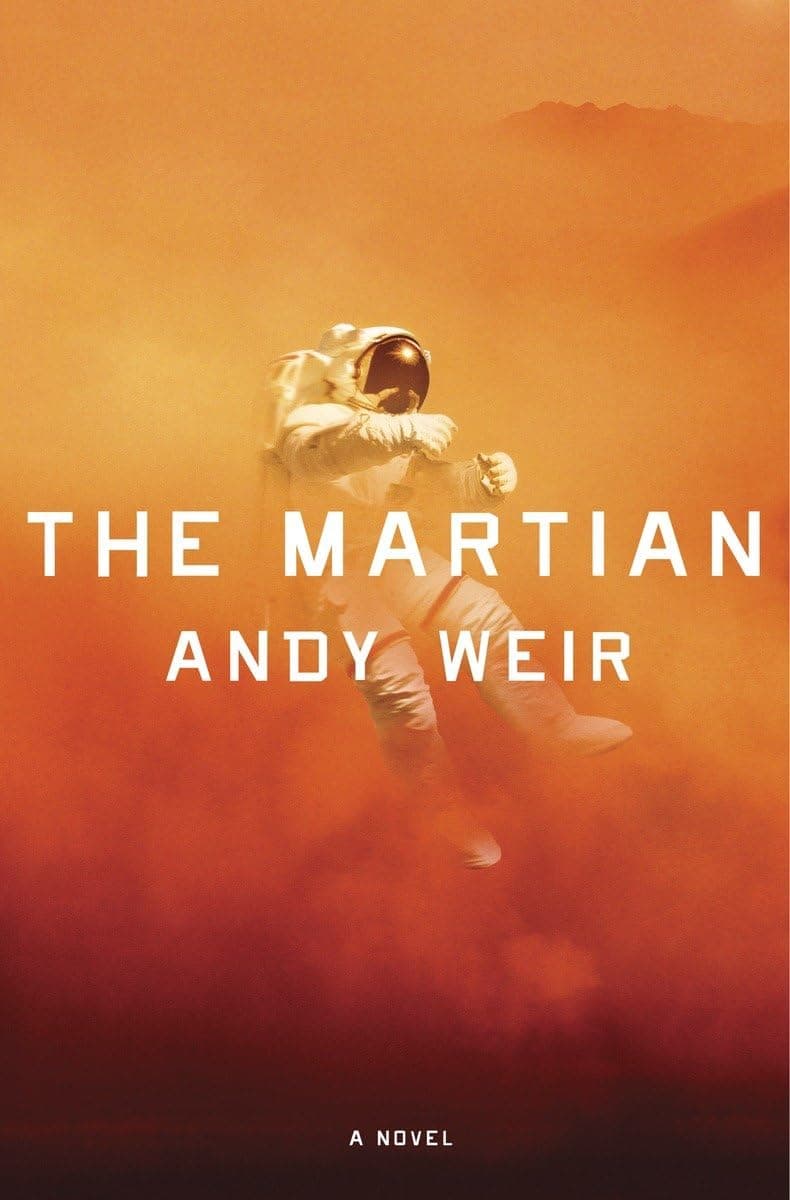
The Martian

Artemis

Lacero
