§Synopsis
01On a remote, icy planet, the soldier known as Breq is drawing closer to completing her quest.
Breq is both more than she seems and less than she was. Years ago, she was Justice of Toren–a colossal starship with an artificial intelligence linking thousands of corpse soldiers in the service of the Radch, the empire that conquered the galaxy.
An act of treachery has ripped it all away, leaving her with only one fragile human body. And only one purpose–to revenge herself on Anaander Mianaai, many-bodied, near-immortal Lord of the Radch.
§Our take
Ancillary Justice is a brilliant, difficult book that keeps the reader one step behind its narrator. The Christian Science Monitor reported that it became the first novel to win the Hugo, Nebula and Clarke in one year, which helps explain the scale of its reputation.
Its formal, guarded voice makes identity feel unsettled rather than decorative. The Radch's conquests, meanwhile, turn empire into a moral problem instead of scenery. Calling everyone 'she' asks readers to notice their own assumptions, though some find it a gimmick or too thinly explained. Alternating timelines build the world in layers and create suspense from what the narrator cannot see. The cost is a demanding opening, heavy exposition and a middle that can feel static. This is a quiet, strange space opera for readers willing to adjust to its rules.
§Themes
- Identity at human scale
- Breq's narrow, bodily existence makes the question of who someone is a practical problem rather than an abstract theme.
- Empire that swallows difference
- The Radch commit genocide, execute dissenters and enforce assimilation, making conquest a system rather than a battle scene.
- The pronoun experiment
- The narrator calls everyone 'she', exposing assumptions about gender even when her readings of people remain unreliable.
- Suspense through ignorance
- Alternating timelines and a narrator with limited self-knowledge leave motives uncertain, so gaps do some of the expository work.
§How it was received
Strange Horizons called it a graceful, awards-worthy debut whose complex structure added depth without sacrificing readability. Kirkus liked the inventive premise and good characters but found the plot tangled; Amazing Stories called it a landmark while warning that it was harder and more exposition-heavy than expected. Nina Allan's dissent focused on its reliance on genre conventions and a simple view of empire, which could make it feel insular to outsiders.
§Read it if
- You like science fiction that makes identity, empire and personhood part of the plot's machinery
- You can tolerate unfamiliar names, heavy exposition and a slow stretch when the world is rich enough to repay the climb
- You want a reflective space opera rather than a story that moves from one battle to the next
§Skip it if
- You need the setting and narration to click at once. The opening names, formal culture and all-'she' narration can be a barrier.
- You want constant momentum. The present-day strand can feel static, and some readers find the middle a drag.
§Before you start
- Reading experience
- Expect a disorienting start, heavy early exposition and a slow middle, especially in the present-day strand.
- Reading order
- Book 1 of the Imperial Radch trilogy: Ancillary Justice (2013), followed by Ancillary Sword (2014) and Ancillary Mercy (2015). Start here. Provenance (2017) and Translation State (2023) take place in the same universe but follow different characters.
- Content notes
- Imperial violence includes genocide, executions for disobedience and enforced assimilation; Captured people have their minds wiped and their bodies used as ancillaries, making body horror central to the premise; A character's drug dependence appears in a subplot.
§Common questions
- Where should I start with the Imperial Radch books?
- Start with Ancillary Justice. It is book 1, followed by Ancillary Sword and Ancillary Mercy.
- Why does the narrator call everyone 'she'?
- The Radch language does not mark gender, so the narrator uses 'she' for everyone. The device exposes assumptions, though some readers find it thin or inconsistent.
- Is there a TV adaptation?
- No screen adaptation exists. The 2014 option reportedly collapsed in 2024.
§If you liked this
- Stars in My Pocket Like Grains of Sand by Samuel R. Delany — Strange Horizons compares the default-pronoun handling here with this novel's experiments in gender.
- Dhalgren by Samuel R. Delany — Amazing Stories uses it as a difficulty benchmark and calls Ancillary Justice denser.
- Foreigner by C.J. Cherryh — Leckie cites Cherryh's Foreigner books as a noticeable influence on the Ancillary novels.
- The Left Hand of Darkness by Ursula K. Le Guin — Le Guin's classic of gender and culture is the natural ancestor for readers who want the pronoun experiment pushed further.
- All Systems Red by Martha Wells — Martha Wells's Murderbot is another non-human narrator working out personhood, in a much lighter and faster register.
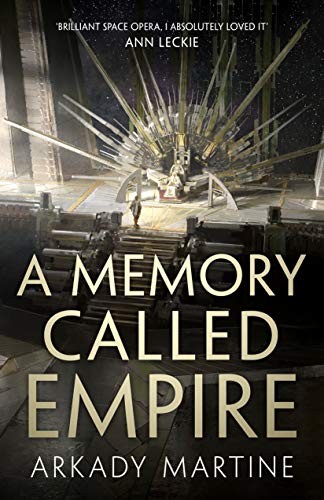
- A Memory Called Empire by Arkady Martine — The closest political companion, sharing a concern with imperial power and cultural assimilation.
Track this book
Add to your library to track progress and write reviews