§Synopsis
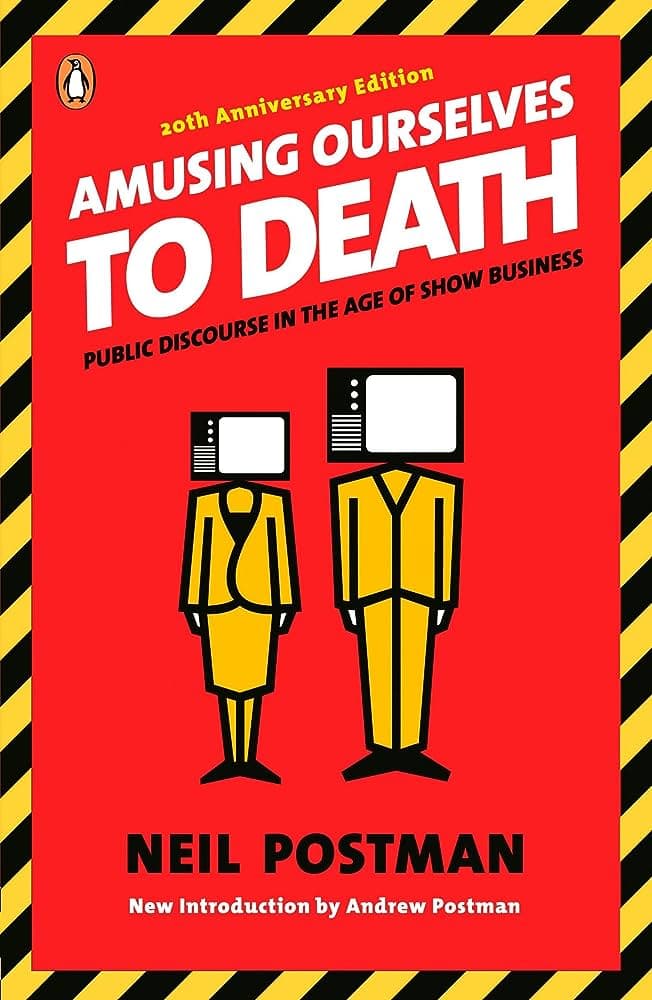
01Examines the effects of television culture on how we conduct our public affairs and how "entertainment values" corrupt the way we think.
Examines the effects of television culture on how we conduct our public affairs and how "entertainment values" corrupt the way we think.
Examines the effects of television culture on how we conduct our public affairs and how "entertainment values" corrupt the way we think.
Add to your library to track progress and write reviews
Add to your library to track progress and write reviews
Find Amusing Ourselves to Death Neil Postman in PDF, EPUB, ebook, audiobook, print, or library editions.
Find Amusing Ourselves to Death Neil Postman in PDF, EPUB, ebook, audiobook, print, or library editions.
1 books in catalog
Critical examination of how mass communication reshapes human thought and public discourse sits at the heart of modern media studies. American educator, humanist, and media theorist Neil Postman devoted his career to analyzing how communication technologies, particularly television, alter public reasoning, child development, and social institutions. Best known for his 1985 work Amusing Ourselves to Death, he delivered enduring commentary on the social effects of technology on contemporary culture.
Born in Brooklyn, New York, on March 8, 1931, Postman grew up in a Yiddish-speaking family before pursuing higher education at the State University of New York and Columbia University. He went on to spend over four decades as a professor at New York University, where he established and held a chair in the field he called media ecology. Throughout a career spanning more than twenty books and two hundred articles starting with his 1961 publication Television and the Teaching of English, he maintained a steadfast critique of technological over-reliance until his death from lung cancer on October 5, 2003, in Flushing, Queens.
As a committed humanist and social critic, Postman was notably personal in his skepticism toward modern digital advances, eschewing personal computers, mobile devices, and the introduction of computer technology into school classrooms. His academic leadership extended deeply into educational philosophy, advocating for critical engagement with language and media rather than passive technological adoption.
Postman's writing style is characterized by articulate, accessible social criticism that bridges academic media theory with public discourse. Central to his work is the concept of media ecology, which posits that media forms act as environments that inherently structure how people perceive information, communicate, and govern themselves. He frequently argued that media shifts, particularly the transition from print-based literacy to image-driven television broadcasting, downgrade public debate into entertainment and shorten attention spans across generations.
Another recurring theme in Postman's bibliography is the preservation of childhood and educational integrity in an era dominated by rapid technological adoption. Works like The Disappearance of Childhood and The End of Education: Redefining the Value of School examine how pervasive electronic media erode the traditional boundaries between youth and adulthood, urging educators and parents to cultivate critical reflection rather than uncritically accepting technological novelty.
1 books in catalog
Critical examination of how mass communication reshapes human thought and public discourse sits at the heart of modern media studies. American educator, humanist, and media theorist Neil Postman devoted his career to analyzing how communication technologies, particularly television, alter public reasoning, child development, and social institutions. Best known for his 1985 work Amusing Ourselves to Death, he delivered enduring commentary on the social effects of technology on contemporary culture.
Born in Brooklyn, New York, on March 8, 1931, Postman grew up in a Yiddish-speaking family before pursuing higher education at the State University of New York and Columbia University. He went on to spend over four decades as a professor at New York University, where he established and held a chair in the field he called media ecology. Throughout a career spanning more than twenty books and two hundred articles starting with his 1961 publication Television and the Teaching of English, he maintained a steadfast critique of technological over-reliance until his death from lung cancer on October 5, 2003, in Flushing, Queens.
As a committed humanist and social critic, Postman was notably personal in his skepticism toward modern digital advances, eschewing personal computers, mobile devices, and the introduction of computer technology into school classrooms. His academic leadership extended deeply into educational philosophy, advocating for critical engagement with language and media rather than passive technological adoption.
Postman's writing style is characterized by articulate, accessible social criticism that bridges academic media theory with public discourse. Central to his work is the concept of media ecology, which posits that media forms act as environments that inherently structure how people perceive information, communicate, and govern themselves. He frequently argued that media shifts, particularly the transition from print-based literacy to image-driven television broadcasting, downgrade public debate into entertainment and shorten attention spans across generations.
Another recurring theme in Postman's bibliography is the preservation of childhood and educational integrity in an era dominated by rapid technological adoption. Works like The Disappearance of Childhood and The End of Education: Redefining the Value of School examine how pervasive electronic media erode the traditional boundaries between youth and adulthood, urging educators and parents to cultivate critical reflection rather than uncritically accepting technological novelty.