NP
§Author· 1 book
Neil Postman
Critical examination of how mass communication reshapes human thought and public discourse sits at the heart of modern media studies. American educator, humanist, and media theorist Neil Postman devoted his career to analyzing how communication technologies, particularly television, alter public reasoning, child development, and social institutions. Best known for his 1985 work Amusing Ourselves to Death, he delivered enduring commentary on the social effects of technology on contemporary culture.
Career & Background
Born in Brooklyn, New York, on March 8, 1931, Postman grew up in a Yiddish-speaking family before pursuing higher education at the State University of New York and Columbia University. He went on to spend over four decades as a professor at New York University, where he established and held a chair in the field he called media ecology. Throughout a career spanning more than twenty books and two hundred articles starting with his 1961 publication Television and the Teaching of English, he maintained a steadfast critique of technological over-reliance until his death from lung cancer on October 5, 2003, in Flushing, Queens.
As a committed humanist and social critic, Postman was notably personal in his skepticism toward modern digital advances, eschewing personal computers, mobile devices, and the introduction of computer technology into school classrooms. His academic leadership extended deeply into educational philosophy, advocating for critical engagement with language and media rather than passive technological adoption.
Writing Style & Themes
Postman's writing style is characterized by articulate, accessible social criticism that bridges academic media theory with public discourse. Central to his work is the concept of media ecology, which posits that media forms act as environments that inherently structure how people perceive information, communicate, and govern themselves. He frequently argued that media shifts, particularly the transition from print-based literacy to image-driven television broadcasting, downgrade public debate into entertainment and shorten attention spans across generations.
Another recurring theme in Postman's bibliography is the preservation of childhood and educational integrity in an era dominated by rapid technological adoption. Works like The Disappearance of Childhood and The End of Education: Redefining the Value of School examine how pervasive electronic media erode the traditional boundaries between youth and adulthood, urging educators and parents to cultivate critical reflection rather than uncritically accepting technological novelty.
Major Works
- Amusing Ourselves to Death — Published in 1985, this seminal social critique analyzes how television has transformed public discourse from serious, print-oriented debate into superficial entertainment, altering political and civic life.
- Technopoly: The Surrender of Culture to Technology — This 1992 critique examines the societal shift toward a state where culture becomes subservient to technological efficiency, warning against the uncritical adoption of tools that displace human values.
- The Disappearance of Childhood — In this 1982 study, Postman argues that mass media and television erode the distinction between adulthood and childhood by exposing young audiences prematurely to adult information.
- Teaching as a Subversive Activity — Co-authored in 1970 and widely cited in educational literature, this influential book advocates for educational reform that encourages students to question authority and think critically about language and media.
- Building a Bridge to the Eighteenth Century — Published in 2003, this work looks back at Enlightenment thought to offer rational, humanistic guidance for navigating the challenges of twenty-first-century technological advancement.
§All Books
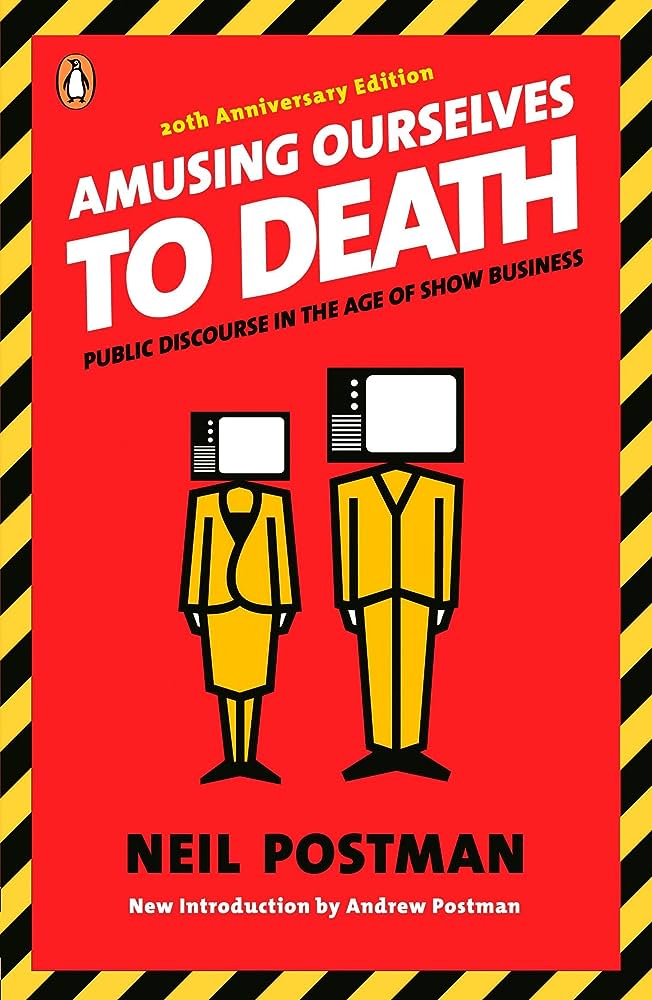
Amusing Ourselves to Death
Neil Postman, 1985
125 ratings
§ About Neil Postman's books
- Books on SansFiction
- 1
- Published
- 1985
- Average rating
- 4.1 / 5 across 125 ratings
- Genres
- Classics, Mass Media, Nonfiction, Social Science
The book: Amusing Ourselves to Death (1985)
Examines the effects of television culture on how we conduct our public affairs and how "entertainment values" corrupt the way we think.
Common questions about Neil Postman
- Who is Neil Postman?
- Born in Brooklyn, New York, on March 8, 1931, Postman grew up in a Yiddish-speaking family before pursuing higher education at the State University of New York and Columbia University. He went on to spend over four decades as a professor at New York University, where he established and held a chair in the field he called media ecology.
- What is Neil Postman best known for?
- Neil Postman is best known for Amusing Ourselves to Death, published in 1985 with 125 ratings and a 4.1 average. It is the most-rated of Neil Postman's books on SansFiction.
- What genres does Neil Postman write?
- Neil Postman's books on SansFiction are tagged Classics, Mass Media, Nonfiction and Social Science.
Explore: Classics · Mass Media · Nonfiction · Social Science