§Synopsis
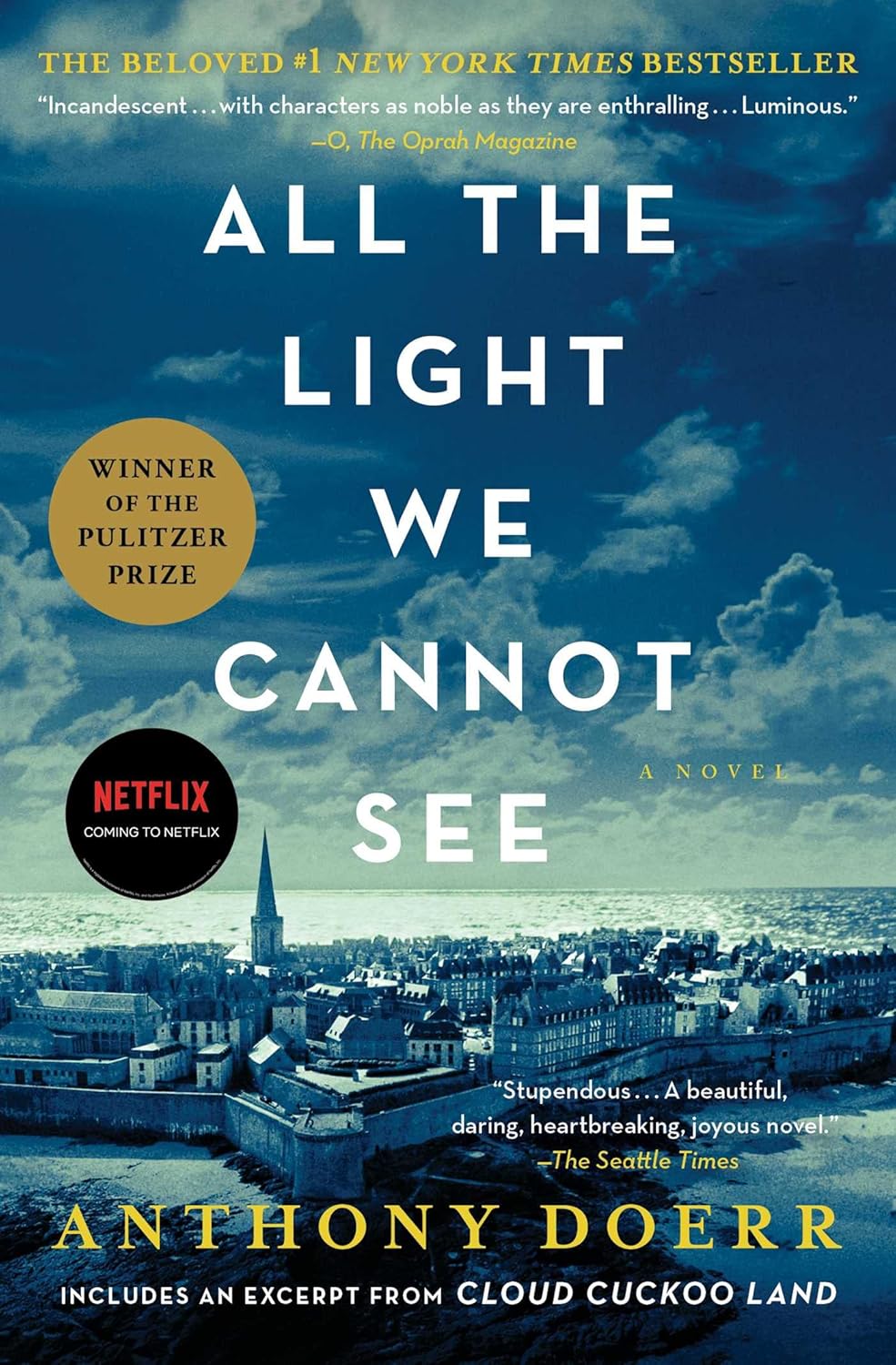
01Winner of the Pulitzer Prize and National Book Award finalist, the beloved instant New York Times bestseller and New York Times Book Review Top 10 Book about a blind French girl and a German boy whose paths collide in occupied France as both try to survive the devastation of World War II.
Marie-Laure lives with her father in Paris near the Museum of Natural History where he works as the master of its thousands of locks. When she is six, Marie-Laure goes blind and her father builds a perfect miniature of their neighborhood so she can memorize it by touch and navigate her way home. When she is twelve, the Nazis occupy Paris, and father and daughter flee to the walled citadel of Saint-Malo, where Marie-Laure’s reclusive great uncle lives in a tall house by the sea. With them they carry what might be the museum’s most valuable and dangerous jewel.
In a mining town in Germany, the orphan Werner grows up with his younger sister, enchanted by a crude radio they find. Werner becomes an expert at building and fixing these crucial new instruments, a talent that wins him a place at a brutal academy for Hitler Youth, then a special assignment to track the Resistance. More and more aware of the human cost of his intelligence, Werner travels through the heart of the war and, finally, into Saint-Malo, where his story and Marie-Laure’s converge.
Doerr’s “stunning sense of physical detail and gorgeous metaphors” (San Francisco Chronicle) are dazzling. Deftly interweaving the lives of Marie-Laure and Werner, he illuminates the ways, against all odds, people try to be good to one another. Ten years in the writing, All the Light We Cannot See is a magnificent, deeply moving novel from a writer “whose sentences never fail to thrill” (Los Angeles Times).
§Our take
This is a beautifully made war novel with one fault line: whether its moral even-handedness is compassion or camouflage. Doerr gives Marie-Laure and Werner equal narrative weight, and a third perspective—a German officer pursuing the jewel—sharpens the moral pressure. Kirkus praised the fresh emphasis on basic decency; Dominic Green’s harsher review in The New Republic called the book sentimental, its Nazis cartoonish and its moral equivalence between Allied and Nazi bombing dishonest. That quarrel is the novel’s live wire, not a side note.
The prose is the real seduction. Images of light, shells, birds, sound and touch make the story feel tactile, which suits a novel led by a blind protagonist, while very short present-tense chapters turn a long book into a mosaic. Some readers call the density overwritten and the pace slack; others find the same sentences hypnotic and hard to put down. The pairing frustration is real, too: the two leads share surprisingly little page time.
§Themes
- The German in the middle
- Werner receives an interior life and equal weight, a humane choice some critics see as erasing moral difference.
- Seeing by touch
- Marie-Laure navigates through scale models, sound and memory, making blindness part of the book’s way of seeing.
- Radio as light
- The title's light is partly radio waves, the unseen spectrum that carries voices, orders and danger across occupied France.
- The jewel plot
- A cursed museum diamond ties the stories together, lending the book a fairy-tale pull that some readers find contrived.
§How it was received
Criticism was largely enthusiastic about the lyrical, sensory prose and the emotional pull of the two young leads, and Kirkus gave it a “Get It” verdict while praising its portrait of wartime and its emphasis on basic decency. It won the 2015 Pulitzer Prize for Fiction and Andrew Carnegie Medal for Excellence in Fiction and was a 2014 National Book Award finalist, though Dominic Green’s hostile New Republic essay charged it with sentimentalizing the war, stereotyping Nazis and flattening moral difference.
§Read it if
- You want lyrical historical fiction that makes sound, touch and radio as vivid as sight
- You like a morally uncomfortable war story that gives a German boy equal weight to the French heroine
- You enjoy a nonlinear novel built from very short chapters, even when a jewel subplot starts to feel contrived
§Skip it if
- You want fast plotting. The pace is deliberate, descriptive and often slow.
- You need a simple moral line. Giving Werner this much sympathy can feel like a dodge to readers uneasy with the book’s even-handedness.
§Before you start
- Reading experience
- Built from very short present-tense chapters, the novel is easy to read in small bites, though its lyrical density, slow stretches and time jumps can make it feel effortful, especially on audio.
- Content notes
- War violence, atrocities, civilian deaths and bombing, including the siege of Saint-Malo; Nazi ideology, the Hitler Youth and Resistance work; An unmarried sexual relationship; Sexual violence by soldiers is referenced; Some readers report stronger profanity than expected.
§Common questions
- Is All the Light We Cannot See historical fiction?
- Yes. It is a novel set in occupied France during World War II, following Marie-Laure and Werner as their paths converge.
- Did it win the National Book Award?
- No. It was a 2014 finalist, but it won the 2015 Pulitzer Prize for Fiction and the Andrew Carnegie Medal for Excellence in Fiction.
- Is it mainly a romance between Marie-Laure and Werner?
- Not really. It is a war novel about two linked lives, with the hidden diamond supplying the link rather than a conventional romance.
Track this book
Add to your library to track progress and write reviews