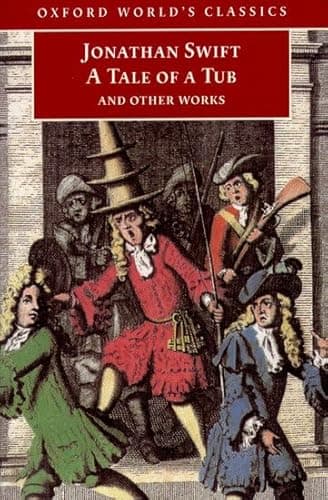
BooksA Tale of a Tub and Other Works
§Synopsis
01"A Tale of a Tub" is a work from Swift's earlier years. It is presented here with "The Battle of the Books", "The Mechanical Operation of the Spirit", and "The Additions"
"A Tale of a Tub" is a work from Swift's earlier years. It is presented here with "The Battle of the Books", "The Mechanical Operation of the Spirit", and "The Additions"
"A Tale of a Tub" is a work from Swift's earlier years. It is presented here with "The Battle of the Books", "The Mechanical Operation of the Spirit", and "The Additions"
Add to your library to track progress and write reviews
Add to your library to track progress and write reviews
Find A Tale of a Tub and Other Works Jonathan Swift in PDF, EPUB, ebook, audiobook, print, or library editions.
Find A Tale of a Tub and Other Works Jonathan Swift in PDF, EPUB, ebook, audiobook, print, or library editions.

3 books in catalog
Satirical prose reached a height of political and social biting irony through narrative journeys that exposed human hypocrisy, institutional absurdity, and societal corruption. Written under pseudonyms and featuring fictional travelers, works such as Gulliver's Travels transformed political critique into enduring allegory. Jonathan Swift established himself as one of the English language's premier prose satirists through a long literary career producing essays, verse, pamphlets, and prose fiction.
Born in Dublin, Ireland, on November 30, 1667, Jonathan Swift was raised by his uncle following the death of his father prior to his birth. He attended Kilkenny Grammar School alongside future dramatist William Congreve before entering Trinity College, Dublin, where he earned a bachelor's degree in 1686. Moving to England, Swift worked as an assistant to the statesman Sir William Temple. He subsequently took holy orders as an Anglican clergyman and returned to Ireland, eventually serving as Dean of St. Patrick's Cathedral in Dublin for the last thirty years of his life.
Throughout his career, Swift was deeply involved in English and Irish political life, serving as an influential pamphleteer first for the Whigs and later for the Tories. Writing frequently under anonymous personas or pseudonyms—such as Isaac Bickerstaff, M. B. Drapier, and Lemuel Gulliver—he published political essays and satires targeting religious corruption, economic policies, and party feuds. Swift died in Dublin on October 19, 1745, leaving behind a prolific body of verse and prose produced over more than fifty years.
Swift's literary style is characterized by its deadpan irony, logical absurdity, and reliance on invented narrative voices. Rather than delivering direct polemics, Swift frequently adopted exaggerated personas to adopt the reasoning of his ideological opponents, driving their arguments to farcical or horrifying conclusions. His writings critique human vanity, religious hypocrisy, British economic policy in Ireland, and the limits of human reason, combining sharp realism with allegorical frameworks.
3 books in catalog
Satirical prose reached a height of political and social biting irony through narrative journeys that exposed human hypocrisy, institutional absurdity, and societal corruption. Written under pseudonyms and featuring fictional travelers, works such as Gulliver's Travels transformed political critique into enduring allegory. Jonathan Swift established himself as one of the English language's premier prose satirists through a long literary career producing essays, verse, pamphlets, and prose fiction.
Born in Dublin, Ireland, on November 30, 1667, Jonathan Swift was raised by his uncle following the death of his father prior to his birth. He attended Kilkenny Grammar School alongside future dramatist William Congreve before entering Trinity College, Dublin, where he earned a bachelor's degree in 1686. Moving to England, Swift worked as an assistant to the statesman Sir William Temple. He subsequently took holy orders as an Anglican clergyman and returned to Ireland, eventually serving as Dean of St. Patrick's Cathedral in Dublin for the last thirty years of his life.
Throughout his career, Swift was deeply involved in English and Irish political life, serving as an influential pamphleteer first for the Whigs and later for the Tories. Writing frequently under anonymous personas or pseudonyms—such as Isaac Bickerstaff, M. B. Drapier, and Lemuel Gulliver—he published political essays and satires targeting religious corruption, economic policies, and party feuds. Swift died in Dublin on October 19, 1745, leaving behind a prolific body of verse and prose produced over more than fifty years.
Swift's literary style is characterized by its deadpan irony, logical absurdity, and reliance on invented narrative voices. Rather than delivering direct polemics, Swift frequently adopted exaggerated personas to adopt the reasoning of his ideological opponents, driving their arguments to farcical or horrifying conclusions. His writings critique human vanity, religious hypocrisy, British economic policy in Ireland, and the limits of human reason, combining sharp realism with allegorical frameworks.