Jonathan Swift
Also known as Isaac Bickerstaff, Lemuel Gulliver, M. B. Drapier, Simon Wagstaff
Satirical prose reached a height of political and social biting irony through narrative journeys that exposed human hypocrisy, institutional absurdity, and societal corruption. Written under pseudonyms and featuring fictional travelers, works such as Gulliver's Travels transformed political critique into enduring allegory. Jonathan Swift established himself as one of the English language's premier prose satirists through a long literary career producing essays, verse, pamphlets, and prose fiction.
Career & Background
Born in Dublin, Ireland, on November 30, 1667, Jonathan Swift was raised by his uncle following the death of his father prior to his birth. He attended Kilkenny Grammar School alongside future dramatist William Congreve before entering Trinity College, Dublin, where he earned a bachelor's degree in 1686. Moving to England, Swift worked as an assistant to the statesman Sir William Temple. He subsequently took holy orders as an Anglican clergyman and returned to Ireland, eventually serving as Dean of St. Patrick's Cathedral in Dublin for the last thirty years of his life.
Throughout his career, Swift was deeply involved in English and Irish political life, serving as an influential pamphleteer first for the Whigs and later for the Tories. Writing frequently under anonymous personas or pseudonyms—such as Isaac Bickerstaff, M. B. Drapier, and Lemuel Gulliver—he published political essays and satires targeting religious corruption, economic policies, and party feuds. Swift died in Dublin on October 19, 1745, leaving behind a prolific body of verse and prose produced over more than fifty years.
Writing Style & Themes
Swift's literary style is characterized by its deadpan irony, logical absurdity, and reliance on invented narrative voices. Rather than delivering direct polemics, Swift frequently adopted exaggerated personas to adopt the reasoning of his ideological opponents, driving their arguments to farcical or horrifying conclusions. His writings critique human vanity, religious hypocrisy, British economic policy in Ireland, and the limits of human reason, combining sharp realism with allegorical frameworks.
Major Works
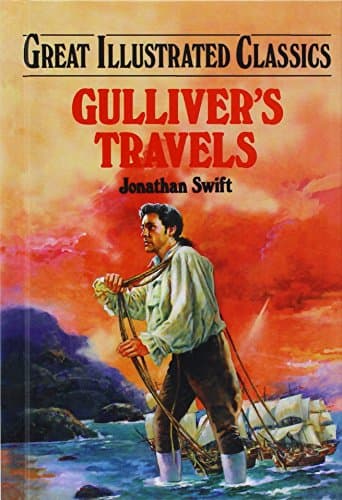
- Gulliver's Travels — First published in 1726 under the name Lemuel Gulliver, this four-part satirical novel recounts voyages to Lilliput, Brobdingnag, Laputa, and the land of the Houyhnhnms, presenting a critique of human nature, politics, and European society.
- A Modest Proposal — Published anonymously in 1729, this satirical essay proposes that impoverished Irish families sell their infants as food to wealthy landowners, utilizing an economic persona to highlight British policy and socio-economic neglect in Ireland.
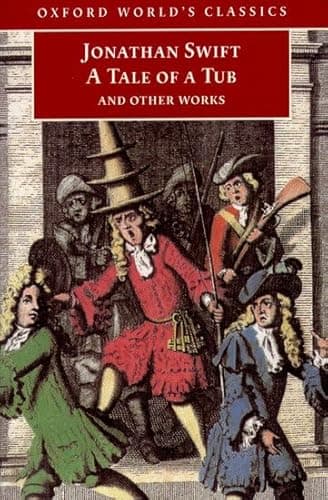
- A Tale of a Tub and Other Works — First published in 1704, A Tale of a Tub is a multi-layered prose satire on religious corruption and intellectual pedantry. Collected editions like A Tale of a Tub and Other Works pair this seminal satire with companion pieces such as The Battle of the Books.
- Drapier's Letters — A series of political pamphlets published between 1724 and 1725 under the pseudonym M. B. Drapier to rally public opposition in Ireland against a private British patent for debased copper coinage.
- A Journal to Stella — A collection of intimate letters written between 1710 and 1713 to Esther Johnson, documenting Swift's daily life, political activities, and personal observations during his time in London.
- An Argument Against Abolishing Christianity — A 1708 satirical essay in which Swift uses an ironic persona to argue that nominal Christianity should be retained in England for practical and social convenience.
Gulliver's Travels

A Modest Proposal