§Synopsis
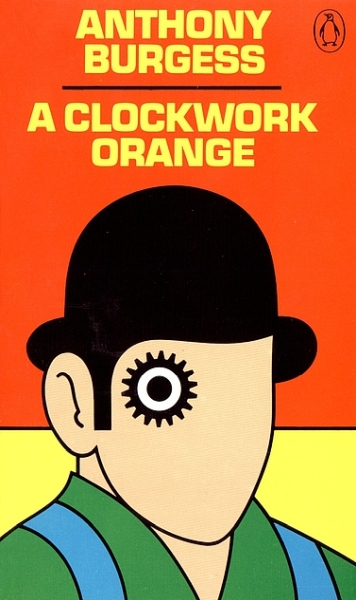
01Fifteen-year-old Alex and his three friends start an evening's mayhem by hitting an old man, tearing up his books and stripping him of money and clothes.
Or rather Alex and his three droogs tolchock an old veck, razrez his books, pull off his outer platties and take a malenky bit of cutter.
For Alex's confessions are written in 'nadsat' - the teenage argot of a not-too-distant future.
Because of his delinquent excesses, Alex is jailed and made subject to 'Ludovico's Technique,' a chilling experiment in Reclamation Treatment...
Horror farce? Social prophecy? Penetrating study of human choice between good and evil? A Clockwork Orange is all three, dazzling proof of Anthony Burgess's vast talents.
§Our take
A Clockwork Orange is less a puzzle than a moral trap: Burgess invents a voice you want to enjoy while the novel asks whether charm excuses what its narrator has done. Alex's Nadsat is musical, fast and strange, learned from context rather than a glossary. That hurdle is also the point. It keeps the violence partly at one remove, though not entirely, and makes the reader complicit in the pleasure of listening.
The edition matters too. British and restored American texts contain 21 chapters; Kubrick's film adapted the 20-chapter American edition. The usual claim is that a publisher imposed the darker ending, but Burgess's letters show that he agreed to the cut and later described that decision differently. Kubrick thought the restored chapter did not fit and kept the 20-chapter shape; Burgess thought the film sent readers the wrong way. Read the ending your edition gives you, then decide for yourself.
§Themes
- Charm as complicity
- Alex's wit, music and fluency pull readers toward him while his violence makes that pleasure morally uncomfortable.
- Conditioning versus choice
- Ludovico's Technique makes goodness involuntary, sharpening the question of whether a moral choice still matters.
- Language as a shield
- Nadsat keeps some of the violence at a distance while making the world vivid, strange and easy to enter once its rhythm catches.
- An ending in dispute
- Twenty- and twenty-one-chapter editions give the moral argument a different shape, and Burgess never settled cleanly on one preferred ending.
§How it was received
British reviews in 1962 were mixed: The Spectator admired the craft but found the plot arbitrary, while The New Statesman credited Burgess with facing a real social problem. Fellow novelists were kinder: Kingsley Amis praised the outrageousness, and Malcolm Bradbury admired the comic skill and language even when the horror was hard to stomach. Kirkus was harshly dismissive of the slang and Alex, while Burgess himself later judged the book too didactic and admitted that the violence sickened him.
§Read it if
- You like language doing structural work and will let Nadsat settle in
- You want fiction that treats free will and conditioning as a genuinely nasty moral problem
- You're curious how an ending can change the book's argument when one chapter appears or disappears
§Skip it if
- Graphic and sexual violence, especially when narrated by the offender, is more than you can stomach
- You need a dependable, sympathetic narrator; Alex can be magnetic and repellent at once
§Before you start
- Reading experience
- The book is short and moves quickly once Nadsat clicks, though the opening pages are the hard part; edition choice matters because some versions have 20 chapters and others 21.
- Reading order
- Standalone novel, not part of a series. Burgess later wrote a stage version and the essay A Clockwork Orange Resucked, but no sequel novel.
- Content notes
- Graphic violence, including assaults and a killing; Sexual violence against young girls, narrated by the perpetrator; Aversion-therapy torture used to condition Alex away from violence; Offensive language.
§Common questions
- Is A Clockwork Orange part of a series?
- No. It's a standalone novel; Burgess later wrote a stage version and an essay, but no sequel.
- Is Nadsat hard to understand?
- At first, yes. Alex's invented slang mixes Russian, Cockney rhyming slang, King James Bible English and Burgess's coinages. The original had no glossary, so context does the work.
- Why do some editions end after chapter 20?
- The first US edition omitted chapter 21 in 1963. Burgess agreed to the cut, later gave different accounts of that decision, and Norton restored the chapter in 1986. British and restored American editions include it.
§If you liked this
- Nineteen Eighty-Four by George Orwell — Another vision of state control over the individual, and a clean comparison with Burgess's nastier version of the same danger.
- Brave New World by Aldous Huxley — Read it beside Burgess to compare two versions of conditioning and the cost of engineered goodness.
- Riddley Walker by Russell Hoban — A good next step for readers who want invented, mutated English doing structural work in the narration.
- Trainspotting by Irvine Welsh — The sharper comparison for dialect-heavy, amoral first-person narration inside a youth subculture.
Track this book
Add to your library to track progress and write reviews