A groundbreaking study that radically alters our understanding of the Americas before the arrival of the Europeans in 1492.Traditionally, Americans learned in school that the ancestors of the people who inhabited the Western Hemisphere at the time of Columbus's landing had crossed the Bering Strait twelve thousand years ago; existed mainly in small, nomadic bands; and lived so lightly on the land that the Americas was, for all practical purposes, still a vast wilderness. But as Charles C. Mann now makes clear, archaeologists and anthropologists have spent the last thirty years proving these and many other long-held assumptions wrong.In a book that startles and persuades, Mann reveals how a new generation of researchers equipped with novel scientific techniques came to previously unheard-of conclusions. Among them:- In 1491 there were probably more people living in the Americas than in Europe.- Certain cities--such as Tenochtitlan, the Aztec capital--were far greater in population than any contemporary European city. Furthermore, Tenochtitlan, unlike any capital in Europe at that time, had running water, beautiful botanical gardens, and immaculately clean streets.- The earliest cities in the Western Hemisphere were thriving before the Egyptians built the great pyramids.- Pre-Columbian Indians in Mexico developed corn by a breeding process so sophisticated that the journal Science recently described it as "man's first, and perhaps the greatest, feat of genetic engineering."- Amazonian Indians learned how to farm the rain forest without destroying it--a process scientists are studying today in the hope of regaining this lost knowledge.- Native Americans transformed their land so completely that Europeans arrived in a hemisphere already massively "landscaped" by human beings.Mann sheds clarifying light on the methods used to arrive at these new visions of the pre-Columbian Americas and how they have affected our understanding of our history and our thinking about the environment. His book is an exciting and learned account of scientific inquiry and revelation.From the Hardcover edition.
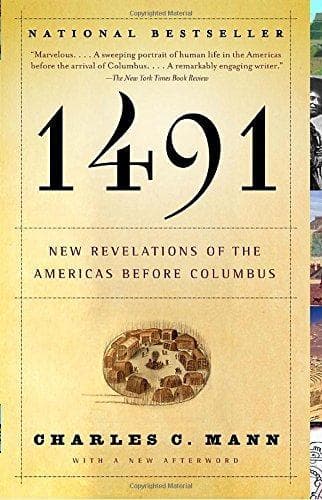
A groundbreaking study that radically alters our understanding of the Americas before the arrival of the Europeans in 1492.Traditionally, Americans learned in school that the ancestors of the people who inhabited the Western Hemisphere at the time of Columbus's landing had crossed the Bering Strait twelve thousand years ago; existed mainly in small, nomadic bands; and lived so lightly on the land that the Americas was, for all practical purposes, still a vast wilderness. But as Charles C. Mann now makes clear, archaeologists and anthropologists have spent the last thirty years proving these and many other long-held assumptions wrong.In a book that startles and persuades, Mann reveals how a new generation of researchers equipped with novel scientific techniques came to previously unheard-of conclusions. Among them:- In 1491 there were probably more people living in the Americas than in Europe.- Certain cities--such as Tenochtitlan, the Aztec capital--were far greater in population than any contemporary European city. Furthermore, Tenochtitlan, unlike any capital in Europe at that time, had running water, beautiful botanical gardens, and immaculately clean streets.- The earliest cities in the Western Hemisphere were thriving before the Egyptians built the great pyramids.- Pre-Columbian Indians in Mexico developed corn by a breeding process so sophisticated that the journal Science recently described it as "man's first, and perhaps the greatest, feat of genetic engineering."- Amazonian Indians learned how to farm the rain forest without destroying it--a process scientists are studying today in the hope of regaining this lost knowledge.- Native Americans transformed their land so completely that Europeans arrived in a hemisphere already massively "landscaped" by human beings.Mann sheds clarifying light on the methods used to arrive at these new visions of the pre-Columbian Americas and how they have affected our understanding of our history and our thinking about the environment. His book is an exciting and learned account of scientific inquiry and revelation.From the Hardcover edition.
Add to your library to track progress and write reviews
Add to your library to track progress and write reviews
Find 1491: New Revelations of the Americas Before Columbus Charles C. Mann in PDF, EPUB, ebook, audiobook, print, or library editions.
Find 1491: New Revelations of the Americas Before Columbus Charles C. Mann in PDF, EPUB, ebook, audiobook, print, or library editions.

1 books in catalog
Groundbreaking re-examinations of pre-Columbian history and global ecological exchange have reshaped how readers understand the pre-modern world and the consequences of European contact. American journalist and science writer Charles C. Mann brought these complex historical and scientific discoveries to public attention through detailed, wide-ranging non-fiction works. His best-known work, 1491: New Revelations of the Americas Before Columbus, challenged long-held misconceptions about Indigenous populations in the Western Hemisphere prior to 1492 by drawing on recent findings in archaeology, anthropology, and wildlife biology.
Born on June 12, 1955, Charles C. Mann earned a Bachelor of Arts degree from Amherst College in 1976. After graduating, he spent two years living in Europe and working as a sportswriter for an English-language daily newspaper in Rome before returning to the United States to pursue full-time journalism. He established himself as a prominent science and technology journalist, serving as a correspondent for major publications including Science, The Atlantic Monthly, and Wired. Over his career, his writing has also appeared in outlets such as The New York Times, The Washington Post, and Vanity Fair.
In addition to his journalism, Mann authored and co-authored several non-fiction books. A trip to the Yucatán peninsula in Mexico inspired him to investigate recent scholarly findings regarding pre-Columbian societies, which eventually led to the publication of 1491: New Revelations of the Americas Before Columbus in 2005. The book received the U.S. National Academy of Sciences' Keck Award for the best book of the year. He followed this success with 1493: Uncovering the New World Columbus Created in 2011 and later published The Wizard and the Prophet: Two Remarkable Scientists and Their Dueling Visions to Shape Tomorrow's World. Mann resides with his family in Amherst, Massachusetts.
Mann's work stands out for synthesizing dense research from disparate fields—such as ecology, agronomy, genetics, and anthropology—into accessible, narrative-driven history. Rather than presenting history as fixed or isolated to single geographic regions, he emphasizes interconnected global systems, human environmental management, and ecological transformation over centuries. His reporting relies heavily on on-the-ground research, field travels, and extensive interviews with scientists and scholars, presenting complex historical debates clearly without oversimplifying the evidence.
1 books in catalog
Groundbreaking re-examinations of pre-Columbian history and global ecological exchange have reshaped how readers understand the pre-modern world and the consequences of European contact. American journalist and science writer Charles C. Mann brought these complex historical and scientific discoveries to public attention through detailed, wide-ranging non-fiction works. His best-known work, 1491: New Revelations of the Americas Before Columbus, challenged long-held misconceptions about Indigenous populations in the Western Hemisphere prior to 1492 by drawing on recent findings in archaeology, anthropology, and wildlife biology.
Born on June 12, 1955, Charles C. Mann earned a Bachelor of Arts degree from Amherst College in 1976. After graduating, he spent two years living in Europe and working as a sportswriter for an English-language daily newspaper in Rome before returning to the United States to pursue full-time journalism. He established himself as a prominent science and technology journalist, serving as a correspondent for major publications including Science, The Atlantic Monthly, and Wired. Over his career, his writing has also appeared in outlets such as The New York Times, The Washington Post, and Vanity Fair.
In addition to his journalism, Mann authored and co-authored several non-fiction books. A trip to the Yucatán peninsula in Mexico inspired him to investigate recent scholarly findings regarding pre-Columbian societies, which eventually led to the publication of 1491: New Revelations of the Americas Before Columbus in 2005. The book received the U.S. National Academy of Sciences' Keck Award for the best book of the year. He followed this success with 1493: Uncovering the New World Columbus Created in 2011 and later published The Wizard and the Prophet: Two Remarkable Scientists and Their Dueling Visions to Shape Tomorrow's World. Mann resides with his family in Amherst, Massachusetts.
Mann's work stands out for synthesizing dense research from disparate fields—such as ecology, agronomy, genetics, and anthropology—into accessible, narrative-driven history. Rather than presenting history as fixed or isolated to single geographic regions, he emphasizes interconnected global systems, human environmental management, and ecological transformation over centuries. His reporting relies heavily on on-the-ground research, field travels, and extensive interviews with scientists and scholars, presenting complex historical debates clearly without oversimplifying the evidence.