
§Author· 1 book
Charles C. Mann
Also known as Charles Mann
Groundbreaking re-examinations of pre-Columbian history and global ecological exchange have reshaped how readers understand the pre-modern world and the consequences of European contact. American journalist and science writer Charles C. Mann brought these complex historical and scientific discoveries to public attention through detailed, wide-ranging non-fiction works. His best-known work, 1491: New Revelations of the Americas Before Columbus, challenged long-held misconceptions about Indigenous populations in the Western Hemisphere prior to 1492 by drawing on recent findings in archaeology, anthropology, and wildlife biology.
Career & Background
Born on June 12, 1955, Charles C. Mann earned a Bachelor of Arts degree from Amherst College in 1976. After graduating, he spent two years living in Europe and working as a sportswriter for an English-language daily newspaper in Rome before returning to the United States to pursue full-time journalism. He established himself as a prominent science and technology journalist, serving as a correspondent for major publications including Science, The Atlantic Monthly, and Wired. Over his career, his writing has also appeared in outlets such as The New York Times, The Washington Post, and Vanity Fair.
In addition to his journalism, Mann authored and co-authored several non-fiction books. A trip to the Yucatán peninsula in Mexico inspired him to investigate recent scholarly findings regarding pre-Columbian societies, which eventually led to the publication of 1491: New Revelations of the Americas Before Columbus in 2005. The book received the U.S. National Academy of Sciences' Keck Award for the best book of the year. He followed this success with 1493: Uncovering the New World Columbus Created in 2011 and later published The Wizard and the Prophet: Two Remarkable Scientists and Their Dueling Visions to Shape Tomorrow's World. Mann resides with his family in Amherst, Massachusetts.
Writing Style & Themes
Mann's work stands out for synthesizing dense research from disparate fields—such as ecology, agronomy, genetics, and anthropology—into accessible, narrative-driven history. Rather than presenting history as fixed or isolated to single geographic regions, he emphasizes interconnected global systems, human environmental management, and ecological transformation over centuries. His reporting relies heavily on on-the-ground research, field travels, and extensive interviews with scientists and scholars, presenting complex historical debates clearly without oversimplifying the evidence.
Major Works
- 1491: New Revelations of the Americas Before Columbus — Published in 2005, this award-winning book synthesizes modern archaeological, demographic, and ecological research to demonstrate that Indigenous societies in the Americas prior to European arrival were far more populous, technologically advanced, and ecologically transformative than previously recognized. It was awarded the U.S. National Academy of Sciences' Keck Award for best book of the year.
- 1493: Uncovering the New World Columbus Created — A companion volume to 1491 published in 2011, this work examines the Columbian Exchange—the worldwide transfer of plants, animals, cultures, human populations, and diseases following Columbus's voyages—and details how these ecological interactions laid the foundation for the modern globalized world.
- The Wizard and the Prophet: Two Remarkable Scientists and Their Dueling Visions to Shape Tomorrow's World — This non-fiction work explores two contrasting scientific perspectives on human population growth and natural resources, contrasting the techno-optimist vision of agricultural scientist Norman Borlaug with the ecological conservation principles of William Vogt.
§All Books
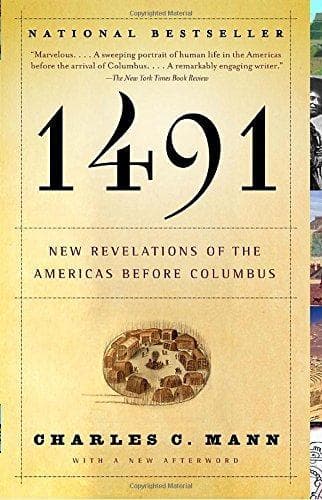
1491: New Revelations of the Americas Before Columbus
Charles C. Mann, 2005
124 ratings