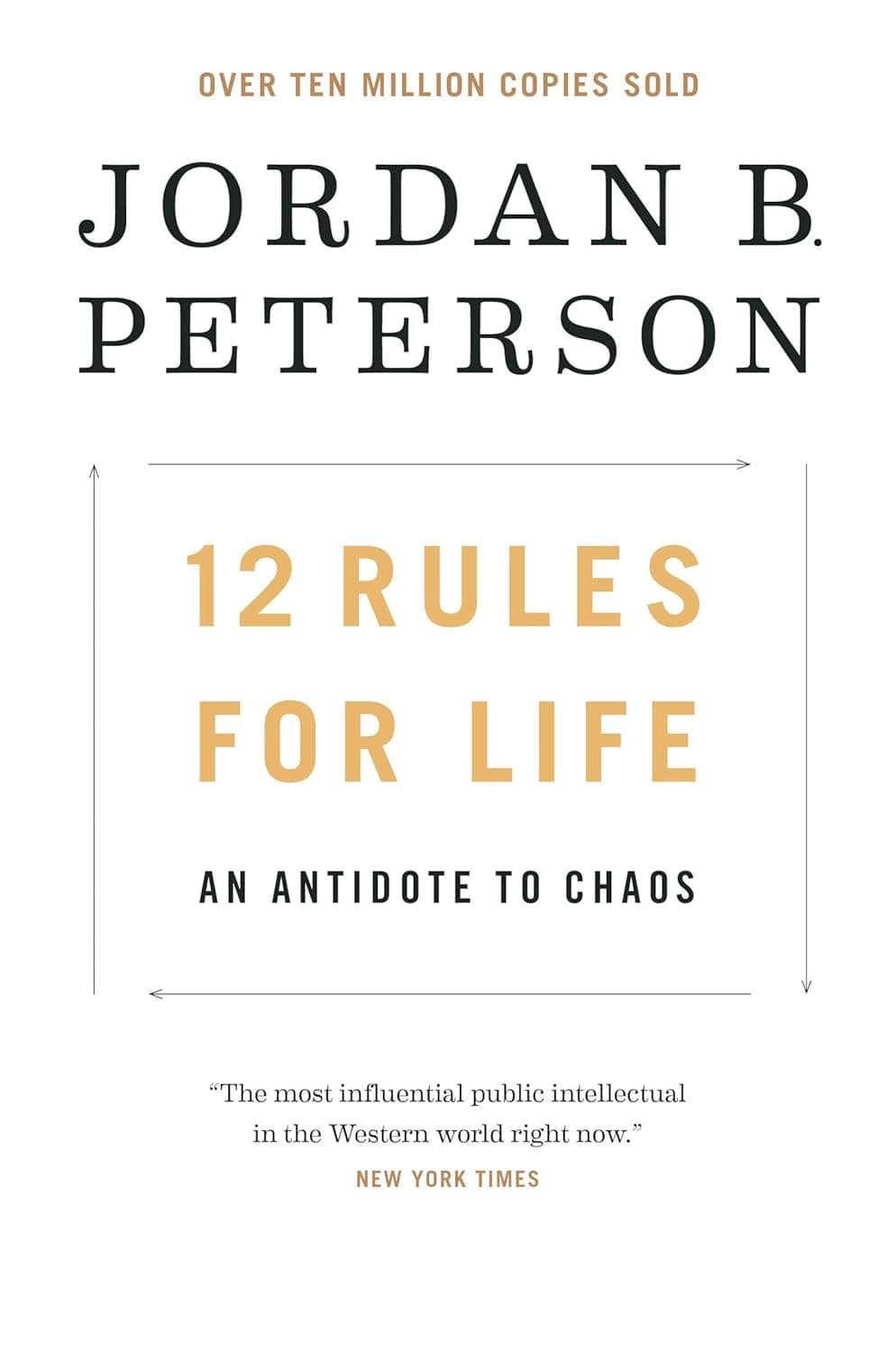
What does everyone in the modern world need to know? Renowned psychologist Jordan B. Peterson's answer to this most difficult of questions uniquely combines the hard-won truths of ancient tradition with the stunning revelations of cutting-edge scientific research.
Humorous, surprising and informative, Dr. Peterson tells us why skateboarding boys and girls must be left alone, what terrible fate awaits those who criticize too easily, and why you should always pet a cat when you meet one on the street.
What does the nervous system of the lowly lobster have to tell us about standing up straight (with our shoulders back) and about success in life? Why did ancient Egyptians worship the capacity to pay careful attention as the highest of gods? What dreadful paths do people tread when they become resentful, arrogant and vengeful? Dr. Peterson journeys broadly, discussing discipline, freedom, adventure and responsibility, distilling the world's wisdom into 12 practical and profound rules for life. 12 Rules for Life shatters the modern commonplaces of science, faith and human nature, while transforming and ennobling the mind and spirit of its readers.
Add to your library to track progress and write reviews
Find 12 Rules for Life: An Antidote to Chaos Jordan B. Peterson in PDF, EPUB, ebook, audiobook, print, or library editions.

2 books in catalog
Combining clinical psychology, evolutionary theory, and comparative mythology, non-fiction writing on human motivation and personal responsibility has attracted millions of readers seeking practical frameworks for personal conduct. Jordan B. Peterson reached an expansive global audience with his 2018 self-help treatise 12 Rules for Life: An Antidote to Chaos, which topped non-fiction bestseller lists internationally across North America, Europe, and Australasia.
His work connects empirical psychological research on personality traits with narrative structures found in myth and religious texts, presenting readers with structured principles to navigate psychological suffering, social dynamics, and personal development.
Born on June 12, 1962, in Edmonton, Alberta, Peterson grew up in Alberta and completed undergraduate degrees in political science and psychology at the University of Alberta. He earned a Ph.D. in clinical psychology from McGill University, remaining there as a post-doctoral fellow from 1991 to 1993. Moving to Harvard University as an associate professor of psychology, he was nominated for the Levinson Teaching Prize before joining the faculty at the University of Toronto in 1998, where he eventually became Professor Emeritus.
Throughout his academic tenure, he co-authored more than a hundred scientific papers investigating personality, competence, and creativity. In addition to his research and clinical practice, Peterson developed public lectures, educational software, and podcasts that expanded his audience beyond traditional academia into international publishing and public speaking.
Peterson's writing synthesizes scientific empirical research with detailed analyses of archetypal literature, mythology, and theology. He focuses on the fundamental tension between order and chaos, arguing that human beings maintain psychological stability by balancing familiar social structures with voluntary exposure to new challenges. His arguments rely on Carl Jung's psychological concepts, evolutionary biology, and close readings of historical and religious texts.
Adopting a direct, instructional tone, his non-fiction balances academic rigor with accessible self-improvement advice. Recurring themes include individual responsibility, the psychological foundation of belief systems, the dangers of ideological extremism, and the necessity of personal truthfulness.
Rules for Life